
In the Golden Globe Race, seamanship and self-reliance matter far more than likes and reposts
by David Schmidt 20 Oct 08:00 PDT
October 20, 2026
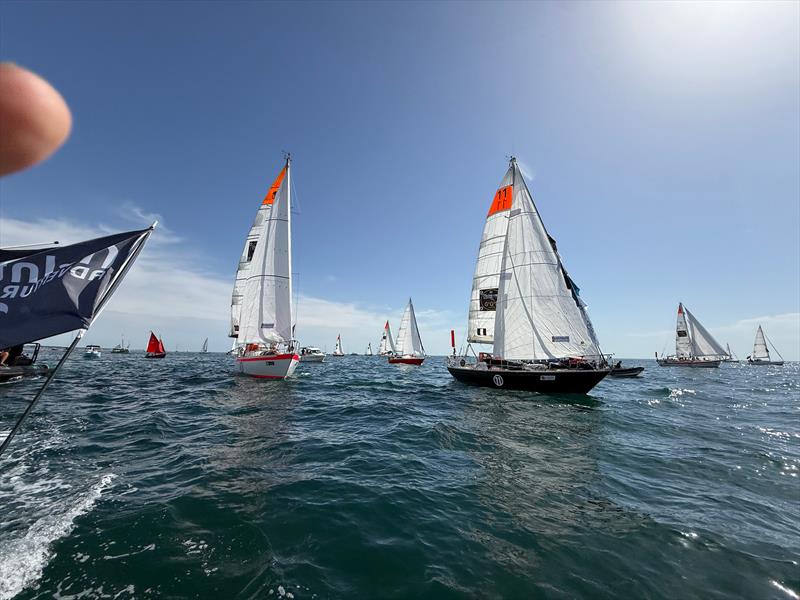
Sixteen GGR2026 skippers leave Les Sables-d'Olonne behind as the fleet completes the short coastal course before heading into the Atlantic. Light winds made for a gentle beginning, but the Bay of Biscay would soon deliver strong headwinds and rough seas © Don McIntyre / GGR2026
There are times that I am grateful for my decision, made in mid-2018, to abandon social media. Call me a Luddite, but this year's Golden Globe Race is one such time.
A small rewind for anyone who is just tuning into the GGR.
It all began with the 1968-1969 Sunday Times Golden Globe Race, which was a nonstop solo circumnavigation race sponsored by the UK-based Sunday Times newspaper. Nine skippers set out on what can be described as a nautical hero's quest. One died of suicide, one was rescued (after sinking), five others abandoned racing, one found his soul in the depths of the Southern Ocean (and also abandoned racing, despite commanding a virtually unassailable lead), while one Robin Knox-Johnston sailed home to a hero's welcome.
While RKJ's time of 313 days, seems pedestrian compared to skipper Francois Gabart's record-setting 42 day, 16 hour, 40 minute and 35 second solo circumnavigation aboard, in 2017, aboard the Ultim trimaran MACIF, it's fair to say that a lot of technological evolution has unfurled in the intervening (almost) half a century.
These times are important.
The 40-day high-performance circumnavigation that Gabart realized was the result of significant corporate sponsorship, land-based weather routing, satellite communications, and one of the world's fastest trimarans. RJK's 313-day homespun circumnavigation represented a bold step into the unknown; a kind of dragon-slaying quest that is increasingly difficult to replicate in today's modern world.
That was, until 2018, when Australian adventurer and offshore sailor Don McIntyre created the 2018 Golden Globe Race, which used period-appropriate vessels and communications and navigation equipment (read: sextants and paper charts) to replicate the kind of dragon-slaying challenges that RJK and his co-skippers faced in 1968-1969.
The point, of course, is a soul-defining adventure, not high-performance sailing. And part of that adventure involves the kind of solitude that RJK faced, for 313 days, alone aboard Suhaili in 1968-1969.
To be fair, the kind of sailors who are drawn to a race that can last eight or nine months (the winning time in 2022, posted by skipper Kirsten Neuschäfer, was 233 days, 18 hours, 43 minutes, and 47 seconds) are likely different from the sort that are drawn to boats like MACIF (or today's even faster generations of Ultims), however one would hope that anyone preparing for a race like the GGR would embrace the challenges of isolation and seamanship that this retro race demands.
The 2026 GGR began on September 6, in Les Sables d'Olonne, France, and saw 16 skippers start out on an adventure of a lifetime.
While GGR competitors are not allowed to have outside contact, this year's event created the McIntyre GGR Window Live, which is a live streaming show where skippers can share their floating lives—via a one-way camera—with the outside world for a few hours each week.
The spirit of these live shows is to showcase round-the-world solo sailing, not to create a one-way communications stream to a specific audience, however this is sadly what has been happening this year.
Like many of her fellow competitors, Helga Marie Løvenskiold Kveseth (NOR), who goes by Mara, has social-media channels, which are being maintained by her team ashore. Unlike her competitors, however, Mara seems especially focused on these channels, and—according to official race reports—used radio communications early in the race to ask passing ships to check her social media accounts.
To be clear, the nature of these communications seems aimed at allowing Mara to evaluate the impact (and prevalence) of her social-media content, not weather routing or other performance-enhancing pieces of data, but the rules are the rules.
The situation further deteriorated on September 28, when Mara used a GGR Window Live to threaten to drop out of the race unless her social-media team increases awareness of her channels (and the social causes that she is trying to advance).
"I don't have a super strong need to sail solo around the world," said Mara during this stream. "I don't need to see the Southern Ocean, I'm good. I really don't."
While Sail-World can only imagine the stresses and pressures that a solo sailor must be facing, some 22 days into a 230-plus day adventure through the Southern Ocean, this attitude flies in the face of everyone who has ever staked everything on an audacious adventure and a dream.
Like Sir RJK himself.
Since then, the situation has further deteriorated, with the GGR now reporting that Mara has made six unauthorized satellite-phone calls, and that the race dinged her with a 16-day time penalty that—at the time of this writing—has been reduced to 10 days. (The situation is even more acrimonious than described; visit the GGR News section for the deep dive.)
Amidst all of this, the bulk of the 2026 GGR fleet is now in the South Atlantic, and skipper Damien Guillou, who is in the pole position, is now at a latitude south (and well to the west) of the Cape of Good Hope, with some 20,845 nautical miles separating his bow from the finishing line.
While there's no question that this is an unfortunate situation, there's also no question that the GGR provides a fantastic adventure for everyman mariners seeking to test themselves in similar crucibles as the ones encountered in the 1968-1969 Golden Globe Race.
Sail-World hopes that all GGR sailors will approach the race with the humility of knowing that what they are doing is not even close to the sport's cutting edge but is rather an increasingly rare and precious opportunity in today's world to define oneself against an unknown and constantly evolving set of challenges.
Here, seamanship and self-reliance are far more important currencies than likes, reposts, or the attention of an outside world that's thousands of miles removed from one's own microcosm.
While I am blissfully unaware of the social-media debates that are no doubt flying around about this controversy, I will end this with the words of the great Paul Elvstrom, himself a four-time Olympic Gold medalist.
"You haven't won the race if in winning the race you have lost the respect of your competitors."
May the four winds blow you safely home.
David Schmidt
Sail-World.com North American Editor