
Sailing in the Olympics and the Importance of Pathways
by Mark Jardine 14 Oct 06:30 PDT
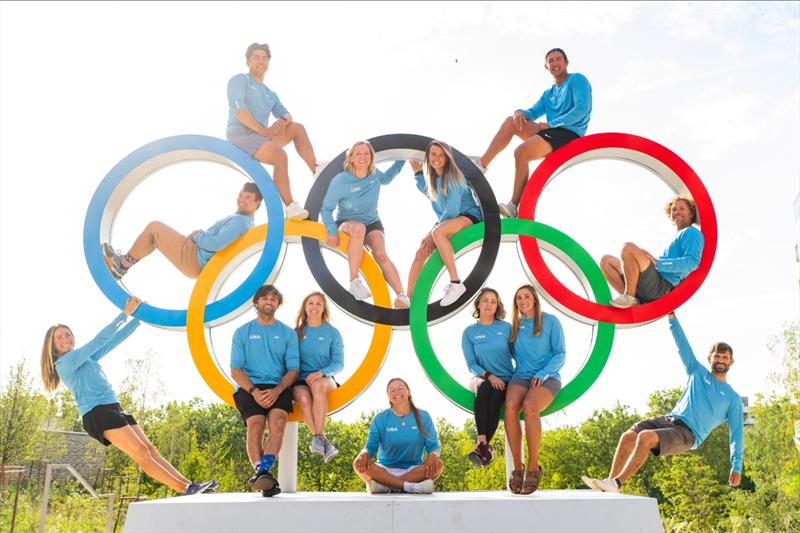
The US Sailing Team together at the Olympic Rings in Paris during the Team USA Welcome Experience before the start of the Games © Allison Chenard / US Sailing Team
The classes and events that should be in the Olympics is always a contentious topic. Every type of dinghy, keelboat or board has its fans, and they will argue the point for its inclusion with fervour.
In reality, the classes themselves aren't what are referenced in Olympic broadcasts and results. Instead it's the discipline which the athletes compete in, and right now that is being decided for the 2032 Games and possibly beyond.
I have a question for you: Should what happens in the Olympics be representative of what you and I do in our everyday sailing? It's not just sailing where this is a contentious debate. Sport in general, and the various governing bodies, debate whether what we see at the Olympics should reflect what the viewers do themselves, continually. On one side you have accessibility and participation while on the other end of the scale you have elite entertainment and extreme athleticism.
Broadcaster appeal
The Olympics itself is fighting to stay relevant in an era where entertainment is king. Every sport needs to have an element of show since the International Olympic Committee (IOC) relies heavily on broadcast revenues, which broadly define whether the event is a success or failure. The disciplines need to be exciting to watch, and if they're not then that sport's place in the Games will be under threat.
It is 100% in the interest of any sport within the Olympics to look exciting. What you have is effectively a once-every-four-years shop window to attract new people to give it a go. Admittedly the majority of Olympic viewers, and sports fans in general, will watch from their armchairs and not ever contemplate competing in any sport, but the minority is still a vast pool of people. It's estimated that 5 billion people consume nearly 30 billion hours of Olympic content through traditional television and streaming platforms throughout the world. Grab your slice of that - however small - and you're reaching a lot of people.
Coming back to sailing, athlete numbers at the Olympics were 461 in 1996, and 330 for Paris 2024, while still retaining ten medal events. This means smaller fleets in many disciplines and the pressure on traditional classes is intense. Spectator appeal and youth attraction are key attributes the IOC looks for.
Also, the Olympic Games itself now has gender parity, with 5,250 female and 5,250 male athletes competing, so having a sport which helps achieve this balance is a major plus in the IOC's criteria.
Change for the better?
Over the years this has seen a move towards first skiffs, and now foiling, but this change often involves a fair amount of compromise with the various lobby groups within World Sailing.
Classes have been changed, such as the Nacra 17 catamaran (the Multihull discipline which is a mixed-gender format) becoming a full foiler after Rio 2016 and the 470 changing from an initial Open discipline in Montreal 1976, to separate Men's and Women's two-person dinghy discipline in Seoul 1988, and then to the Mixed two-person dinghy we saw at Paris 2024.
Personally I find the 470 dinghy racing hard to watch due to modern pumping techniques. Anyone who's competed in a major sailing event will know about Rule 42, and there are often judges on the water to spot illegal pumping, be that by body movement or fanning the sails, and hand out penalties to those who are deemed to be propelling their boat in a way that is outside of the rules.
Many classes now use the Oscar flag to signify that pumping is allowed above a certain wind strength, and this has led to a bizarre-looking technique in the 470 class where the crew bounces their body on the trapeze to fan the sails as efficiently as possible. I don't know how anyone can call it a good look and I don't see how it can in any way be a good advert for sailing itself. I loved sailing the 470 a long time ago, but it is now a far cry from that type of sailing. Things have moved on in sailing and the adaptations the class has made to stay in the Olympics are, in my opinion, now damaging for the sport itself and its place in the Games.
Where are we now?
For LA2028 we have ten disciplines; Men's and Women's One-Person Dinghy, contested in the ILCA 7 and ILCA 6 classes respectively, the Men's and Women's Skiff, held in the 49er and 49erFX classes, the Two-Person Dinghy and the Multihull which, as we've discussed are mixed disciplines held in the 470 and Nacra 17 classes. Then we have Men's and Women's Windsurfing, using the iQFOiL class (one design equipment), as well as Men's and Women's Kiteboarding, which uses the Formula Kite class (a box rule with approved equipment).
Which classes are under review?
For the Brisbane 2032 Olympics the Men's and Women's Kite, the Mixed 470 and the Mixed Nacra 17 are formally under review.
The kite class focus is about accessibility, gear standardisation and safety, as well as considering whether newer board or foiling formats, such as wing foiling, are more appealing. The focus on the 470 concerns build costs and global participation and the Nacra 17 review is mainly on whether a platform with a broader weight range and lower campaign cost is needed.
To make their decisions, the World Sailing Council and General Assembly take advice from the Events and Equipment committees and working groups to come to their decision, although the IOC Executive Boat holds final veto and approval power. The World Sailing Annual Conference takes place in Qingdao, China mid-November.
Why Pathways are vital
Going back to the title of this article, I am increasingly convinced that pathways need to play an important role in the decisions that the World Sailing Council, Assembly and Committees need to make. The America's Cup has now been foiling for over a decade and SailGP in the foiling F50s is revolutionising professional sailing and bringing the sport to the masses in a way that has never been achieved before.
The athletes who come through Olympic campaigns to achieve success are the sailors who will compete in the America's Cup and SailGP and will become the stars of the future, going on to inspire the next generation to take up sailing in the first place.
Sport is all about aspiration. Sport has the ability to get people to push themselves in ways they would have never thought possible, and in this day and age where we spend more time doomscrolling on our phones than actually going outside to enjoy what the world has to offer, it's more important than ever. We all know the power sailing has on our minds and bodies, so any way we can inspire more people to take it up must be grasped.
Olympic sailing needs to fully adapt to the changing times, fulfilling the dual roles of being a visual spectacle that inspires new participants, as well as being a pathway to the professional areas of the sport like the America's Cup and SailGP.
The 470, through evolution of the sport, modifications to the discipline, and pumping rules simply doesn't fulfil the necessary criteria. In my opinion it should be replaced with a more exciting and photogenic option - a singlehanded foiling dinghy.
There's no doubt as to where the current crop of sailing superstars come from. Take a look at the America's Cup and many of the top sailors have won 49er gold medals and a Moth World Championship or two. The tactical nous, split-second reactions, and athleticism required in the classes is exactly what the IOC wants in an Olympic sport, and wow is it good to watch. Adding a singlehanded foiling dinghy to the Olympics would cast sailing in a good light and would attract more people into the sport.
But wait a minute...
At this point you'll have a couple of questions: how can a singlehanded foiling dinghy replace a double-handed 470, and isn't the Moth a development class?
In answer to the first question it could replace either kitefoiling or the 470. In the case of kitefoiling it would be a straight swap to Men's and Women's singlehanded foiling dinghy classes, while if the 470 was replaced, a more novel format would be needed, such as the combined scores of a male and female sailor from a nation. I know World Sailing and the IOC want an element of jeopardy going into the final day of an Olympic event so that medals can't be decided early, and a combined format would take a bit of thinking through but could be incredible.
As to the second question. Yes, the Moth is a development class, bringing steel foils and eye-watering costs at the top end, but there are strict one design foiling dinghy options available.
The Waszp exploded onto the scene a decade ago and has attracted thousands of younger sailors into the sport, and I've just been at Lake Garda covering the Switch Global Championship, which takes one design foiling to a whole new level, bringing champions from classes as far apart as the 470 and wing foiling together to compete on level terms.
So the options are there already and Olympic sailing needs to adapt.
Wing and a prayer?
I talked to a number of sailors who sail conventional dinghies, foilers and wing foils over the past few days and the conversations were enlightening as to what they want. It's not unanimous, but the vast majority want to see a foiling singlehander in the Olympics, and their wing foiling is recreational.
The northern end of Lake Garda has always been a mecca for boardsports. Back in the 1980s and '90s there were windsurfers reaching across the lake, then in the 2000s it was kiteboard reaching across the same stretch of water, and now it's the wing foils doing exactly the same. They launch off the beach, have a blast, then come back in. Competition is the last thing on their mind, just as it was when I used to windsurf back in the '80s.
Another very noticeable trend is that wing foilers generally don't use sailing clubs. They have no need for a dinghy park slot or a mooring and it's a solitary pastime, quite often with a GoPro as a companion to post a clip on Instagram.
There's absolutely nothing wrong with wing foiling and I think it's damn good fun, but I don't think it becomes a pathway to further sailing such as SailGP on the America's Cup. There are wing foil racing circuits, but 99.9% of wing foilers don't compete in them.
One of sailing's greatest strengths is its network of worldwide clubs and everything they provide from training to community, and heading down the wing foil route for competition doesn't support those clubs.
I tend to think of wing foil more like surfing, and maybe that's where the competition element of it will end up. Far more subjective scoring with judges and held at the same venue as the Olympic surfing competition.
Is a foiling singlehander relatable to me?
If, like me, you sail a traditional dinghy, then you'll probably be wondering how a foiling singlehander is representative of the type of sailing that you do. The racing tactics are remarkably similar and require many of the same skills. You need to start on time, take the wind shifts and understand the wind bends, keep your air clear and judge lay lines - just about everything that is important in traditional sailing is important in a singlehanded foiling dinghy, but every decision needs to be made faster.
So yes, it is the sailing you and I know and, in my opinion, it's far more exciting to watch. Highlights from races work as reels, feeding the social media machine, and longer videos and live coverage can be superb.
The question is, will World Sailing take the leap or stick with the traditional.
Mark Jardine
Sail-World.com and YachtsandYachting.com Managing Editor