
Who is sailing the boat?
by John Curnow, Sail-World.com AUS Editor 7 Oct 14:00 PDT
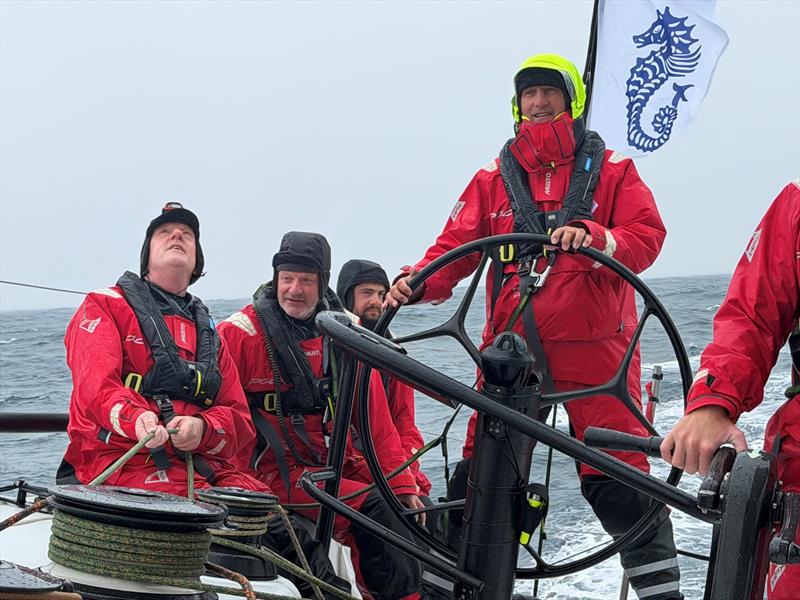
'A big sense of completion', Johnny Vincent at the helm of his Volvo 70 Pace © Anthony Haines
Well, the alternate headline is nowhere near as catchy. For it simply goes, 'Technology, AI, and the line offshore racing cannot afford to discover too late.' So, accurate, yes. In-your-face? Definitely! Now it was only a few months ago that we looked at The tech curve..., and this both is and isn't a follow-up Editorial.
Primarily, we're here to look at the uncomfortable question sitting beneath all the cleverness, and it is reasonably simple. Namely, when does technology stop helping the sailor, and start replacing the sailor? Well, the curve has not flattened. If anything, it has stood up, squared its shoulders and started running at us.
The discussion is no longer about an autopilot holding a compass course while somebody makes a cup of tea. It is about a connected ecosystem capable of steering, learning, measuring sail shape, trimming it thereafter, adjusting all of the appendages, looking after standing and running rigging, moving ballast, and increasingly, making the sort of decisions that were once the very reason people went ocean racing in the first place.
In a lot of ways, calling it autopilot is both inaccurate and belittling. Right oh, and before you start at the keyboard in haste, perhaps finish reading, ponder, and then yes, type away if required.
Matt Allen AM, is the Chair of World Sailing's Oceanic and Offshore Committee, and he sees the sport at precisely that junction. Technology has unquestionably made offshore sailing faster, safer, and in many cases, more accessible, but the arrival of computer control across multiple systems changes the nature of the discussion.
"There is a major fork in the road, and we're sort of at that fork right now, because we've obviously got numerous systems that can be controlled directly with no human involvement," said Allen. Those systems extend well beyond the rudder itself, even the toe in of the twin rudders (where fitted), to canting keels, canards, daggerboards, trim tabs, foils, and crucially, the rigging and sail trim that convert the wind into speed.
That last point matters. Racing Rule 52 does not accidentally talk about rigging and appendages being controlled by the crew. As Allen notes, rigging means the whole shooting match. So that's running and standing rigging, sheets, halyards, runners, and also the systems that manipulate them.
Powered winches and powered systems have already required sensible accommodation inside the prescription, but the next step is different in kind, rather than merely degree. In other words, it is material.
"It's all been fine until we get to the point of this sort of massive computer control of appendages and rigging, which is enabled by AI technology, and the rapid and significant development of the autopilot. In other words, this is not a debate about whether hydraulics or electricity turns a winch. It is about who, and also what, decides when and how that winch turns."
Autopilot no longer paints the right mental picture
The name itself may now be part of the problem. Autopilot still conjures an image of an actuator/ram pushing/pulling a quadrant, whilst a fluxgate compass from yesteryear tries to work out which way is North. That era is disappearing astern.
Modern, solid-state AHRS (attitude and heading reference systems), using inexpensive sensors developed at enormous scale for phones, cars and other applications, measure heading, pitch, roll, rotational rates, and three-axis acceleration many times a second, without the mechanical limitations and damping required by the old fluxgate units.
The result is not simply a more convenient helmsman substitute. It is a helmsman that can be relentlessly consistent, does not become seasick, does not need sleep, does not lose concentration at 0400hrs, does not have to get his eye in, especially at night, and can be connected to an expanding network of sensors and control systems.
"The recent autopilots steer vastly better than the older units, and if they're properly set up to achieve the critical damping, even the cheap autopilots probably steer better than 95% of the sailors."
Note to all, this is the point at which an aid becomes performance enhancing in a very realistic sense, for that's better than 95% of souls, all day, every day, across every watch. Now consider the miles it will add to your 24-hour run...
Scary thought? The good ones are better than 100%. Mic drop right there...
Then add artificial intelligence. No one can know where we'll be in two years, let alone ten, but that uncertainty is precisely why future proofing matters.
"This has been coming at us for a long time, and it's here now, for better, or for worse." That's the ubiquity of AI, and the expectation from those immersed in the field is that present-day use is only a fraction of what is coming. The important word there is not AI, and it is not even arrival, or scope. It is consideration, or the ultra-crucial, what?
As such, the offshore autopilot should not have to be considered as an isolated steering device. Feed it wind, motion, rudder load, boat speed, heel, pitch, sail shape, load from everything, including foils, wave information, along with historical performance data, then let machine learning to continuously refine the response.
Just who was Ben Johnson?
The conceptual jump from steering the boat to sailing the boat is not particularly large, but the consequences? Indeed, in some corners of high-performance sailing it has already been made, and if you read these here ditties, you'll know I love it. It is as addictive as watching Ben Johnson in the 100m sprint.
Thing is, it is fine in a realm where that is what is on offer, like doing a lap at the best part of 30 knots average. There's even a safety aspect to it all...
Now, the question then for mainstream offshore and ocean racing, is whether that same trajectory should simply be allowed to wash through every fleet, simply because the technology exists?
Sail trim is the obvious next frontier. LiDAR can observe sail shape, and a computer (with appropriate coding - the key) can analyse it.
"The important distinction is between technology advising the sailor, as opposed to technology acting directly. I don't think we can ban having a LiDAR camera with a computer basically telling you what to do. What we can potentially ban is the LiDAR camera looking at the sail shape through the technology, and then directly trimming the sail, all without human involvement. This is the line in its simplest form. Information can augment the sailor, whereas automatic actuation can remove the sailor from the loop," said Allen.
Then ask yourself is it a line, or something way more amorphous? Get the systems talking to each other, and it varies again. Sail trim cannot be separated neatly from rig tune, mast behaviour, runner loads, or the changing aerodynamic package, to say nothing of sea state. A machine that understands sail shape may also understand that a runner needs easing, a sheet needs trimming and the boat needs bearing away two degrees.
Structural rig developments will add another layer. The complete performance problem is an amalgam, and that amalgam is precisely what makes the issue so much larger than whether an autopilot is permitted to steer.
Ballast, appendages and the invisible crew
Then we go underwater, where things become even more interesting. Modern offshore yachts can carry a formidable inventory of movable systems, like canting keel, water ballast, daggerboards, canards, trim tabs, twin rudders, elevators, and foils. Some boats combine several of them.
Allen (with James Mayo) of course chartered MasterLock Comanche, which is a good example, for the aircraft carrier not only has powered winches after being launched with grinders, but water ballast, canting keel, and daggerboards, all systems that can materially alter the yacht's attitude and performance.
"All which with enough money could have been automated. Follow that road and the boat can be sailing along while the machine continuously decides not merely where to point, but how the entire platform should be configured."
Water ballast is a particularly good example because it sounds so benign. Pump water from here to there, empty it, refill it, alter righting moment, and fore-and-aft trim. Yet once ballast movement is linked automatically to heel, sea state, heading, wind strength, and target performance, it becomes part of the control architecture.
The same is true of a canting keel. The same is true of a trim tab. The same is true of a daggerboard, or canard.
Each individual action may appear incremental, but collectively they can amount to a virtual crew member with access to every lever in the boat, and one that thinks way faster than any of us. So, if it is a better helmer, then it is also a better sailor... Let that soak in Mrs Marsh. (And yes, that is a distinctly ageist and Aussie joke - sorry.)
Rudders are moving into the same territory. Toe-in and toe-out on twin-rudder configurations, automated rudder geometry, and increasingly sophisticated control surfaces mean that steering itself is not necessarily confined to turning a wheel, or tiller.
Foils take the discussion further again. "The angle of attack of the foils is just around the corner as well, or here already," said Allen. If active control of the angle of attack of the foil, elevators, or other surfaces is integrated with steering, ride-height information, and the aero package, then the boat is no longer merely being pointed by a computer. Both its aero and hydrodynamic configurations are being continuously optimised by one.
Did Han Solo go sailing?
This is where rule writing based on today's hardware becomes dangerous. Ban Product A and Product B arrives. Define an autopilot too narrowly, and the steering function migrates into an integrated control system. Regulate one appendage, and designers will exploit another.
Future proofing therefore has to deal with functions and human involvement, rather than a shopping list of specifications, equipment, or devices. Allen's Committee is wrestling with exactly that problem, because the rate of change makes a conventional rule cycle look glacial.
Then there is also the matter of propulsion. Variable ballast and canting systems can do more than stabilise a yacht if cycled in particular ways, which raises the question of whether stored or powered energy is effectively contributing to propulsion. That is not a new philosophical problem for sailing, but automation makes it much easier to optimise and repeat the action. Add machine control, and the grey area can become a performance system before the rule makers have finished defining that particular shade of grey.
The distinction is important because nobody is arguing that development classes should be frozen in carbonite. IMOCA, Ultim and other specialist programmes can create their own boundaries, and push them as hard as they like. Foiling itself is not the enemy, nor is powered equipment, insanely clever software, or advanced materials. The issue is whether a computer should compete directly against a human in the fundamental tasks that define the sport, and then whether mainstream owners should be forced into that contest simply to remain competitive.
Future proof the people, not only the boats
That brings us to money, and money has a habit of making theoretical debates wonderfully concrete. Once a performance advantage is legal, serious competitors will chase it. Allen has already heard the reaction from owners, who unanimously say, 'We know the new autopilots are performance enhancing. If we're allowed to use it, we will use it for racing, but actually we don't think we'll race any more!'
N.B. This is not technophobia. It is owners asking themselves why they should spend substantially more money to remove themselves from the part of sailing they actually enjoy.
The arms race is easy to imagine. Today's competent pilot becomes tomorrow's baseline. Then somebody arrives with more sensors, faster processing, better software, and an AI model that keeps learning at a prodigious rate. The hardware requires installation, structural work, calibration and specialists. The software becomes an ongoing development programme.
Allen jokingly invents a 'Widget 5000' with 28 sensors and a vast installation bill to make the point, but the joke works because everyone in Grand Prix sailing knows exactly how quickly an advantage becomes an expectation.
Worse still is inconsistency. If every organising authority writes its own technology rules, a yacht could be compliant for one marquee event, and fundamentally compromised for another. "This opens up a dilemma for anybody wanting to retrofit a boat, or build a boat. Do you configure it for Sydney to Hobart, Fastnet, Newport Bermuda, Transpac or a Transat race?"
Do you install systems that must be disabled or removed for particular events? Do you build a boat around one rule, and watch its resale market shrink when another race heads in a different direction? Future proofing is not merely about anticipating the next sensor. It is about keeping owners involved, protecting investment, and preserving the ability of boats to move between events.
World Sailing's Oceanic and Offshore Committee has established a technology working group (with some very serious heads involved in it), and is then moving towards broader consultation with the people who actually race offshore. Allen wants active sailors and boat owners surveyed globally, with enough explanation attached to each question that respondents understand what contemporary systems can actually do.
"The education piece before they answer the question is critical, because an opinion based on a 2001-era autopilot is almost irrelevant to a debate about integrated, AI-enabled control."
The proposed survey is intended to look across the full landscape from: autopilots, to variable and movable ballast, canting keels, trim tabs, daggerboards, canards, foils, rudder control, LiDAR, sail trim, and the other systems gathering around them. It will also distinguish between fully crewed and short-handed sailing, professional and amateur participants, different rating environments, boat ages and sizes, and the regions and clubs in which people race.
This is not bureaucracy for its own sake. It is an attempt to understand where the sport's participants believe the human should remain indispensable.
Allen is emphatic that the debate cannot simply be parked while everyone waits for certainty. "I make no apology for having this debate. It's the responsibility of the Committee. I don't think there's any critical, credible argument that we should not be having that debate now."
That is perhaps the most important element of future proofing. You do not future proof a sport by correctly predicting every invention. You do it by creating principles, and a rule architecture capable of absorbing inventions that nobody has thought of yet.
The point is to retain agency. A sailor should still have something meaningful to do with the information, the controls, and the sea in front of them. There is a profound difference between a computer telling a trimmer that the sail could be flatter, and the computer flattening it. Just as there is between a system displaying optimum foil angle, and a servo continuously setting it, or between instruments reporting angle of heel, and a controller automatically moving ballast, canting the keel, and adjusting appendages without a hand being laid on anything. That difference is the space in which skill and experience still lives.
The simple definition
Ocean racing is long periods of boredom, interspersed with moments of sheer terror. Offshore racing risks outsourcing its best bits, whilst retaining the woeful food, wet gear, broken sleep, bilge water everywhere, and a stench that only those that know, know...
As Allen puts it, "If the machine steers better, trims better, configures the appendages better, and makes the boat faster, the human can become payload with a toolbox."
There will always be a place for extreme technological contests, and there should be. Let the laboratories rule. Let designers explore active foils, autonomous control, advanced routing, machine vision, and whatever comes after AI as we currently understand it.
Ocean racing has benefited enormously from people asking what is possible next? Yet the broader sport also has to ask a different question, like right now, and that is fundamentally, what is worth preserving? If the answer includes steering, trimming, judgement, fatigue management, seamanship, and the satisfaction of making a boat go fast through an ocean with other humans, then the rules need to say so before the machines make the decision for us.
Ocean racing is a gift with lessons for your life, and I thank everyone I have come to be involved with from it. Nothing else gives you nature and human endeavour on a magnificent scale, all whilst crammed into a microcosm.
The overarching aspect here is about the cumulative effect of the autopilot, sail trim, rigging, water ballast, canting keel, rudders, trim tabs, daggerboards, canards, foil angle of attack, remote processing, and AI, when they all become one system. Any single component can be defended as progress. The amalgam is something else entirely, and we are not talking about learning from Mrs Marsh.
This is why the next rules have to be written with the boat of 2030 in mind, not the boat tied to the dock today, just as much as Organising Authorities all realising ocean racing is the one ool, and you'll notice there is no 'P' in our pool. Let's keep it that way!
If this was land, we'd say it's a fork in the road. As it is water, we'd say one path went off on that board, and the other path selected the this board. One uses technology to extend what sailors can do. The other uses sailors to service what technology can do.
Offshore racing has time to choose, but not an unlimited amount thereof. Tick Tock. Tick Tock.
The smartest piece of future proofing World Sailing can undertake is probably the simplest. Namely, that when the starting gun goes off, and the bow points towards the horizon, somebody is on board and still genuinely sailing it.
Thank you for being a crucial part of Sail-World.com
John Curnow
Sail-World.com AUS Editor