
What's the link between loudspeakers and boats?
by John Curnow, Global Editor, Powerboat.World 16 Oct 03:15 AEDT
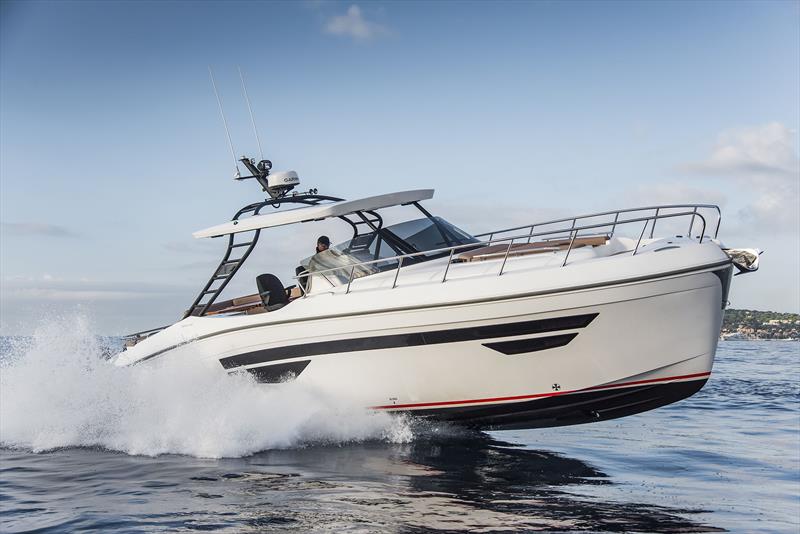
Oryx 379 © Gulf Craft
If boat usage and/or ownership has changed and is a-changing more each day, then how about some of the companies/builders in the industry? What do they think? What are they doing? Ponder if you will, Have it all. Do it all., and then also Starting Premise., which dealt with usage.
So then, what about a builder whose craft, or brands really, are so very different, and none of the recreational vessels even carry the parent company’s name? They are sizeable, and been around for quite some time now, too. It’s not just pleasure craft they are known for, either, for there are plenty of ferries and patrol vessels in the overall mix, as well.
All of that said, you’d have to think they get to see a lot of changes we have been talking about, and make boats to suit. Additionally, the CEO is a lifetime stalwart of the industry, so not just change, but adaptability and resilience come to the fore. Finally, and by no means forgotten, the group has had the same owner since the get-go.
Name the game
When looking at a boatbuilder with several brands under one roof, there is a temptation to imagine that the exercise is mostly about badges. Change the name, change the styling, adjust the website and the brochure, and then move on to the next customer segment. Erwin Bamps sees it very differently. For Gulf Craft, the brands guide people through a wide offer, but the distinctions not only have to be real, but marked.
Majesty and Nomad yachts and superyachts, Oryx cabin cruisers, and SilverCat power catamarans are not supposed to be slightly altered versions of the same idea. They are intended to answer different expectations, different uses, and very much increasingly so, disparate, even divergent ways of spending time on the water.
This distinction is very central to Bamps’ second tenure as CEO of Gulf Craft, re-commencing about 16 months ago. Back when he first took on the role in 2002, he describes Gulf Craft as a ’20-year-old startup’. A company that knew how to build boats, but was not yet truly focused on international markets, or branding. The task became one of segmentation.
The Majesty brand emerged alongside a growing ambition to build larger yachts, followed by Oryx, SilverCat, and later on, Nomad. Bamps puts it plainly, “We started building individual brands for the different segments that we were trying to focus on. and make it easier for a client to understand what each one stood for.”
The other job was much harder. Gulf Craft was building in a region without the marine manufacturing clusters found in established boatbuilding centres. If the company wanted stainless work, marble installation, furniture, paint or carpentry, it had to import the teams, or develop the skills itself. As Bamps puts it, “Gulf Craft effectively built so many companies under one roof.” Necessity became vertical integration, and an early disadvantage became one of the company’s most important assets. Namely, self-reliance, and given they are literally in the middle of the desert, it’s an important core business function.
Now in terms of brands, it matters very much so, because the promise is not just visual differentiation. Bamps successfully argues that vertical integration allows Gulf Craft to modify interiors and designs more quickly and more cost-effectively, “…without passing changes through layers of subcontractors and accumulating margin on margin, on margin. This makes a higher level of customisation possible within a given price segment. That’s a very compelling USP in any language spoken on Earth.
A client spending serious money on a villa expects personalisation. Bamps sees no reason why a yacht buyer should automatically be restricted to an à la carte checklist, unless the budget moves into another category altogether. “Something that was really an obligation, a necessity, because there was nobody to help us, became an asset. So for the same price tag, we can offer a higher level of customisation,” said Bamps.
One company stands. Several brands go boating, differently!
Beneath the brands sit common values that Bamps does not want diluted. Namely; reliability, usability, and the sturdiness of the build. These values come partly from where Gulf Craft learned to build. The Middle East delivers heat, humidity, dust, and demanding operating conditions. Water temperatures can be double of elsewhere, and this dramatically changes cooling efficiency, whilst crews in some global markets may not have the same level of training as their counterparts in the more traditional superyacht centres.
This is not just important or fundamental, but rather oh-so-mission-critical, for it means engineering the boat to the client base, and its operational environment from the outset, rather than assuming that one generic specification is equally suited to every coastline. Accordingly, Bamps engineering premise is thus - You engineer to your client base, and to your market.
Gulf Craft have loads of commercial craft, and also private vessels, operating in places such as the Maldives, Indonesia, the Philippines, and Gulf Cooperation Council, where equipment may be used hard and maintenance may not always happen with a white-glove approach. Bamps analogy is a four-wheel-drive vehicle: if something is expected to survive difficult conditions, it is built differently. The same thinking, he said, is one reason Majesty 120s have found a place in charter. A charter yacht is not always treated like an owner’s private possession, so reliability, durability, maintenance access, and low cost of ownership overall stop being background engineering terms, and become commercial advantages.
Common engineering does not mean common character (No. No. No!)
Bamps is deliberately pushing the brands further apart, giving each more focused design choices. If one yard name has to appeal to everybody, compromise creeps in. Whereas with several brands, one can pursue quiet luxury and sturdiness, another gloss and elegance, another adrenaline, and yet one more the emerging family-boating model built around shorter, more intense periods on the water. “I want to make sure that even more so than in the past, we’re trying to give a clear USP for each of the individual brands, so that I can go a little bit more extreme,” added Bamps as away of underscoring the word, ‘clarity’.
Majesty sits at the visible end. This is the yacht you want to be seen with. The one that belongs with the skyline of Monaco, Miami or Dubai in the background, and is ‘selfie-central’ on Insta. It is bought to enjoy, but also to show. Clearly, the speakers will be on the outside for this brand.
Now, the design language is therefore important, with Gulf Craft working to bring a recognisable lineage, and proportion across the range. From the Majesty 120 upwards, Cristiano Gatto Design has helped shape a new visual direction for the brand’s superyachts.
Bamps talks about the design question in almost philosophical terms: “Engineering is about usability and function, whilst another design-centric mind may be preoccupied with the perfect line, and the scale and connectivity of the proportions. Majesty has room for that theatre, but the function still has to remain underneath it.”
Nomad heads in another direction. Bamps sees substantial growth potential in what he refers to as, ‘quiet luxury’, although he is also quick to acknowledge how overused the phrase has become. His definition is more useful than the label, however - 'I don’t care what you think of me.’ Nomad is about the owner’s quality of life on the water, and time with loved ones, rather than whether somebody on shore is looking, or not. The interior is not meant to feel like a showroom where the owner worries about disturbing the presentation. It is a place where shoes can be thrown into the corner, and life just happens. What matters instead is personal enjoyment. This is where the good speakers will be found on the inside.
This no-nonsense character is reflected in the design approach. The Netherlands-based design team, Phathom Studio, is working on the Nomad 101 interior update, along with the new Nomad 70, and the Dutch take contrasts with the more overtly Italian emphasis on styling. Thus, the brand ethos for Nomad is simply described as engineering, usability and functionality, with no need for the marina to applaud…
Oryx is described in physical terms. These are the performance boats, where you come back in with your hair standing up from the adrenaline. Speed matters. Fun matters. It is for time with friends, or a sporty family, and the brand can be allowed to focus on that sensation, rather than being softened to satisfy the priorities of a power-catamaran buyer.
As its own marque, Oryx does not have to be everything to everybody, and makes no attempt to do so. Here the speakers would be found in the headrests, just like premium, and expensive Recaros from back in the 80s.
“It’s the boats where you want to come out and your hair is like this because you have an adrenaline boost. It’s about speed. It’s about having fun with the guys or with the family.”
SilverCat is “the fastest-growing part of the pleasure-boat portfolio, and one of the most interesting responses to changing behaviour,” as Bamps states. For emphasis, Bamps looks to how people are spending more time around boating, but often in shorter periods on the water. In other words, intensity.
His own description of younger generations is telling. “They want ‘fast fun’. A weekend is no longer one or two activities, but a packed sequence of events, and boating may only occupy just one part of the day. Therefore, the boat needs to deliver community, entertainment, space, and immediacy, without requiring the whole weekend to justify the outing.
Bamps sees a broader market shift behind the demand. Large outboard engines helped dayboats push into territory once occupied by smaller flybridge yachts, while powercats now provide volume and accommodation without following the traditional flybridge formula. They offer front and rear terraces, an expansive, air-conditioned main deck, and enough accommodation to keep the family aboard overnight. Their inherent stability also addresses the comfort issue that has become increasingly central to the way buyers judge a boat.
So, the powercat gives a group a large platform, a massive floating entertainment area, and in Bamps’ own words, “Your beach until you’re bored.” People still want bigger engines because they want to get to the destination quickly and come back just as swiftly, because life moves on rapidly, but once on board, they increasingly expect the comforts they already take for granted ashore.
Early SilverCats were more heavily oriented towards fishing, family use, and easy maintenance. The new expectation is more comfort, luxury, softer seating, visual appeal, Wi-Fi, connectivity, and even Netflix. The question is no longer simply whether the boat can perform, but whether the boat can become part of the owner’s normal connected life. Clearly, this is not simply about speakers for surround sound, but full bore Dolby Atmos FlexConnect.
The common denominator
Comfort may be the biggest change Bamps sees across the industry. Twenty years ago, he remembers speed being, “…the first and last question. Today, people are far more interested in gyros, ride-control systems, stability, large windows, cool interiors, and the absence of fumes, vibration, and unpleasant movement. He calls Gulf Craft, “…an engineering company that builds interiors and fibreglass around it”, but his instruction to the engineers now is not to focus on performance first. “Focus on the comfort and fun, first, because this is what people are looking for.”
Additionally, this helps to explain why the brand structure matters more, not less. Buyers may share common expectations of reliability, durability, intuitive use, low maintenance, comfort, and customisation, but they do not share one definition of fun, or how that may look. Some want the visible glamour of Majesty. Some want Nomad’s quiet, sturdy independence. Some want Oryx to deliver the adrenaline. Some want a SilverCat to become the family’s floating social platform. Bamps’ aim is to let each brand move closer to its own extreme, rather than forcing all of them back toward a safe middle ground.
That’s all fine, well, and good, but the learnings still have to flow across the group. Of this, Bamps says the management challenge is “…a balance of centralised learning, and decentralised focus.” Furthermore, you have to not just take into account those things attained in the recreational market, but the hard won knowledge from building passenger craft, ambulance boats, coast guard and law-enforcement vessels, fire and emergency services boats and other commercial craft.
Naturally, these boats may not carry the gloss of a superyacht brochure, but they are required to work when conditions are poor, and that means there is another source of knowledge about durability, and performance for the entire group to tap into.
Then there is Gulf Craft’s service and refit facility (SYSC is part of the Group's business diversification), for which the majority of work coming through is for non-Gulf Craft vessels. Being integrated allows the refit group to carry out work expeditiously, but also means they see what not to do, when it comes to building craft that are required to operate in harsh climates, and may not have the best of care throughout their life. It all means that Gulf Craft can build a better ownership experience and journey, which in turn builds advocates for the brands.
Whilst the loudspeaker analogy is all good and well, underneath there is the not a flicker, but a solid beam of the guiding light that will deliver future growth. Ponder that Gulf Craft is less of a conventional manufacturer, and more akin to a construction company. Why? Because a client does not necessarily go to a trusted builder because they want the last villa copied again. They go because they trust that builder with a new project. That trust builds and cements relationships. Those relationships place orders, now, and into the future.
The final edict
Consider then that Gulf Craft is now 44 years old, and it has the same owner since inception. In the boatbuilding game, that sort of continuity is rare enough that it becomes the example held up to others. Stability of this nature creates both an opportunity, and an obligation to all the stakeholders.
As it turns out, this is how Bamps frames value. Price is not his opening argument, and not even argument number five. The conversation starts with what Gulf Craft can offer. Then it is what the client wants, and how the team can involve that owner in the process. The surprise about the low quantum of the bill comes at the end.
You could go with building an honest product for an honest price, and it would be true, but the cornerstone is functionality. “Form without function is not enough, and a polished promise that does not survive ownership is not luxury in any meaningful sense,” said Bamps.
Gulf Craft see themselves as manufacturers over being a style house, but that is not to say form is absent. Perhaps it is best to come back to the real connection between loudspeakers and boats. Different owners want to hear different things. Some want volume, some want refinement, some want the soundtrack of speed, and some want the whole family gathered around it.
As Bamps says, “The sizzle still matters, but you had better deliver the steak!” Gulf Craft is not a product house. It is a relationship builder.
You can search Powerboat.World with the button right up the top of the landing page, above our logo. If you want to add to it, then please reach out now via email.
Finally. Please look after yourselves.
John Curnow
Global Editor, Powerboat.World