
Who is maintaining the boat?
by Mark Jardine 27 Oct 09:00 PDT
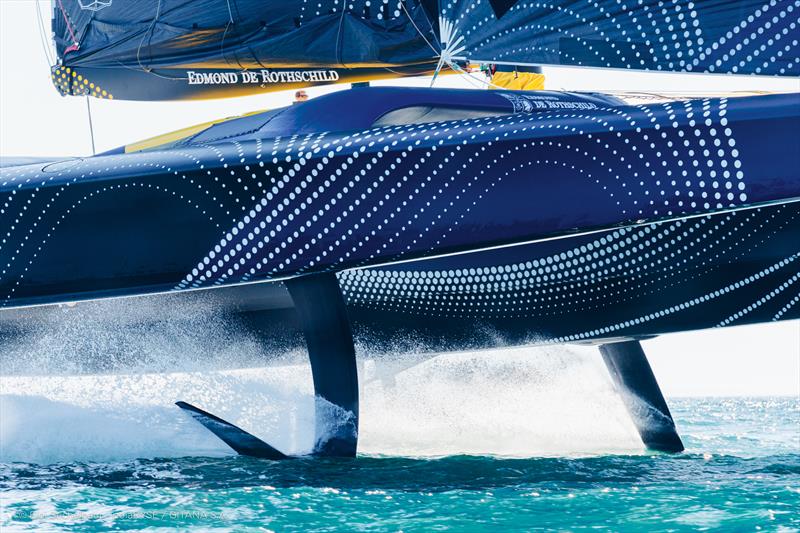
Maxi Edmond de Rothschild Gitana 18 © Eloi Stichelbaut - polaRYSE / Gitana S.A.
I was fascinated by John Curnow's recent editorial 'Who is sailing the boat?' where he asked the question about whether sailing is becoming a purely technological battle, replacing the skills needed by a human to helm a yacht at the best speed.
Advances in technology, with ultra-accurate sensors and instrumentation, advanced processing, and AI-powered autohelms (and ride height systems for foilers) have changed the game and can react far faster than any human can hope to achieve. John referenced Ben Johnson's Olympic sprint in 1988, but as we soon found out, the dice were loaded in that race... I think the battle of human versus AI helming a foiler offshore is more like a straight mile race between Usain Bolt and a Formula 1 car. It really is becoming that imbalanced.
I've now read the article several times, as it has such profound questions for the sport, but it also led me to another question: who is maintaining the boat?
The upcoming Route du Rhum-Destination Guadeloupe, which starts on 1st November, is extraordinary. 115 solo skippers are taking part across the six classes: Ultim, IMOCA, Ocean Fifty, Class40, Vintage Multihulls and Vintage Monohulls. The race village is the largest-ever for an offshore sailing race and the French public have been flocking to St. Malo, despite the weather, to meet the skippers and see the boats.
The fleet of eight Ultim trimarans - leviathans which measure up to 32 metres long and 23 metres wide - equals the record set in the 2022 edition of the race, but has seen the technology rocket to a whole new level with Gitana 18, skippered by Charles Caudrelier, fitted with a range of T foils and unique U foil rudders; it is capable of smashing the 24 hour distance record, possibly achieving over 1000 nautical miles in a day.
Let's put that into perspective; that would mean averaging 41.67 knots for 24 hours. None of the instantaneous speeds of fifty-something knots we see in the America's Cup and SailGP, this is an average speed, day and night, of nearly 42 knots for 1,440 minutes, or 86,400 of those instantaneous seconds we see inshore.
Gitana 18, while easily the most radical boat in the fleet, isn't the only Ultim capable of smashing the 24 hour record as many of the others have had some major modifications. Anthony Marchand's Actual Ultim 3 has a new mast, Armel Le Cléac'h's Maxi Banque Populaire XI has a new daggerboard, Thomas Coville's Sodebo Ultim 3 has a new set of foils and Tom Laperche's SVR-Lazartigue has new foils and rudders. All of these are capable of next-level performances. The race record of 6 days, 19 hours, 47 minutes and 25 seconds is under severe threat.
The foil technology on Gitana 18 very much borrows from the much smaller International Moths and, on a little bigger scale, the AC75 of the America's Cup with T-foils and wing arms. These are inshore boats, completing races which are often under 30 minutes, not the days it takes to complete the Route du Rhum, or the weeks for a Jules Verne Trophy record attempt. The inshore foiling dinghies and America's Cup yacht come ashore each day for a bit of what is known as 'bimbling' in the Moths, and then a full overnight maintenance programme for the AC75s. That kind of boat maintenance simply can't happen offshore, especially when you're sailing singlehanded.
What happens to water over the foils when you reach speeds of 50 knots is fascinating. It's well understood that hydrofoils create lift in the same way an airplane wing does, with the difference being the medium the foil is travelling through, forcing the water travelling over the upper surface of the foil to go faster than over the underside. At 50 knots the velocity is so extreme that the water pressure drops below the vapor pressure of water, making the liquid boil. The water literally tears apart, and then violently collapses with extreme force. It is like continually micro-sandblasting your foils and it takes its toll on the materials.
The Ultim trimarans are having to strike a balance between outright speed and resilience. They want the ability to break records without breaking the boat, and the Route du Rhum will be an indicator as to whether they're achieving that goal. If a foil breaks or delaminates then it's effectively game over for that boat in a race.
On my recent visit to Pisa, Italy, to see the extraordinary Ferrari Hypersail hull, I noted how they have covered the 9-metre wide side foils in 0.6 millimetre titanium to protect the carbon against cavitation. Being a monohull with foil arms and a twin-skinned mainsail, this is directly transposing the technology of an AC75 into the offshore world. There is no luxury of coming ashore after a couple of hours racing to check all the systems; Ferrari Hypersail needs to keep going day after day, week after week, if they're going to achieve their goal of breaking the round-the-world record and capturing the Jules Verne Trophy. The titanium-coated foils are just one example of the kind of engineering on this yacht. Do take a look at my latest video on Ferrari Hypersail.
Above the waterline are areas that a skipper can effect limited repairs, but sailing singlehanded makes that no mean feat. All of this extra speed puts extra load on the spars, sails and rigging. In 30 knots of wind, travelling on a beam reach at 40 knots, the apparent wind over the deck is 50 knots. If you've ever tried to walk in a 50 knot wind then you'll know how hard it is. Try that on deck when you're in a 5 metre sea... Little wonder offshore yachts are now mostly sailed from inside a cockpit.
The new breed of offshore sailors are as much engineers as they are sailors. It is no less extraordinary, and the sleep deprivation, navigational decision making and, crucially, knowing when to back off, are the same as they ever were. It was always necessary to know every inch of your yacht as an offshore racer so that you can continue when things inevitably go wrong, but the level of complexity in the latest generation of yachts has meant these engineers aren't just needing practical skills, they require degree-level qualifications in it.
The Route du Rhum-Destination Guadeloupe is going to be fascinating to follow for so many reasons. The records, the battles, the rivalries and reliability will all unfold in November, and I know the first thing I'll be doing each morning is taking a look at the tracker and seeing what has happened overnight. We'll keep you posted every step of the way on Sail-World.com, YachtsandYachting.com and on our @Sail-World.com YouTube channel.
Mark Jardine
Sail-World.com and YachtsandYachting.com Managing Editor