
Pietro Negri Interview: Pathways, Retention, and the Pivotal Olympic Decision
by Mark Jardine 27 Oct 02:00 PDT
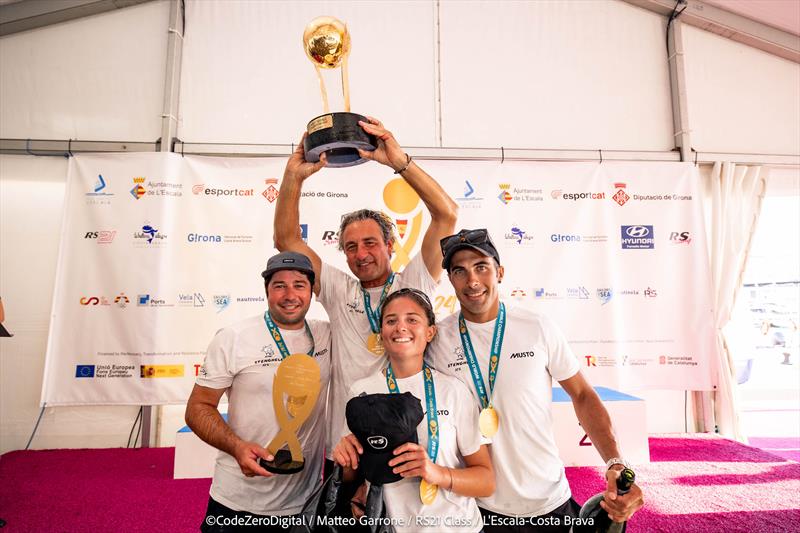
Italian team, Stenghele, helmed by Pietro Negri with crew Niccolo Bianchi, Giovanni Meloni and Camilla Cordero di Montezemolo win the RS21 World Championship 2024 © Code Zero Digital
Pietro Negri is one of the most knowledgeable and highly respected figures in the Italian sailing industry, and has a unique insight into what is happening at clubs, within classes, and to the sport as a whole.
Most importantly, Pietro understands what is attracting young people into sailing and what is turning them away.
While recently at Circolo Vela Torbole, Lake Garda, which is Pietro's home club, I took the time to speak with him to understand his views on sailing's pathways.
Mark Jardine: You have been working with bringing people through sailing's pathways, working with what was the Laser, now the ILCA,. How do you keep younger sailors excited and make sure they've got the community around them that they enjoy?
Pietro Negri: The pathway is something really important. At our sailing clubs the kids start with sailing school in the summer, in an opi or whatever boat, and then they progress on to the ILCA or double-handed boats, but at some point they need to have a view for the future, to have targets to reach. Aspirationally they will have the Youth Nationals or the Youth Worlds, or championships in whatever class they do, and the pathway has always been strategic for sailing, and for the whole infrastructure of sailing.
Mark: We have a real issue in the sport, and it's not just unique to sailing, where at 18 we lose a vast number of sailors. Over the years, what successes and failures have you seen?
Pietro: That's always the moment where the sailors have to decide what they want to do in the future. They end up in high school and things change in their life. The clubs usually are organised for younger sailors, and at that point they have to organise themselves, they also need to organise their coaching, so it's a complicated moment and I'm not sure how this problem can be resolved.
We tried several times to try and put people together, but they have different needs, different timings, and other issues. But what we've seen - for example in the Waszp or the Switch, which surprised me quite a lot - we brought back many of those sailors that were hanging around, maybe doing some sportboat racing. People were coming back to the sport.
Mark: We've got some incredible pathways now in sailing. Previously, you'd look and you'd go to the Olympics, and there were things like the Extreme 40, but the circuit was very small. But now, the America's Cup, SailGP, the maxi circuits, all require a pathway which is relatable, and the Switch is a good example of a class that can help you through those pathways. Do you think that's good for the sport?
Pietro: It's really good for the sport, and the Switch is already the pathway to those boats. If you look at our first Switch sailors, many of them now are part of America's Cup teams, SailGP teams, to the point where they are pushing their teams to buy Switch foilers and to train on Switches.
If you look at America's Cup, they were selecting sailors at the beginning, and they had to organise clinics with the 69Fs because there was no other boat or class to pick from, because the Moth is always difficult to judge, and usually you don't have youth sailors in there because they don't have the budget to have the the platform that can make them get the results. When we started with the Switch, immediately the names of these guys started coming up, and we knew that was the class we have to have our eyes on.
Mark: One of the key things I noticed at the Switch Global Championship was the number of sailors under 23 years old, and the fact you have that category shows how they're taking the next step after 18. Was that a conscious decision of the class?
Pietro: At the beginning we were thinking of under 21s, but we wanted to try to stretch it a bit because these were people not sailing a dinghy anymore. The under 21 was limiting these guys, so we said 'let's go up a couple of years' and see what happens. The America's Cup is doing the under 25 event, and we are doing the youth worlds as an under 25 event, because it's youth for the America's Cup. It's probably not the right term for a 25-year-old, but I think it's good that we give the opportunity to the America's Cup captains to pick from our class also the under 25s.
Mark: Back in the 1980s, there was an explosion in windsurfing, but it was recreational windsurfing, and while we all sailed, we would go out and have a blast on our windsurfers. There must be parallels with what is happening with wing foiling at the moment, where it is effectively a recreation for sailors. Could our error be making a judgement as to how people are viewing wing foiling as a sport and not as a recreational hobby?
Pietro: I think it's very difficult and complicated to predict this. We've seen in the past more or less the same in the kite foil. The racing in winging is a niche and most of the wing foilers are recreational, where the youth mainly like freestyling or wave winging.
Here in Lake Garda the world champion is from Torbole. Many of the wingers are training a lot, and they're doing their stuff but for how much time will they do this? don't honestly believe in the consistency in this. It's a complicated animal because the materials are evolving and it has a cost. A one design wing board is going to be old in a year, and after two or three, these guys will get bored of it.
Mark: Probably the strongest asset sailing has is its network of clubs, and these clubs are in severe danger because people will just go off and recreationally wing or kite do it from a beach.
Pietro: Yes, this is true, because those sports you don't need a club to do. How many wings did you see going out from this club this week while you're here for the Switch regatta? Nobody. They are going from the beach, it's full. I was discussing this with a club the other day and I had the same arguments. In two or three years, you're teaching and running the sailing school - which is a cost for you - and you bring them into the sport, and then you send them on to a wing, and then in two years they will go o the beach. They will not come to the club anymore. That's what will probably happen. Maybe you'll catch a few of them, but it's not like the pathway you had till now, where you have 15 to 20 ILCA sailors at the club.
Right now they have Waszp sailors, and they're coming to the club every weekend, and they're now moving to the Switch. Their club will be their place for years.
Mark: It's incredibly difficult for World Sailing as the evolution is proving to be so fast. How do they stay ahead of the curve and make decisions that are good for the long-term viability of the sport?
Pietro: They should listen to the sailors. If you go around and you ask.I don't need to ask because they come to ask me, 'Pietro, when is the Switch becoming Olympic? Is the class becoming Olympic? Why isn't this happening?'
For them, it's like logic that this happens. If you go to an ILCA regatta and you start asking around what they would like as an Olympic class, they would tell you a single-handed foiler because that's what they want to do. Maybe also do wing, because most of these guys then come back from the Switch and they go out for half an hour playing with the wing, but primarily they want to race. So first of all listen to the sailors.
The other important aspect to the sport sailing at the Olympics is single-handed dinghies, and for years it was the Laser giving the universality to the sport. Now we are at risk because we don't have a foiling single-ended boat at the Olympics, and the single-handed classes always have the highest participation.
Yes, we have foiling at the Olympics, but I don't think the Nacra 17 is an option for many because of the costs, while the Switch we see here, we have 70 sailors even though it's not an Olympic class. We probably have more people racing Switches than there are in that Olympic class.
Mark: From the point of view of national associations, and outside of sailing, when you are looking at the Olympics, you are looking at the number of medals, not the number of sailors who get medals or people who get medals. So, if you have a double-handed class it's just one medal for the nation. While it may not be representative of sailing as a whole, the single-handers are going to be more attractive to nations themselves, and this brings up the point, in classes like the 470 and the Nacra 17, is it more important from an Olympic point of view, where athlete numbers are dropping, to keep the medal numbers the same, just by going the single-handed route?
Pietro: It could be. There are different logics around the world where you have countries which have a culture for double-handed classes. It's a difficult question because I think that there is a need for a single-handed foiling dinghy for sure, and there's also a matter that needs to be resolved in the double-handed classes because the 49er is great boat, with a great international class, but with no activity nationally and the mixed 470 has low participation. So we are deciding medals for a sport that is not being done locally in any nation. The Nacra 17 is the same - there's no national activity in Naras, so we are again deciding medals in what is only an Olympic sport.
I think that this is a problem because if we want participation, you start participation with local racing. Racing in Garda, you bring people in at low cost, and then you bring it to a national level, and then from there you bring them to the international stage.
Sailors are selected by their federations to go into the Nacra or 470 because they need somebody representing them in that class, but they are not coming from that class. They start sailing these classes when they become Olympic. In the Switch we have members from the beginning because they want to participate in the class.
Mark: World Sailing has town hall meetings. Are these too much speaking and not enough listening?
Pietro: I don't know, it's difficult. There is logic there which I don't understand sometimes and maybe decisions are taken due to national interests. I believe we are in a moment where sailing cannot make mistakes anymore, because we know that sailing is at risk because it's a complicated sport to have at the Olympics, with lots of logistics compared to other sports which are easier to handle and see on television. I think that we have to be very careful, and I talk to many people who are aware of this and understand it. Others probably don't see the problem, and we should try to find a way of making these people more aware of what is actually going on. Maybe they should come to a Switch regatta.
Mark: Without talking about the classes themselves, what would you regard as the ideal Olympic roster of events? I know that's a difficult question!
Pietro: I would like to have proper classes which grow the sport in terms of numbers. Classes that have a proper pathway in double-handed, single-handed, foiling and non-foiling boats. The pathway should cover the sport from grassroots to professional activities, so I think that should be the aim for sure.