
An interview with Mike Rutledge on the 2026 Lauderdale Olympic Classes Regatta
by David Schmidt 14 Jan 03:00 AEDT
January 16-19, 2026
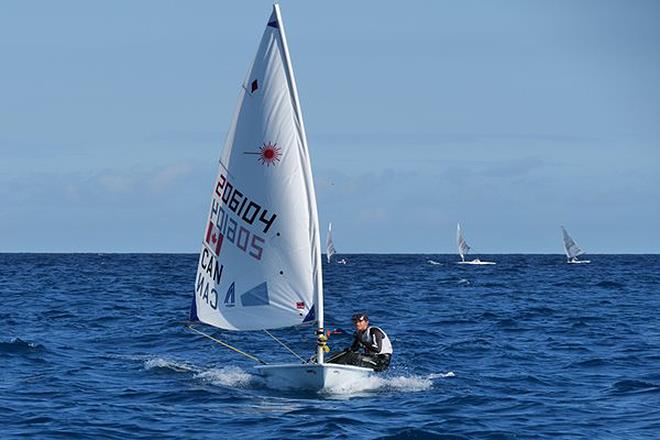
2019 Lauderdale Yacht Club Olympic Class Regatta © Sail Canada
The Los Angeles 2028 Olympics and the Brisbane 2032 Olympics might still be years over the horizon for most sailing fans, but for Olympic hopefuls, these are important times to be honing one's craft. This holds true both for sailors who are trying to qualify for the LA Games, and for sailors who are aiming at Brisbane 2032. Enter the 2026 Lauderdale Olympic Classes Regatta (LOCR; January 16-19), which will be hosted by the Lauderdale Yacht Club, in Fort Lauderdale, Florida from January 16-19.
This annual event is set to unfurl on the waters of the Atlantic Ocean, roughly one mile north or south of the Port Everglades Channel Entrance. The LOCR is open to ILCA 7s, ILCA 6s, ILCA 4s, Nacra 15s, and 29ers, and regularly attracts top-shelf sailors from around the country, and from points abroad.
While the LOCR isn't one of the events that US Sailing uses to determine the US Sailing Team's roster, the event offers great competition and gives Olympic hopefuls the chance to check their speed against their rivals.
I checked in with Mike Rutledge, who serves as the LYC's regatta chair, via email, to learn more about this high-level One Design event.
We're about 1.5 years into the 2028 Olympic quadrennial. Can you please give us an idea about how competitive you think this year's Lauderdale Olympic Class Regatta, especially given that the next Games will be contested on U.S. waters?
Due to a variety of factors, this year's LOCR is going to be a bit smaller than usual—the racing schedule here in Florida is packed in the winter, and unfortunately, another major event conflicts with this year's LOCR. We also have another year or so before the push for the Olympic trials really ramps up, however the top three Nacra 15 teams will earn spots on the US Sailing Youth National Team, and the top 29er team gets a spot at the 2026 29er World Championship
Lastly, the conditions sailing in the Atlantic Ocean off of Fort Lauderdale can be very challenging, which does limit the range of competitors a bit.
Do you see some classes at this year's LOCR being a bit more competitive than others? If so, which ones and why?
The ILCA classes and the NACRA class will all be very competitive this year. We also have a few 29ers making the trek to LYC for the event.
The ILCA and NACRA classes both have several top LYC sailors who will be competing on their home waters, which will make for formidable competition for the competitors from out-of-town.
What's do you think the scene will be like at the regatta's dinghy park? For example, do you envision sailors huddled with their coaches, or do you anticipate more of a congenial, all-ships-rise-on-the-tide atmosphere?
The ILCA sailors tend to keep to themselves and/or their teams, perhaps due to the solitary nature of the ILCA or the simple setup that doesn't require a lot of tuning on land or comparing of notes. Whereas the double-handed sailors tend to be more social as their boats are more complicated to set-up and have more options for tuning the rig (and comparing settings with fellow competitors, etc).
What kinds of conditions can visiting and local sailors expect to encounter on the waters near the Port Everglades Channel Entrance in mid-January? What are typically the best-case and worst-case scenarios?
Worst-case scenario is that the inlet is essentially closed due to heavy winds and swell. Thankfully, this rarely happens.
Best-case scenario is that we will see a nice range of wind and wave conditions over the three days, with warms temps and no rain. Luckily, this happens quite often in the winter in Fort Lauderdale!
Do you see local knowledge playing a big or small role in the regatta's outcome? Can you please explain?
I don't necessarily see local knowledge as a key to doing well in the event, but I do think that the sailors who have more experience in open-ocean big-swell surfing conditions have a distinct advantage.
As many dinghy sailors have experienced, the ability to skillfully surf the boat on a wave can pay huge dividends on the racecourse! Many of this year's LOCR competitors recently raced at the US Sailing Youth Champs that LYC hosted, so this experience will probably help them in [this] event.
If you could offer one piece of advice to visiting (and local) sailors, what would it be?
Be sure to take advantage of LYC's great dining options in our newly renovated clubhouse when you're here!
Is there anything else about the 2026 LOCR that you'd like to add for the record?
It's not too late to sign up! Come join the fun in the warm weather of South Florida!