
A look at The Ocean Race 2027's routing and its stop in St. Pete-Clearwater, Florida
by David Schmidt 24 Mar 08:00 PDT
March 24, 2026
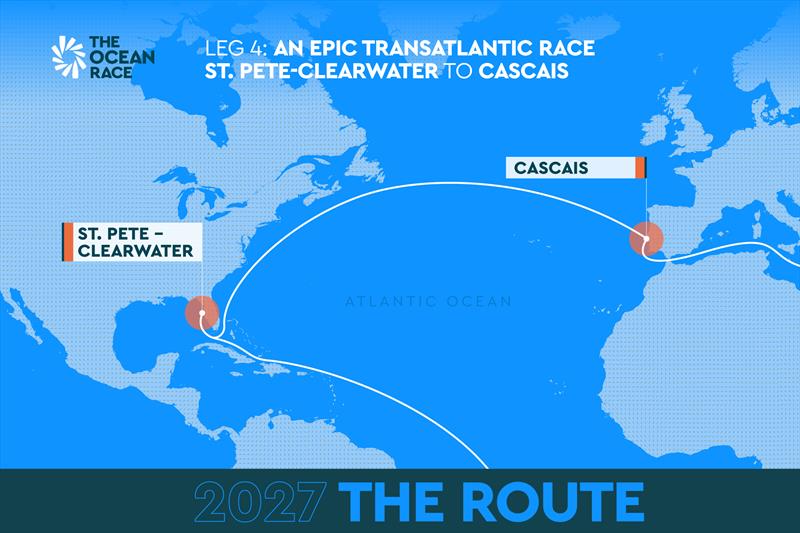
The Ocean Race 2027 Leg 4 - St. Pete-Clearwater, Florida, to Cascais, Portugal © The Ocean Race
Time and distance have ways of playing with one's mind, especially when the most valuable currency—wind—can be an unpredictable actor. This recently came into focus when the news broke last week that St. Pete-Clearwater, Florida, has been named as the sole U.S. stopover for The Ocean Race 2027. And this, in turn, inspired a visit to The Ocean Race's website to learn more about the course for this fully crewed, around-the-world race. That's when I saw the length of the race's first leg, which takes the fleet from Alicante, Spain, all the way to Auckland, New Zealand: 14,000 nautical miles.
So much for the old days, when the Whitbread Race/Volvo Ocean Race stopped in Cape Town, South Africa, before taking a deep dive into the windswept depths of the Southern Ocean.
Instead, the sailors participating in The Ocean Race (TOC) 2027, which is set to begin on January 17, 2027, will launch straight into the longest leg in the race's 54-year history and will knock off two of the world's three great capes before getting their first real shower in weeks.
"As it has for more than 50 years, The Ocean Race represents the pinnacle of professional offshore sailing," said Richard Brisius, TOC's Race Chairman. "The 2027 edition raises the bar once again with a route that will challenge even the most accomplished sailors in our sport. The opening leg to Auckland is a statement of intent: this is offshore racing at its most extreme and most thrilling."
From Auckland, the fleet will then press on through the rest of the Southern Ocean, passing Point Nemo (the watery coordinates considered to be the most remote place on the planet) and then rounding Cape Horn before climbing South America's Atlantic seaboard to Itajai, Brazil.
From Itajai, the fleet will race to St. Pete-Clearwater, Florida, before crossing the Atlantic to Cascais, Portugal. Then, the fleet will cross the Mediterranean before transiting the Suez Canal and racing to the finishing line off of Amaala, on Saudi Arabia's Red Sea.
If it feels like this route map is missing some of the stopovers of yore, this can likely be explained by the speeds of the boats. The 2027 edition of this storied race will be contested using foiling IMOCA 60s that are capable of delivering jaw-dropping speeds that have a way of shrinking the passage times needed to circle our lonely planet.
Back to the Sunshine State.
While previous editions of the race have visited Fort Lauderdale (1989-1991, 1993-1994, 1997-1998) and Miami (2001-2002 and 2011-2012), 2027 will mark the first time that the race has visited the Sunshine State's West Coast, plied the waters of the Gulf of Mexico, or enjoyed the St. Petersburg Yacht Club's hospitalities.
The St. Pete-Clearwater stopover is planned for May 4-16, 2027.
In addition to St Petersburg's splendors, including the Dalí Museum, visitors can expect great opportunities to see the fleet of IMOCA 60s, take in sailing and ocean-focused exhibits, and learn more about STEM, ocean science, sustainability, and ocean conservation.
"For more than a century, the St. Petersburg Yacht Club has helped shape the sailing culture of Tampa Bay, hosting generations of sailors and world-class regattas," said Christian Bergstrom, commodore of the St. Petersburg Yacht Club. "We are honored to see that legacy continue as St. Petersburg enters a new chapter and becomes the North American stopover for The Ocean Race in 2027."
From Florida, the fleet will race 4,500 nautical miles to Cascais, Portugal. While this would be a mammoth leg in any other race, one can imagine that it will feel more like a middle-distance race to sailors who have already sailed roughly halfway around the world, nonstop, in the race's first leg.
"The Ocean Race has always been defined by the cities and communities that embrace it, and this new transatlantic leg showcases everything the race stands for," said Brisius in an official TOC communication. "Departing from the shores of St. Pete-Clearwater and arriving in the historic sailing waters of Cascais is a way to connect two coastal cities with enormous passion for the ocean... And to arrive in Cascais, where Portugal's maritime heritage is felt on every cobblestone, is the best way to complete an epic transatlantic journey."
May the four winds blow you safely home.
David Schmidt
Sail-World.com North American Editor