
Analogue v Digital.
by John Curnow, Sail-World.com AUS Editor 26 Mar 03:00 PDT
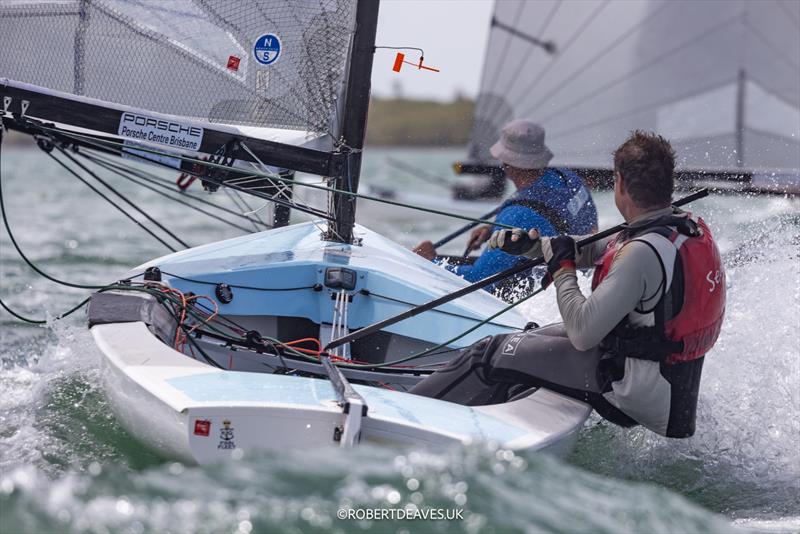
Casey chasing Trujillo - 2026 Finn World Masters © Robert Deaves
It all started with the mighty Finn. Now some 77 years old, and no longer an Olympic Class, you might have considered that it had wandered out to the far reaches of the back paddock and now rests under a big tree. It doesn't.
In the Northern Hemisphere, World Masters regattas more often than not had over 400 boats, and it's heading back towards that number once again. The most recent Southern Hemisphere version was just held at the Royal Queensland Yacht Squadron and there were just over 100 entries, which is a sterling effort considering the old tyranny of distance...
Finn Masters sailor, 66-year-old Andrew Coutts, had said to us that we needed to be there, which would have been awesome, but alas, way too many things to deal with at the desk, and recovery from surgery put a halt to any notion there. Did not mean we weren't looking, however, for a well heavy dinghy (100kg) with a yesteryear look that requires significant physicality to make it go (10m2 rag aloft) sort of hit me as the nautical equivalent of round gauges with white needles versus touch screens. Shelby Cobra 427 versus Yaris GR kind of thing...
Add in that Coutts has Chronic Inflammatory Demyelinating Polyneuropathy, or CIDP, and it was all a bit compelling, to say nothing of the odd legend bobbing around Moreton Bay - hello Rafa and Nocker. Some might also reflect that the great Michael Klim OAM has CIDP, and was recently on TV about it all. Pretty devasting stuff, and when you're used to the body going, and then it does not so well anymore. Yes. It's just a tad more than challenging.
Coutts is nothing if not a raconteur, and has been more than happy to shed light on this condition, so it was good to catch him just after one of his visits for a total transfusion. He's desperately quick to point out, and then immediately thank all those who donate blood, from which his vital plasma products are derived. He's less vampire, and more mechanic - grease and oil change. Close the hood. Off you go.
For emphasis, Coutts added, "Really wanted to emphasise that blood and plasma donations keep people alive. The people who donate regularly are the real life savers! Going through 40 plus donors worth of blood every three weeks means I have a lot of people I'm grateful to. I owe them my life. So many of my sailing mates donate regularly in my name. They know what that means to me."
Great Grand Master Coutts was always going to be going to Brisbane for the World Masters, and probably knew he was going to pay for it once back in Melbourne, which he did. Still, the chance to actually do all the racing, and finish in 41st place puts a smile on his face, and joy in his voice. BTW, Australia's Brendan Casey won it, and is the first Aussie to do so. Three bullets certainly helped. Well done.
Coutts was also in awe of 91-year-old Gus Miller, stating, "He worked out in the gym on the days off between races. Unbelievable. When it was blowing 20-plus knots he did go in the drink going downhill. He wasn't alone. There were more than a few others. Gus actually waved off the rescue boat, brought a boat up, which with the Finn is a really serious effort, climbed back in, and completed the race. Like, the determination and the guts. He's an extraordinary individual."
Being diagnosed with CIDP 20 months ago now, was not a deterrent for Coutts. He took it on, and is proud of the fact that he usually gets his boat to the water, but does look for a bit of help on the way back out. Not that he has to look too far, for there are always sailors keen to help, which Coutts recognises as one of the big things about Finns.
"Community is huge in the Finns. Phil Chadwick has said that it is 80% social and 20% racing, and when I say 20% racing, I don't mean the racing's not important. What I'm saying is what we've already known is that racing's racing. You can pretty much have a good race anywhere. So, it's what happens between races that really counts. This is what's going to attract people. It's belonging to a group. It's that sense of belonging," said Coutts who also referenced it as somewhat of a nautical Men's Shed.
"Not that women are excluded, by any means. On the contrary, it is as welcoming as you get. In Europe there is a small group of women involved, but a hefty boat that is ready to slap you over gills is not the most competitive choice for a more petite frame. It is also not that expensive, with AU$15k more than enough to get you going."
FYI - Chadwick is the recently retired IFAA President, and prime mover in building the Australian Finn Fleet. He and treasurer David Bull have worked tirelessly to build the class numbers. They both received Lifetime Awards at the 2026 Nationals (February saw 3 regattas, 28 races, so that's Australian Champioinship, Finn Gold Cup, and Masters Worlds, all back-to-back at RQYS.
As if to underscore the very things Coutts has been saying about the Finns, he added, "After a lifetime (60 years) of competitive sailing, from Olympic dinghy ambitions to international offshore racing, I feel like I've found my sailing tribe in the Finn Fraternity. They keep me going physically, Dragging me out to mid-week training sessions at Davey's Bay, blood donations made in my name, and also emotionally, providing me with the friendship and challenge of being there for the next regatta. Last year that challenge meant I drove over 17,000km to every Finn event in the country."
A class and all class
The carbon rig has certainly made the Finn more adaptable by allowing a wider weight range to be competitive. Coutts talks about the kudos of being a Finn sailor, and points to Sir Ben Ainslie, Giles Scott, and one John Bertand AO when highlighting how in demand they have been for America's Cup campaigns.
"With the move towards less physicality and more technology, the focus has moved to sailors who have got a background in foiling. The cockpit looks like in the latest iteration of the AC75 has got maybe 50 different parameters that you need to be able to get your head across, all displayed on screens just below deck."
"Whereas the Finn, at its heart, close-quarters combat. It has always been man-on-man, and whoever can tolerate pain and suffering is more likely to win. So, it produces a mental toughness, not just a physical toughness, and those attributes combined are pretty desirable in any competition."
Coutts added, "If you say, 'I sail a Finn', the shorthand version is you're a pretty good sailor. It's like a nod and a wink. The opportunity also to measure up against some of the best, and most competitive sailors that have ever been produced, is not bad either. To have your name on a trophy that carries the names of others of incredible accomplishment is really something."
"I think there were like four or five Olympians in the top 10 of the Brisbane World Masters results, and then if you go down from there, you'll still find Olympians in the top 30. Also, and to be honest, there's a bit of an addiction about it too."
Tapping into the Men's Shed point mentioned earlier, Coutts commented, "Masters Finn sailing is growing, especially with those that are retired, because it gets you friends. I hear this a lot from people coming to the class. 'My friends are usually associated with my workplace. Now that I'm looking to retire, or I have retired maybe, I find myself a bit lonely. I find I don't have a really big connection with anyone. Of the friends I have, we catch up for lunch twice a year or whatever, but unless you play golf, you don't see anyone that often. I don't play golf. I'd rather go sailing. It's always been something that's interested me.' So here you've got a group that you can start to build friendships in later in your life, and that's been the big key."
Highlighting the point from personal experience, Coutts said, "People I'd never met two years ago, I now count in my close friendship circle."
Acronym not name
Chronic Inflammatory Demyelinating Polyneuropathy might be way harder to say than CIDP, but the ironic part is that the diagnosis introduces a new level of complexity. It is a condition that interferes directly with the body's ability to communicate with itself, stripping back the insulation around nerves and disrupting the signals that control strength, coordination, and response. For someone whose life and work revolve around being capable, responsive, and physically engaged, it is not just a medical condition. It is a fundamental shift.
Quite possibly, the difficulty with CIDP is not simply what it does, but how it does it. It is inconsistent. It is unpredictable. And perhaps most challenging of all, it erodes trust. Not trust in others, but trust in your own body. There is a moment when you realise that what used to be automatic is no longer guaranteed. That reaching, stepping, bracing, all these things that have been repeated thousands of times without thought, now actually require attention.
"My diagnosis came after I experienced some tingling sensations in my legs that I first noticed at the 2024 Finn Australian Championship. It progressed terrifyingly quickly, but the speedy diagnosis and treatments have thankfully slowed its advance. As I was so bluntly given the news at the time, 'It's progressive. There's no cure, and it'll likely get you in the end.' Yeah. So much for bedside manner!!"
"Still, I did not want to step away from what I knew, but I did have to re-engage with things differently. Tasks were no longer simply done. Everything is considered and planned. Energy is no longer assumed, you manage it. I have also enjoyed being able to help others with their journeys in CIDP, and you do get something from that for yourself," said Coutts.
"It is not so much the limitation, but the variability. Fatigue is a big one, as well. You're a bit out of sync then, coordination runs away, and the connection between thought and action feels delayed. That inconsistency is difficult to plan around. It introduces hesitation. Not necessarily in a visible way, but internally. A second thought. A recalculation. A quiet check-in before committing to movement."
"For someone used to operating without that layer, it can be confronting. Yet, there is no option to simply opt out. Life continues. Work continues. The environment, particularly on the water, remains the same, which we know is always changing, and this is good for the competitive mind. The connection with the water keeps things moving better.
"Stepping away was never really on the table. Instead, the question became how to stay engaged while managing the reality of what was happening physically. How to maintain involvement without overreaching. How to remain capable, even if that capability needed to be redefined. This is where the shift begins; from resisting the condition to understanding it. Not as something to defeat, but as something to work with."
"The body adapts, often unconsciously, to maintain function. It finds ways to complete tasks, but not always efficiently. Over time, those compensations can create additional fatigue, additional strain, and a cycle that reinforces the very issues you're trying to avoid. Breaking that cycle is key. Not by pushing harder, but by refining how things were being done."
"One of the most immediate benefits was in the management of fatigue. CIDP does not just affect strength, it affects endurance. By reducing unnecessary strain and improving movement efficiency, the overall energy demand begins to decrease. The difference is subtle at first. A task feels slightly easier. Recovery feels slightly quicker. The drop-off at the end of the day is not quite as sharp. Over time, those differences accumulate, and with that accumulation comes a shift, not just physically, but mentally," stated Coutts.
Coutts definitely has a more considered, more measured approach now. In some ways, this aligns even more so with the realities of the marine environment, where conditions are rarely perfect, and adaptability is always required. Boating life has always relied on visual and sound signals. CIDP may mean that the signal from the brain to the lower legs may not be as immediate as it once was, but it is there. Clear enough.
Reliable enough, and if worked with correctly, strong enough to keep moving forward.
So, if you didn't get it earlier, the message is thus. "When I explain what CIDP is and does and people ask what they can do to help, I tell them 'Donate Blood!' (And as I say to my Finnster mates. You can do that voluntarily, or I can come get it myself - with a bucket!" Argh. Argh. Argh.
Thank you for being a crucial part of Sail-World.com
John Curnow
Sail-World.com AUS Editor