
An interview with The Magenta Project's Victoria Low about the findings of the 2x25 Review
by David Schmidt 2 Apr 08:00 PDT
April 2, 2026
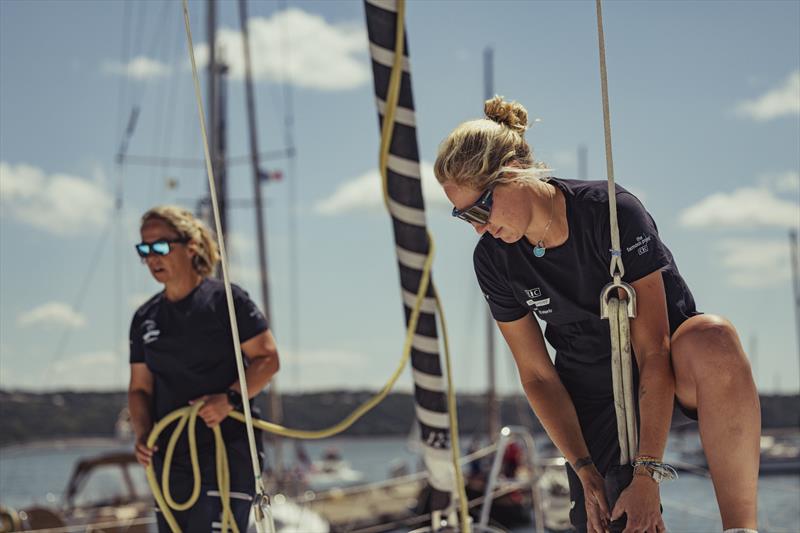
The Famous Project Boat Prep in Brest, France July 2025 © Robin Christol
The Magenta Project, in collaboration with 11th Hour Racing and World Sailing, recently conducted the largest gender equity study in sailing's history. The findings weren't great. The study, called the 2x25 Review, shows that while some progress has been made at sailing's highest levels, the gender-equity needle has barely budged for most sailors since the findings of the World Sailing Trust's 2019 Strategic Review were released.
Of the 2x25 Review's 2,500 respondents, hailing from 68 countries, 65% reported experiencing some kind of discrimination. Worse, more than 85% of female respondents reported experiencing sexism, while 67% of study participants (across all genders) reported gender-imbalance issues.
The World Sailing Trust's 2019 Strategic Review found that 80% of female participants felt that gender imbalance was a problem in sailing. Jump ahead seven years to the 2x25 Review and 75% of female respondents report feeling that gender imbalance is still a problem.
Additionally, the 2x25 Review also found that there's a 29% pay gap between what men and women earn across all occupations in entire marine industry. Here, however, it's important to note that an academic analysis conducted by Dr Rachel Scarfe found that this pay gap was primarily driven by the fact that women have fewer chances to earn and accumulate the kinds of professional experience needed for higher-paying positions, rather than being paid lesser rates for the same work as their male colleagues.
Granted, 83% of the study's respondents reported that they believe that female representation in sailing has improved since the 2019 Strategic Review (high-level examples cited included the Women's America's Cup, SailGP, and the Vendée Globe), but outside of sailing's highest echelons, the rate of progress remains stuck in full displacement mode, not foiling mode.
I checked in with Victoria Low, CEO of The Magenta Project, via email, to learn more about the findings of the 2x25 Review, and steps that can be taken to help level sailing's gender-imbalance problem.
While I'm disheartened to read that there was only a +5% change in polling numbers in the 2x25 Review on the question of gender imbalance in sailing from 2019 to 2026, I am pleased to see that the change is at least moving in the right direction. What steps do you think that can everyday sailors take to help accelerate this curve?
Yesterday I was at one of the 'Royal' yacht clubs in London and I was asked, 'what can men do to help'. My answer was simple: 'speak up for us in rooms that we are not in'.
Simple actions matter more than people realize. If you're at your club and you see women being overlooked for crew positions or coaching roles, speak up. If you're organizing a regatta, actively recruit women race officers and jury members. If you're a skipper, make sure your crew selection isn't just "the usual guys."
The gap between elite-level progress and everyday reality is real and closing it requires thousands of small decisions by everyday sailors to be more intentional about inclusion. It's not complicated—it's about noticing who's in the room and who isn't and doing something about it.
Based on the findings of the 2x25 Review, what do you see as the bigger issue right now—sailing's gender imbalance, or its pay gap? Or are the two closely related?
They're absolutely related. The 29% pay gap we found isn't about women being paid less for the same work—it's about women not getting access to the high-value roles where the money is. You can't fix a pay gap with equal pay policies if women aren't getting into senior positions, high-performance teams, or decision-making roles in the first place.
So, the imbalance creates the pay gap. Fix the access problem, and the pay gap follows.
The past year has seen women skippers win two major offshore ocean races, Transpac (Alli Bell) and the Sydney Hobart (Jiang Lin). How important do you think it is for other women sailors (and skippers) to see these wins?
It's huge. These wins don't just inspire—they dismantle the narrative that women can't compete at the highest levels. Every time a woman wins a major race, it becomes harder to justify why women aren't getting opportunities elsewhere in the sport.
These victories create permission for other women to see themselves in those roles and for decision-makers to take women sailors seriously.
But here's the thing - we can't rely on a handful of elite wins to drive change throughout the sport. The everyday reality for most women in sailing hasn't caught up to what's happening at the top, and that's what the 2x25 Review makes clear.
In order to help create and foster positive change as soon as possible, do you think sailing needs more women role models or more women in leadership positions?
Both, but if I had to choose, I'd say leadership positions. Role models inspire, which is important. But leaders create the structures that actually change things—they hire, promote, set policy, allocate budgets, and decide who gets opportunities.
When women are in leadership positions, they can create pathways for other women rather than just being an example of what's possible.
That said, the visibility of women like Alli Bell and Jiang Lin winning major races matters, [and] The Famous Project's achievement in the Jules Verne Trophy matter enormously because it challenges assumptions about what women can do in sailing. We need both the inspiration and the institutional power to make change stick.
The America's Cup and SailGP have both mandated that teams include women sailors. What are your thoughts on these kinds of programs? Do you think they will help move the needle towards making sailing a more inclusive and welcoming space for sailors of all genders in a meaningful way?
These mandates are important because they force teams to invest in women sailors and create pathways that wouldn't exist otherwise. But mandates alone aren't enough. The real question is what happens after the mandate. Are women getting genuine opportunities to develop and compete, or are they just filling a quota? Are teams investing in women's development long-term, or just for the duration of the mandate?
The best outcome is when mandates create momentum that becomes self-sustaining because teams realize that investing in women makes them more competitive. We're starting to see that at the elite level of offshore racing, but it is still early days.
On the media side, the past couple years have seen two circumnavigations generate significant non-endemic interest, namely Cole Brauer's Global Solo Challenge and skipper Alexia Barrier and her (The) Famous Project crew's recent Jules Verne Trophy attempt. How important is it to have women sailors featured in non-sailing media when it comes to leveling the sport's gender imbalance?
It is super important—when women sailors get mainstream media attention, it changes the perception of who belongs in sailing. [Brauer's] Global Solo Challenge brought sailing to audiences who'd never followed the sport before, and many of them were young women who saw themselves in her. That kind of visibility creates a pipeline of interest that the sport desperately needs.
But media coverage alone doesn't change the structures that keep women out of leadership, coaching, and race management roles. It's a piece of the puzzle, not the whole solution.
On a club level, how important do you see events like the New York Yacht Club's inaugural Women's International Championship for helping to foster and create positive change?
Events like this are valuable because they create high-level competitive opportunities for women, and send a signal that clubs are taking women's sailing seriously.
But the real test is what happens at the club level every day.
The NYYC is in a unique position with its first-ever female commodore, which is a massive step forward. We now need to see women being recruited as race officers, coaches, and committee members.
Generally, are clubs looking at how to build pathways for women into leadership? As I said above, sustainable change happens in the everyday decisions clubs make about who gets opportunities and who doesn't.
Are there other sports that you think have done (or are doing) a better job than sailing has to reduce gender-imbalance issues? If so, which ones, and what lessons can sailing draw on to make our sport a better, more welcoming and more inclusive world for all participants?
Women's football [Editor's Note: soccer to Americans] has made remarkable progress by investing in professional leagues, media coverage, and grassroots development simultaneously. They've shown that you can't just focus on elite visibility and hope it trickles down—you need infrastructure at every level.
Rugby, tennis, cricket and cycling are following similar paths, and sailing could learn from that. We're good at celebrating elite women sailors, but we're not as good at creating clear pathways from grassroots to professional levels, or at investing in women's development in coaching, officiating, and technical roles.
The other lesson from other sports is that progress requires sustained investment and commitment, not just good intentions.
You will also have noted that the 2x25 Review also features a substantial Further Reading section. We felt was important to be able to show what other sports, and industries, are doing and how they have adapted and changed, and simply, allowed more diverse groups into those 'rooms'.
If you could change one aspect of sailing and sailing culture (including yacht club culture) to create a far more equitable gender balance, what would it be? Also, what is it about this metaphorical lever that you think would be transformative?
That is a good question! I think I would change how we think about 'experience'.
Right now, high-level roles in sailing—whether that's skippers, coaches, race officers, or leadership positions—require experience that can often only be gained by already being in those roles. It's a closed loop that keeps women out.
If we deliberately created pathways for women to gain that experience through structured mentoring, internships, and sponsorship into roles, we'd break the cycle. This is transformative because it addresses the root cause of the access problem. Women don't lack talent or commitment—they lack the networks and opportunities to gain the experience that opens doors.
Fix that, and everything else follows.
Is there anything else that I didn't think to ask you about, or that you'd like to add for the record?
One thing the 2x25 Review makes clear is that we can't wait for change to happen organically. The 5% improvement in reported discrimination over seven years shows that good intentions aren't enough. Organizations need to be deliberate—set targets, track progress, hold people accountable, and invest in resources.
The sport has the foundations for real change: we already have men and women competing side by side, we have governing bodies willing to commission research, and we have a community that cares about getting this right. What we need now is the courage to act on what we know rather than just talk about it.
As we have said all the way through this process, the 2x25 Review is an invitation to help shape what comes next.
Readers can access the full 2x25 Review here: www.themagentaproject.org/research.