If seeing is believing, then trying is buying a FLIR (part 1)
by John Curnow on 31 May 2012
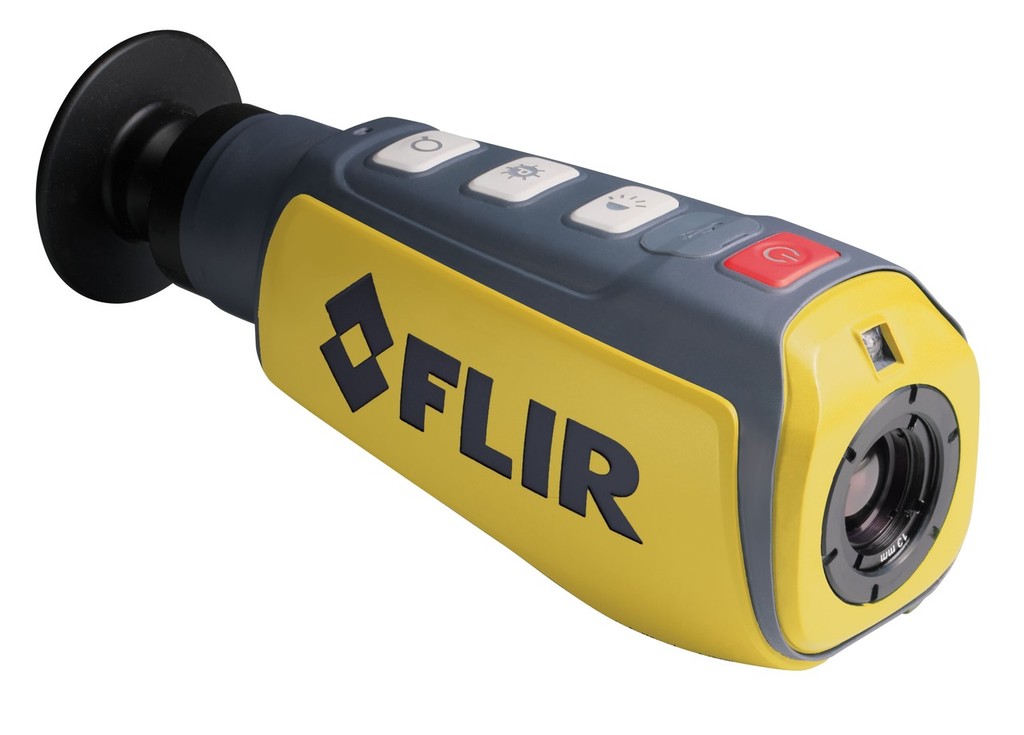
Flir’s First Mate MS Thermal Imaging Camera Flir Systems
Fortune. Not a word used much these days by news services, unless its stock market riches lost and won on the back of the latest Eurozone rumours. However, it has indeed been my fortune to have the unlimited use of a FLIR First Mate MS Series, handheld, infra-red, thermal camera. At just 172x58.7x62mm in size, a mere 340g, displaying images at 320 x 240 pixels and from AU$2300 RRP, it is simply fantastic.
Any crew that had one of the FLIR cameras on board would also be fortunate, for if a GPS enabled PLB takes the Search out of Search and Rescue then a FLIR Infra-red thermal camera can certainly take the Rescue out of a MOB scenario at anytime, but especially with little or no light, in a way that a low-light camera or night vision goggles will never be able to take on.
FLIR Systems Inc have dominated the world of Infra-red and pioneered the use of microbolometer sensor arrays that have allowed for the size, weight and complexity reductions that now sees certain IR technology literally in the palm of your hand.
Infra-red works on thermal signatures, of which everything on this planet has one, as different materials firstly absorb and then omit heat at different rates. To understand this, think of an ice cube as ‘hot’, for it is just below 0degrees Celsius, yet absolute zero is -273degrees C. The microbolometer reads these variations in heat signature and then displays them. In one of the images here, you’ll see the dog’s fur has different shades as it extends from the body and passes it to the atmosphere, for instance.
It does not matter whether you are a superyacht, local hobbyist fisherman, round the world cruiser or serious offshore racer, as there is a FLIR product to not only match the size of your vessel, but your needs and applications as well. If you’re a racer, you could see the requirement to keep a handheld version strapped to the pedestal and be as important overall to the boat as the ship’s knife.
The First Mate is the entry-level product line in the FLIR offering. It is rugged, small, lightweight and therefore ideal for sailors and trailer boats. The HM Series allows for a video feed and also has a 2x Extender available for the lens, to increase its range. It can record live footage for up to two minutes, as well. The ability to run off batteries means it is suitable for land-based activities, which is why mobile surveillance units choose one of the HM range.
The Navigator II is the first of the fixed mount FLIR products. It is affordable and ideally suited to forward looking only applications on larger, displacement hull types of powered vessels, as it does not have shock resistance, which the pounding of a planning hull landing after jumping waves would provide plenty of.
If the latter is you, then the award-winning M Series is far more suitable, as it is able to handle higher G force rates, has a user-friendly interface to control it and switch between white-hot and black-hot vision, along with a sleek modern design incorporating both tilt and pan functionality. You can choose the resolution/range you require and whether or not you need a low light CCTV camera as well. This is currently the volume seller in FLIR’s maritime range.
The Voyager II is at the ultimate end of the microbolometer series of FLIR products. It offers the longest range – able to detect a MOB at 1.4nm - and it’s gyro-stabilised, so the on-screen image remains steady. There are two thermal imaging cameras for both wide and narrow angle vision, as well as a low-light camera and importantly, it can link in to your radar to track targets. You can also push the video to compatible devices, so that the vision can be seen in multiple locations. Control of the Voyager II is achieved via a Joystick and the panel also incorporates all controls for switching between cameras.
Importantly, you can also access the Voyager via TCP/IP, meaning you can see the imagery from any Internet capable network, the world over.
The FLIR First Mate is so, so easy to use and fires up virtually instantaneously. I just love the red screen, but you can have it display as white or black hot too and the image processing chip, the microbolometer, which is inside the unit and makes it all possible, differentiates to 0.05 degrees Celsius and operates from -20 to +50, so you’re never short of contrast and you can see small craft, like say a tinnie at up to 0.7nm. Whilst the much larger HM Series has a far wider field of view and offers even better image quality with an additional focus ring on the lens, it also takes much longer to power up and we all know just how quickly things can go south when you’re out at sea.
That’s all fine, for the HM Series was originally intended for law enforcement and border patrol, where the massive field of view, better penetration and larger size were more appropriate. It can also run off regular AA batteries, eliminating the need to charge and thereby allow for prolonged activity in the field. There is an image capture version, but it is three times the price of the First Mate, so this is why the images taken here are with an iPhone into the back of the viewfinder.
It goes a long way to explaining the graininess of said images and the best way that I can explain what you see from inside the viewfinder is to imagine the FLIR logo and function icons as crystal clear. That is how much better the whole thing looks in your eye. At any rate, if I thought the HM Series was a handful, I was quickly reminded of the portable, military, helium cooled unit that can see 20 kilometres. I just pity the poor soldier who has to carry that lot!
So before you end up carrying way too many words on FLIR in your head, we’ll end Part One and come back very soon with Part Two. In that article, we will look at what you can do with not only FLIR’s MS First Mate, but some of their other products and why you may very well see their wonderful infra-red technology in devices you hitherto thought more than unlikely, but FLIR website
If you want to link to this article then please use this URL: www.sail-world.com/97920