J24 Australia - The Early Days- the World titles 1982
by J24 Australia on 22 Sep 2010
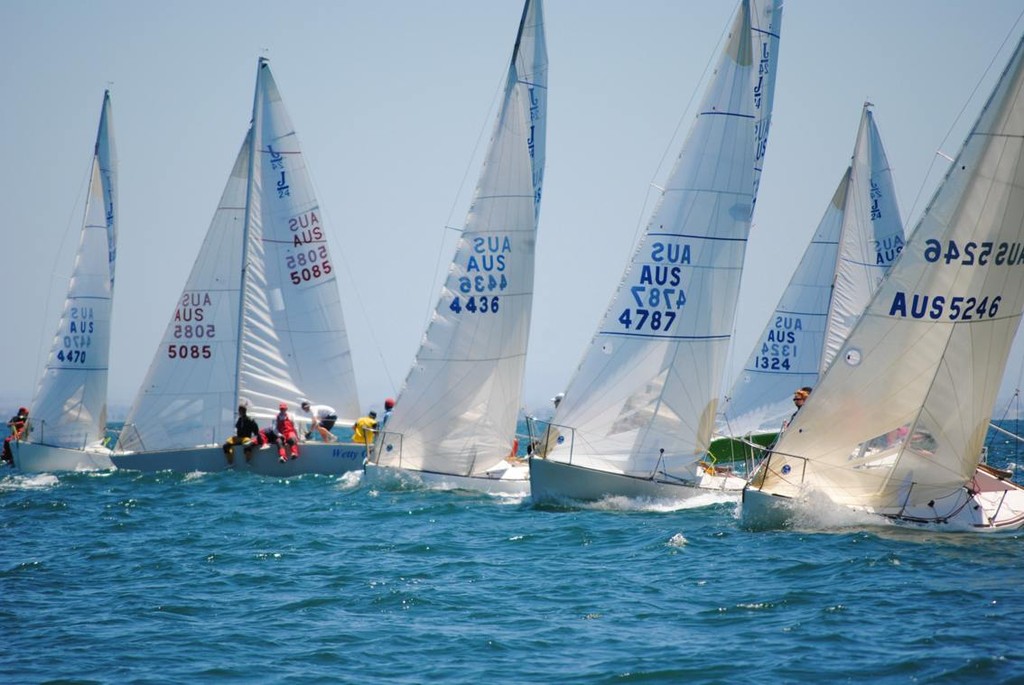
Up to 30 J24s are expected for the Legends Regatta David Staley - copyright
J24 Australia - Ahead of the October Long Weekend J24 Legends Regatta at Gosford, history continues to surface.
This is the second of the two articles republished by the J24 class from early Australian Sailing magazines written by Bob Ross in 1982.
In winning the J24 worlds, Mark Bethwaite and his Soling crew Ian MacDiarmid and Glen Read brought a fresh approach to tuning and equipment detailing that cut across much of the conventional wisdom in the class.
The Australian champion Soling crew, plus John Diacopolous who worked forward and owner Bunker Snyder, put together in Bandit a successful campaign that was largely outside the mainstream of competition in the Sydney fleet.
Bethwaite lives in Melbourne, has a demanding job, and used some of the weekends he commuted to Sydney earlier in the season to put in some time on the Soling. They were unable to sail regularly in J24 races before the series.
Much of the tuning load fell on MacDiarmid, who is a sailmaker – production manager at North’s Sydney loft. He sailed in the all important trimming spot on the boat, working mainsheet as well as tailing and trimming genoa sheets through tacks.
At a time when extremely high shroud tensions were becoming fashionable in the class, Bandit went the other way with caps just firm and lowers quite loose. MacDiarmid explained: 'We sailed with not a lot of shroud tension but were using the vang to flatten the mainsail and not much backstay. Sailing to windward, the leeward cap was slack and the lower very slack.'
A Harken swivel was added to the vang tackle on the mast to make it easier to use under high load and the vang tail led back to a cabin-top winch to be cranked on hard. Runner-up Dave Curtis (US) on Jeronimo was also vang-sheeting, MacDiarmid said.
Vang-sheeting made it possible for Bandit to drop a fall out of the mainsheet system and eliminate the Harken ratchet block most of the top Js use. MacDiarmid continually played the mainsheet, down to pulling it on hard going up the wave and easing it out down the wave.
Bandit sailed with the mainsheet traveller hauled up to windward of the centreline all the time, he said, even in fresh breezes. 'The further you can get it up, the better the leech movement.' MacDiarmid said.
Bethwaite used an endless traveller control line that looped around through the pushpit to overcome the problem of the helmsman having to come inboard to drop the leeward traveller line out of its cleat after a tack before hauling the car up to windward. Pulling on the slack in the endless line on the windward side of the boat released the line from its clam cleat on the leeward side.
Bandit’s rig was set up with maximum I, maximum J and maximum forestay length measurements. Maximum J and maximum forestay length are almost universally adopted in the J24s but maximum I is a little unusual. Minimum I had become accepted as the way to go. With maximum J and forestay length, it allows more mast rake which makes the boat easier to steer by giving it a slight bite of weather helm. Many Australian boats have gone to the trouble of trimming the bottom off the mast supplied as standard to achieve minimum I.
MacDiarmid and Bethwaite reasoned however, that it was better to have maximum I to allow maximum luff-length headsails. To this end they also replaced the snap hook of the headsail halyard with a captive-pin Wichard shackle swaged directly and tightly onto the halyard which, MacDiarmid estimates, gives six inches more luff-length, with the shackle ground right into the block, than the standard snap-hook arrangement.
Sails were pretty well standard Norths, designed on North American experience with shapes and modified by the Sydney loft in the light of Australian experience.
Bandit sailed with very little Cunningham eye pressure on its hard-finish cloth mainsail and the purchase was reduced to 2:l.It did use a lot of Cunningham on the main when sailing with the jib.
Halyard tension on the genoa was moderate; a grid pattern was marked alongside the halyard cleat so that the sheeting position could be matched accurately to varying headsail halyard tension.
Increasing the luff tension on the headsail, MacDiarmid said, lifts the clew so the car has to be shifted say one and a quarter inches aft to retain the same sheeting angle. The grid pattern enabled the halyard to be set in exactly the position required, with leather sewn through the halyard matched to marks on the deck – number 1 halyard position matched with number 5 sheeting hole read off the grid; number two with number six, and so on That was very important,' MacDiarmid said. 'Enabling correct settings to be made quickly at mark roundings.'
Although only moderate tension was taken up on the genoa halyard. Bandit sailed with extreme luff tension on the jib (non-overlap sail used in winds fresher than 18-20 knots on J24s)
'The jib was about six inches shorter on the luff than the genoa.' MacDiarmid said. 'and we still cranked the halyard right into the block. The sail looked overstretched and inside out but it was certainly fast.'
The Bandit crew did not shift spreader angles forward or optimise the keel shape, two popular measures in making the Australian J24s faster before the worlds.
'We felt we did not know enough about the class to experiment in those areas.' MacDiarmid said. 'We tended to just overcome the problems of sailing the boat as we identified them.'
They did spend a lot of money and time on perfecting the bottom surface, which they felt caused them speed problems in light winds early in the campaign.
While Snyder bought the sails, the other four crew members each put in $500 towards optimising Bandit. $1000 of that $2000 budget went in slipping, paint stripper, sandpaper and some professional rubbing help from two hard-working girls. Between 80 and 90 hours of labor went into perfecting the bottom surface.
Every fitting on the boat was critically examined. The two primary winches were moved to the maximum forward position in the cockpit so the tailer could watch the sail as he ground it in (the forward position is standard on the newer J24s).
The tiller was lengthened to put the helmsman closer to the mainsheet traveller and backstay controls. The backstay tackle was re-organised to put it in reach of the helmsman.
As many controls as possible were removed from the cockpit and placed within convenient reach of the other three crewmen instead of complicating the work of the helmsman and trimmer working in the cockpit. A set of Harken cam cleats was installed in place of the standard clams to back up the spinnaker sheet/brace ratchet blocks. The spinnaker sheet/brace tweakers were cleated off forward in cleats right near the pad eye. The spinnaker halyard was cleated off just behind the turning block lead from the mast and the spinnaker pole topping lift was cam cleated off on the mast. All these measures were devised to make maximum use of the crew of five, which everyone has come to recognise is essential in Australian conditions to maintain race-winning stability.
The crew of Bandit, tallying 8501b on the rail, went even further in that cause. They donned two sweaters each and jumped over the side before the moderate-fresh air races to come out of the starting lines with probably 9501b sitting to windward.
The big genoa headsail is difficult to tack on the J with bowlines attaching the sheets to the clew liable to snag around the shrouds and on deck fittings Stainless steel bales were fitted to the deck-mounted halyard turning blocks to stop the headsail sheets catching behind them.
The genoa sheets, of the minimum size permitted by the rules (as were all lines on the boat) were seized with leather directly to the headsail clews to present minimum resistance around stays and mast through tacks.
The foot round of the genoa was cut to minimum so that the sail would flop easily inside the lifelines after a tack.
Wire-to-rope splice halyards were lengthened so that the wire as well as the rope was gripped by the clam cleats, minimising stretch.
The Gemini headfoil, standard with the Australian Js, was taken off and replaced with Soling-style press studs on headsail luffs, for a weight saving of about 35lb. The second headsail halyard was taken out of the mast, also to reduce weight aloft.
Another advantage of the press studs, MacDiarmid said, was that on spinnaker hoists immediately the halyard was released, the headsail fell to the deck, enabling the spinnaker to set straight away.
Barber-haul systems were not used; the crew felt speed was competitive in light air and superior once the true wind speed exceeded 12 knots.
MacDiarmid said he had a full-time job on his hands with mainsheet trim. The crew kept up a good flow of input and Bethwaite would 'look around occasionally'. (Steering a J demands high concentration and the helmsman is unable to contribute as much to tactical decisions as in many other classes.) Once the breeze freshened to the point where the Bandit crew became confident in their speed, MacDiarmid would read compass and contribute to tactical judgments.
Bandit had two windows in its headsails – the first, almost to the luff of the sail, was for the helmsman to see the opposition converging on opposite tacks, useful when pulling behind boats. The second window was for MacDiarmid who, sitting in the forward end of the cockpit, could see converging boats and call the helmsman around marks.
A window high in the mainsail, to judge the distance of genoa leech from spreader, was little used after MacDiarmid became accustomed to reading the trim by distance of the foot of the sail off the shrouds.
http://j24australia.com.au/
If you want to link to this article then please use this URL: www.sail-world.com/74904