Hydrofoiling remote controlled sailing trimaran on test + Video
by Ian Holt on 5 Feb 2014
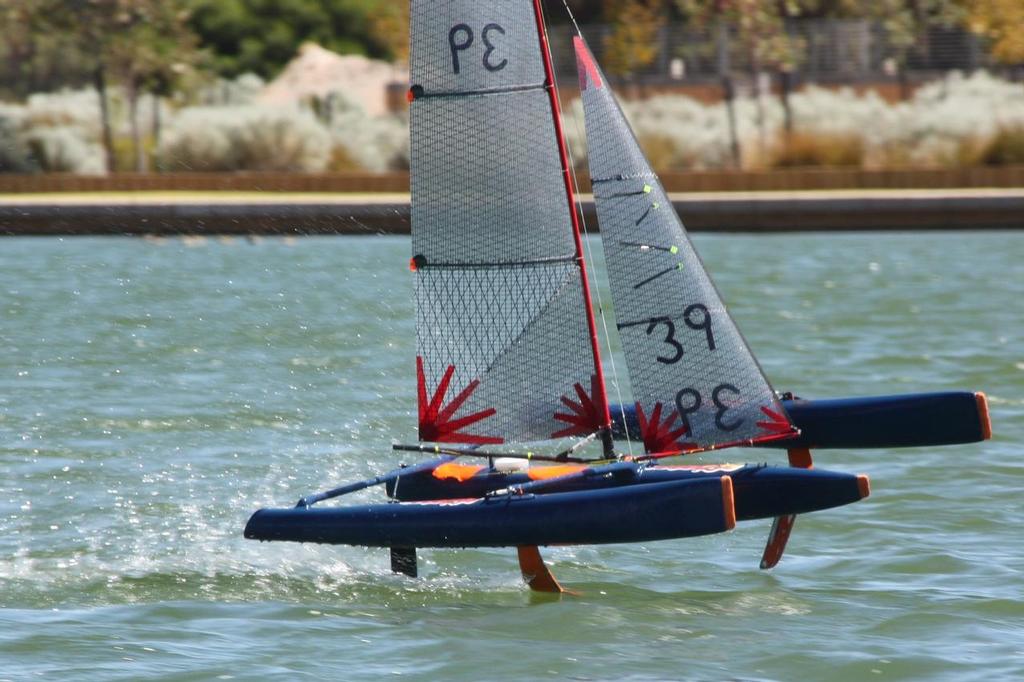
Hydrofoiling with the Number 3 rig Peter Costello
There was a good breeze at Austin Lakes, Mandurah, for test-sailing a Mini40 RC trimaran, using all four rigs, although too windy for the number one rig.
Designer Ian Holt describes the remote controlled foiler's performance:
The boat foiled upwind a few times but, will make changes to the foils before I sail the boat again. When on starboard tack and foiling, the boat sometimes veers hard to port. Right now, the port foil is perfect for lighter air foiling, whilst the starboard foil works well in a breeze, but only on a reach, not on a broad reach. Clearly, there is a fine line between good and bad settings for the foils!
Whilst the mainstream of radio control yachting centres around the One Metre Class, with the RG65 gaining popularity, and 10raters, the Marbleheads and the A Class offering alternatives for faster sailing with more freedom of design, there is another less well known option – the Mini40. The class is based on the Formula 40 class established in Europe back in the 1980s, the basic parameter here being that the boat had to fit inside a 40ft container to assist with transporting between events around Europe. For the radio controlled version, a 1/10th scale was adopted, resulting in maximum dimensions of 122cm x 122cm and a maximum sail area of 0.9sq metres. This means the number one rig is slightly smaller than a 10rater top suit, so sails can be made from old 10rater rigs if needed. Interestingly the Mini40 class rules state that you can have an unmeasured jib for use in speed trials – now there’s encouragement if ever it was needed to design a fast boat!
There is a mixture of cats and tris in the class. The cats are naturally lighter and so accelerate better, but you still have to work out how to support the mast and rudder – and the common solution is two rudders which add complexity to the steering control. One of the advantages of the main hull for a trimaran is that it helps tacking in light airs. More importantly, it permits the use of a single rudder which leads on to a few basic requirements for the boats. First of all, you need to stop them pitchpoling downwind. The only way to do this is to fit a 'T: foil on the bottom of the rudder, which works very much in the same way as a rear spoiler on the back of a racing car, holding the back end down. With the single rudder on a trimaran, this works well, you just need a rudder that is deep enough to keep the T foil immerse when the boat is flying the main hull, and a length of around 30cm appears to be a good compromise. The size of the T foil is found by trial and capsize. Too large and it slows the boat down but your five year old son can sail the boat safely. Too small and it pitchpoles too easily!
Then comes the interesting part – the foils. Some designs do not use foils, but just a single centreboard under the main hull. A cut-down One Metre fin can work well (obviously throwing out that antiquated lump of lead first). If the floats are designed with sufficient buoyancy to not bury their bows when flying two hulls, then this can be a good all-round set-up for racing round a course. Far more fun though to try hydrofoiling . . . . Here we are still in the infancy of experimentation.
Mike Dann in the UK got his Ghost Train trimaranhydrofoiling in the mid 2000s and if you search You Tube you can find some very successful experiments in France and Spain in particular in the same era, some with very small floats, but with an overall beam in excess of the length. The trick is to find a happy compromise of getting the foils far enough forward form the rudder so that there is directional stability, yet keep the balance of the centre of effort of the foils below the centre of effort of the rig so that you can still tack. If the foils are too far forward, you can not get the boat to bear away, complete a tack. I have found the solution here is to ignore a common belief that the rig on a multihull needs to be further aft than on a similar sized monohull, and instead put the foils approx. 70% away along the hull from the stern, and then place the rig above this. I also have more sail area in the jib than is popular elsewhere in the class and this appears to be working.
Once you get foiling, then the hull shape is irrelevant, we are into foil development, and that is the problem. We need more people trying out ideas! I am using cheap helicopter blades bought over the internet as the basis for my foils, but it would be great to have more people getting interested in the class and helping push forward the development of the class.
Dave Creed is avidly searching supermarket shelves for large plastic drink bottles that we can use as hulls and create cheap platforms for the rig and foils. Others use old Marblehead hulls as the main hulls.
People have asked why we don’t use a similar foil design to that used by Oracle and the Kiwis in the America’s Cup. The answer is that the America’s Cup cat weigh proportionately much more than our Mini40s, and their foils were actively adjusted whilst sailing. The 'V' concept, where the foils are at 45 degrees to the vertical, are a happy compromise for us.
As the boat goes faster, so the additional lift form the foils causes the boat to rise out of the water, reducing the area of foil in the water, reducing the amount of lift, so the boat goes down again, and the cycle repeats
However, comparing ourselves to the aircraft industry, we are not much further on that the Wright Brothers! Undoubtedly the step-change that needs to come is for the windward foil to produce negative lift, thus holding down the boat and creating more power. We all recognise this, but it’s not easy to adapt to our size of boat. Some clever guys are using the adjustable foils system perfected by the Moth class, with wands automatically adjusting a T foil on each float foil, but this is beyond my carbon and West Epoxy construction skills. Another option would be for servos to be attached to each foil, with a '+ve' and a '-ve' setting. If there is anyone out there who likes a construction challenge, I can tell them what we need!
The boats are tremendous fun. You only need three or four of these to make any lake appear small.
[Sorry, this content could not be displayed]
[Sorry, this content could not be displayed]
[Sorry, this content could not be displayed]
[Sorry, this content could not be displayed]
If you want to link to this article then please use this URL: www.sail-world.com/119024