
America's Cup Recon: French find the Naples seaway
by Richard Gladwell, Sail-World NZ 12 Nov 15:06 PST
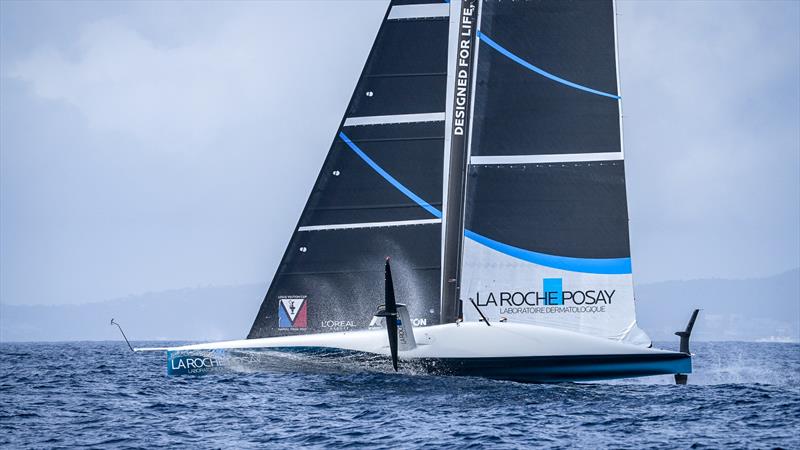
La Roche-Posay Racing Team - Day 21 - November 11, 2026 - Naples, Italy © Pierre Bouras / America's Cup
On Wednesday, the La Roche-Posay Racing Team had another extended session on Golfo di Napoli, encountering a 1-metre seaway plus small chop - the largest experienced since the team's arrival in the 2027 America's Cup venue.
However it did not cause the team the problems others encountered working up off Barcelona ahead of the 2024 America's Cup.
A former match racer and Olympic coach, Philippe Mourniac was asked in the post-session Recon interview, if he thought it possible for a team to employ fake tacks and gybes in an AC75.
"Yes, everything can be a solution."
"What you need to do is to do things you have already practised during training, and if you manage to succeed at that, it's all your strength, all your weapons you have in your pocket to play the opponent."
Given today's sea state and wind on a start approach, Mourniac was asked if he would rather see a team leading the opponent or chasing the opponent?
"It depends on many things. It depends on the entry. It depends on how the start will take place with the opponent.
"Depending on the wind speed, we have a plan A, to achieve compared to the other boat. But after that, there are so many factors that sometimes it works well. Sometimes you just have to adapt yourself to a new situation."
Imagine the team lost the start. Do you just sit back and hope you have a faster boat, or do you think the team has solutions, boat speed-wise, to overtake the opponent?
"I don't know if we have that solution today, but it's one of the goals."
"When the Louis Vuitton starts in May, we definitely want to have in our pocket this ability to really have maybe a touch better speed than the opponent, and if we are behind, maybe it will be an option to overtake."
La Roche-Posay Racing Team - Sailing Day 21, November 11, 2026 - Naples, Italy
Weather Conditions:
- Summary: AM: Grey Overcast with clear patches PM: Overcast and humid
- Wind AM: AM 7-9kts 180°-190°
- Wind PM: 4-8kts 185° to 175° @ 1430hrs
- Sea State:1metre with small chop. Biggest sea to date in Naples.
Crew List:
- Port Helm: Diego Botin (ESP)
- Starboard Helm: Quentin Delapierre (FRA)
- Trimmer/Flight Control: Jason Saunders (NZL)
- Trimmer/Flight Control: Florian Trittel (ESP)/Leigh McMillan (GBR)
- Position 5: Maelenn Lemaitre (FRA) Position 6: Florian Trittel (ESP)/Leigh McMillan (GBR)
Stats and Times:
- Dock Out: 1018hrs. Dock In: 1554hrs
- Start sailing: 1050hrs Time Sailed: 3hr 8mins
- Tacks: 69; Fully Foiling - 46; Touch & Go: 21 ; Touch Down: 2
- Gybes: 49; Fully Foiling - 35; Touch & Go: 12; Touch Down: 2
How the Recon Unit saw Sailing Day 21:
La Roche-Posay Racing Team sailed their AC75 "B1" south east of Nisida in a light southerly over what appeared to be the most wavy sea state of the campaign so far, a swell of around 1 m from the south with a small chop on top, in a session built around manoeuvres and pre-start manoeuvring drills, with what appeared to be a modified rudder on trial. The team had notified an 08:15 mast roll out the evening before, and the mast was already out on arrival, with no apparent change. The morning was grey and overcast with a few patches of blue sky, humid and mild. B1 rolled out at 09:00. The "Laboratoire Dermatologique" lettering on the starboard side, which had looked dirty on previous days, now appeared clean white.
The rudder appeared new or modified. Seen from the starboard side only, the blade was now entirely black with four white ride height marks on the trailing edge, where the rudder used until the previous observed day carried a white upper section with two dark marks and a black lower section with a white mark at its top. Compared with earlier photographs, the planform appeared unchanged from the root down to a kink just after mid span, between the second and third ride height marks. Below it, the trailing edge appeared to sit inboard of its earlier line by around 5% of the local chord, down to a second kink at the blade to elevator junction, where the blade trailing edge now stopped short of the elevator trailing edge, leaving a gap where the two had previously lined up. This would be consistent with a trailing edge cut on the lower blade rather than an extension above the first kink. The blade may also be thinner in that region, which could not be perceived from the available angles. The aim would possibly be to reduce the wetted area and spray drag of the part of the blade immersed when foiling, a reduced chord on the immersed part of the rudder blade being documented on other AC75 programmes, while keeping the full chord near the root, where the bending loads are highest, or to test a shorter chord before a fuller modification. No change was apparent on the elevator. Also a shore crew member was proceeding with some sanding finish work at the blade top root before launch.
The mast was stepped around 09:15 and B1 was in the water around 09:30. B1 docked out at 10:18 and J3-3 and MN3-1 were hoisted shortly after, off the base. Delapierre and Botín helmed, Saunders trimmed port forward and Maelenn Lemaitre was in the port aft pod; Leigh McMillan, back aboard, trimmed starboard forward, with Trittel in the starboard aft guest pod.
B1 was bow towed from near Nisida and released at 10:50 on a starboard reach, the only towed start of the day, and sailed out to what appeared already to be a windward leeward course set in a southerly of around 7 kt, gusts of around 8 to 9 kt, between what seemed to be the marks used for the session: a windward gate around 3.9 NM south south east of Nisida (around 40.741 N, 14.208 E) and a leeward gate around 2.8 NM south east of Nisida (around 40.771 N, 14.215 E), a course of around 1.85 NM along around 190 degrees. On this first run, the last upwind and downwind took around 5:10 and 4:46 (min:s).
Run 2, self sailed like all the following runs, was a windward leeward lap sequence: after a first upwind that was not timed, downwind 1 took around 4:37, upwind 2 around 5:35, downwind 2 and upwind 3 around 10:12 together, and downwind 3 around 4:09, before upwind 4 was stopped by the chase boat after around 2:10, about a quarter of a full leg. These timings would give rough leg average VMGs of around 20 to 21 kt upwind and 23 to 27 kt downwind. On some of the gybes B1 appeared to use the swell to glide through, with a slow rotation, exiting low and letting the boat run on the exits. Some tacks were still exited with the traveller low and a couple came in with more heel; five of the six starboard to port tacks of run 1 were touch and go. No high, slow starboard to port tack exits like those of the previous observed day were seen in these first two runs.
A battery change took place around 12:26. Batteries were then transferred from the chase boat to the second chase boat, which went back to the base, apparently to charge them; it shuttled between the chase boats and the base four times through the afternoon, which might be consistent with a charging rotation for a long session. Trittel went to the chase boat and an unidentified guest took the starboard aft pod for run 3, a pre-start manoeuvring drill close to the chase boat, positioned around 3.0 NM south east of Nisida (around 40.759 N, 14.209 E), similar to the drills of the previous observed day.
B1 alternated port and starboard entries, coming back past the chase boat just under every two minutes after a tack or a gybe, around eight passes in all; whether a countdown was used could not be determined. At the end of the drill, B1 sailed upwind for a short moment, where one high, slow starboard to port tack exit was seen around 12:49, so these exits were still practised in the swell. Around 13:22 McMillan moved to the guest pod and Trittel back to starboard forward. Run 4 was a short spell on the same course, starting upwind on starboard and bearing away quickly for a couple of gybes before going upwind again, possibly to bring Trittel up to date on what had been worked on with McMillan in that pod.
The breeze eased to around 4 kt, gusts of around 6 kt, around 13:50. Run 5 was a second drill around the chase boat, positioned around 3.5 NM south east of Nisida (around 40.754 N, 14.219 E); no clear entries could be perceived, the drill seeming more focused on the approach, with B1 arriving at the chase boat at full speed upwind every two minutes. On the last pass, when continuing upwind, B1 appeared to exit the first starboard to port tack high and slow after a starboard start. These drills would be consistent with work on time on distance, acceleration off the line and the critical first boundary tack.
A second battery change took place around 14:29. Run 6, after what might have been a start and another high, slow tack exit, went on to a few windward leeward legs around the gates, before B1 sailed back towards Nisida, ending on a few gybes. Sailing ran from 10:50 to 15:14, for a total sailing time of 3 hours 8 minutes, with 69 tacks (46 fully foiling, 21 touch and go, 2 touch down) and 49 gybes (35 fully foiling, 12 touch and go, 2 touch down), the high touch and go count appearing linked to the swell. The sails were dropped around 15:27, B1 docked in at 15:54 and, after the mast was unstepped, rolled into the shed at 16:47.
The session appeared to focus on manoeuvres and pre-start manoeuvring drills in the most wavy conditions met so far in this campaign, alongside the first sailing of the modified rudder. The high, slow starboard to port exits and the low, gliding gybe exits are not standard manoeuvres. Whether the sequencing of foils, flaps and sails through these non-standard manoeuvres came from pre-set sequences adapted for them or from manual inputs by the crew could not be determined. Two battery changes, on a manoeuvre count similar to the previous observed day, gave no sign of reduced system use, which would be consistent with automated sequences still being used and varied for these manoeuvres rather than replaced by manual control, although this cannot be established from the water.
In his interview, coach Philippe Mourniac described a swell of around one metre but with a long period, so not too bad, and, on the new rudder blade shape, said the team had decided to do this test on the day and that it was okay. He said the boat handling was improving, with a long way still to go, the team working hard on the water and in the debriefs on video and data. Between tacks and gybes, he found the more interesting details in the gybes; on the low, slow gybe exits in the swell, he said the first aim was to stay on the foil, with a couple of exercises to try different ways of doing the manoeuvres, which would be consistent with the gliding exits and the touch and go count.
He said the goal for the start of the Louis Vuitton Cup in May was to have slightly better boat handling than the opponent, as an option to overtake from behind. In French, he compared the team to pianists doing their scales, still discovering the boat and multiplying manoeuvres, and said that being the first team to sail in Naples, after being the last to arrive and launch in Barcelona, should help the team feel at home there, with enough knowledge of the water, the sea state and the wind to have the weapons to play.