
America's Cup Recon: French caught in fishing gear off Naples
by Richard Gladwell, Sail-World NZ 27 Oct 22:13 PDT
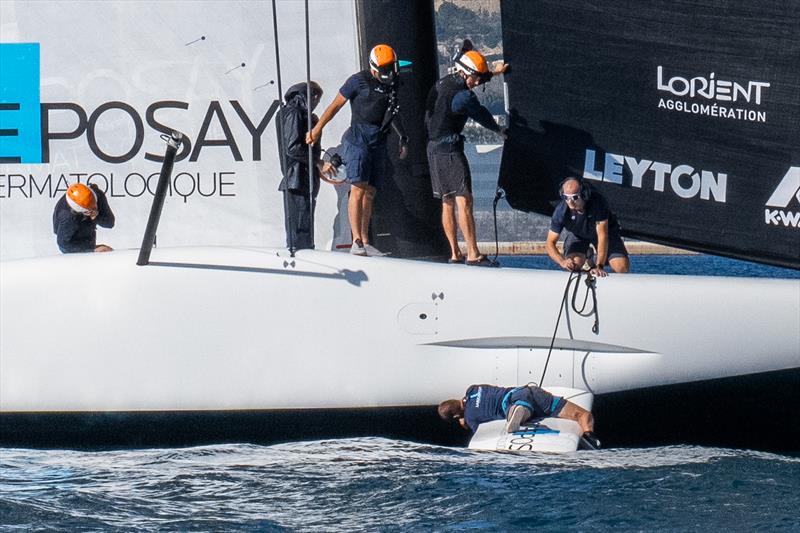
La Roche-Posay Racing Team - Day 15 - October 26, 2026 - Auckland, NZ © Pierre Bouras / America's Cup
La Roche-Posay Racing Team caught what appeared to be fishing gear off Naples during a sailing session on Monday.
The sailing session continued after the gear was cleared from the starboard foil. The Recon Unit reported no damage when the AC75 was hauled.
During both Friday's and Monday's sessions, the Recon team covering the French challenger captured interesting shots of the mainsheet system used to control the double-skinned mainsails and individually adjust the two skins, along with the fairing to reduce aero-drag.
Further shots of the mainsail clew area show the degree to which the NZ-aligned design teams are looking to tidy up the aero drag in this area, with some large flaps on each skin coming together at the exit point to smooth air flows.
Emirates Team New Zealand's mainsheet control system was included in the design package they supplied to the French team, and is a similar concept to that used on the America's Cup champions.
Team Australia, which also purchased a design package from Emirates Team New Zealand, is expected to run a similar control system on its modified AC75, purchased from the Kiwis, who successfully defended the America's Cup in March 2021.
La Roche-Posay Racing Team - Sailing Day 15, Oct 26, 2026 - Naples, Italy
Crew List:
- Port Helm: Diego Botin (ESP)
- Starboard Helm: Quentin Delapierre (FRA)
- Port Trimmer/Flight Control: Jason Saunders (NZL)
- Starboard Trimmer/Flight Control: Florian Trittel (ESP)
- Strategist: Maelenn Lemaitre (FRA)
- P6: Guillaud (Sail Design), Pajusco (Performance Analysts & AI)
Wind & Sea Conditions:
- Summary: Sunny with high cloud
- Wind: Light to moderate and gusty, ~7 kt mean early in the session, building further offshore in the sailing area to ~14 kt mean with gusts to ~18 kt around ~15:45, easing to ~9 kt mean, gusts ~11 kt, towards the end
- Shifted from 030° - 80° over day
- Sea State: Small residual swell
- Dock Out: 1241hrs
- Dock In: 1654hrs
- Time sailed: 1hr 54 minutes
- Started sailing: 1316hrs. End 1629hrs. 7 runs sailed
- Incident: Caught fishing net on foil on Run 2. Fixed and continued sailing.
Recon Unit Report: La Roche-Posay Racing Team - Sailing Day 15, Oct 26, 2026 - Naples, Italy
La Roche-Posay Racing Team sailed B1 from the Bagnoli base on a sunny day in an offshore north-easterly breeze that was shifty in both strength and direction. This was the first time the team was observed sailing the AC75 in such shifty and gusty conditions.
The boat rolled out of the shed at 10:43 with no apparent change. Once the mast was stepped, systems checks started with the boat still on its trailer, and the mast rake angle appeared to be measured closely with a conventional tool, after a digital measurement had been seen on the previous observed day.
B1 was launched at 11:29hrs. During the sailors' dockside checks, the port foil appeared reluctant to cant back down after being raised. Some batteries also appeared to be taken back ashore from the dock before B1 docked out at 12:41hrs.
MN3-1 and J4-3 were hoisted just outside the marina, then the team sailed in the Golfo di Pozzuoli, southwest of Nisida and out toward Capo Miseno. Two short runs followed, with ride height and pitch appearing unstable in the shifting breeze, and the boat often pitched bow up. Run 2 ended in a sudden, unexpected touchdown while sailing upwind on port.
After stopping, a starboard-side sailor looked out at the starboard foil, and the technical crew boarded; the photos later showed a rope caught on the starboard foil, possibly from fishing gear such as a net or a pot line, wrapped around the foil arm up to the FCS junction at the hull. In Run 3 the team mixed long straight lines with what appeared to be windward leeward work, and ended on a touchdown gybe.
The jib was then changed to J3-3, the first time this jib has been observed. Just before run 4, the second chase boat appeared to bring out the batteries seen leaving the dock earlier and transfer them to the main chase boat as B1 prepared to sail, suggesting they had been left ashore to charge, possibly because they hadn't been put on charge beforehand. Runs 4 and 5 followed a windward-leeward pattern, and Timothé Lapauw boarded from the chase boat after run 4 to brief the crew.
With the breeze building, J4-3 went back up after Run 5, together with a battery change and a guest change. Run 6 was a single upwind leg going closer to shore on starboard with sudden, marked mode changes. Run 7, closer to Nisida where the breeze appeared softer and J4-3 possibly small for the conditions, included several touchdowns and a long stretch in displacement mode upwind on port after a touchdown tack.
Pitch and ride height appeared to settle through the middle of the session, further from the coast where the breeze looked steadier, before the difficulty returned late in the session closer to the shore, with touchdowns on bear aways and on manoeuvre exits. Overall, the session appeared focused on long straight lines with the new J3-3 and on sail trim and manoeuvre settings in gusty, shifting breeze.
Finding enough power for take-off and manoeuvre exits, then depowering quickly as the boat accelerates, would be harder still when wind strength and direction change constantly, and the team appeared to struggle at times to change gear with each gust and shift, especially when sailing close to shore. The sudden mode changes on run 6 and the repeated manoeuvres suggest the team was testing and adjusting presets in these conditions, both for manoeuvre sequences and for straight line sail and foil trim.
A possible reading of the day is that the team was calibrating these presets for a variable breeze, as settings tuned in steadier conditions would only fit part of each leg in breeze like today's. On the long upwind of run 6 in particular, the changes would be consistent with modes being selected in turn rather than the boat being steered progressively, and the guest change for the last two runs, bringing a performance and AI engineer aboard, would fit data collection for this work.
Total sailing time was 1h54 over seven self-started runs between 13:16 and 16:29. B1 docked in at 16:54 and was back in the shed at 17:49.
In the interview, Lapauw described his role as a spare trimmer working across the performance, mechanical and sailing teams, and said his briefings between runs covered sail shapes and the choreography of manoeuvres, which would be consistent with our guess of the team working today on boat handling and manoeuvres through presets and system control in gusty conditions.
He said the team had been surprised in a good way by the energy use, the battery allowance appearing sufficient for sail trimming, so that the focus had moved more onto areas such as the FCS.
La Roche-Posay Racing Team - Sailing Day 14, Oct 23, 2026 - Naples, Italy
Crew List:
- Port Helm: Diego Botin (ESP)
- Starboard Helm: Quentin Delapierre (FRA)
- Port Trimmer/Flight Control: Jason Saunders (NZL)
- Starboard Trimmer/Flight Control: Florian Trittel (ESP)
- Strategist: Maelenn Lemaitre (FRA)
- P6: Quentin Abeille (Sail Design) and an Electrical Engineer
Wind & Sea Conditions:
- Summary: Sunny with high cloud
- Light, 3 - 8 kt, 7 to 8 kt; 15:00 - 16:00; easing after 16:30
- SW 225°
- Sea State: Small swell
- Dock Out: 1241hrs
- Dock In: 1654hrs
- Time sailed: 1hr 47 minutes
- Started sailing: 1313hrs. End 1704hrs.
- Configuration: Using same foils, sails mast as previous session.
Recon Unit Report: La Roche-Posay Racing Team - Sailing Day 14, Oct 23, 2026 - Naples, Italy
La Roche-Posay Racing Team sailed B1 for a full afternoon session in light, marginal foiling conditions, a south-westerly breeze of around 3 to 8 kt over a small but pronounced residual swell, possibly left over from the unsettled weather of the previous days. The session was sailed south and south-east of Nisida, off Posillipo and out towards the middle of the Bay of Naples.
The mast had rolled out earlier in the morning with no apparent change and was raised vertical; the boat rolled out at 11:21, apparently with some delay. The mast was stepped, and the boat was craned in around 11:50.
It was noticed that the white fairings on each corner of the mainsheet traveller opening, fitted in Lorient, have appeared absent on every observed day in Naples, and the blue sticker on the starboard side of the rudder blade, seen peeling off on the two previous observed days, appeared to have been removed completely.
After the usual routine system checks, the boat docked out at 12:31.
The crew appeared more and more efficient on rigging as the sailing days pass, with, as on D16, the mainsail head already engaged in the mast track ready to hoist while leaving the marina. MN3-1 was hoisted, then J2-1, and sail designer Quentin Abeille boarded the starboard aft guest pod.
The lineup appeared to be Trittel, Delapierre and Abeille on starboard, and Saunders, Botín and Lemaitre on port.
B1 sailed from 13:13 to 17:04 for a total sailing time of 1h47 over ten runs and one failed attempt, all started from a bow tow except Run 3, which was self-started. The breeze appeared patchy and unstable, and the boat appeared to struggle to stay on the foils, more than in comparable light air in Lorient, although the light air days in Lorient had a flat sea state and the tide might have helped; many spots in the Mediterranean are also likely to see eddies off the coastal mountains, which can make the wind inconsistent.
Several manoeuvres ended in long touchdowns, notably the first gybe and a tack in Run 1, and the touchdown tacks in Runs 5 and 7 were followed by long stretches in displacement mode.
The session appeared made of long straight lines with mode variations; no windward leeward laps were sailed, possibly because of the light breeze. The crew appeared to make large sail trim adjustments and large mode and angle changes to keep foiling, and many times the boat appeared to end up close to a reach, very heeled to windward, just enough to keep the pressure on for foiling.
After Run 2, technicians boarded and appeared to work again in the traveller area, this time around the mainsheet and sheeting angle system on the traveller car, applying adhesive tape. The batteries appeared to be changed after Run 4.
Around 15:54, between Runs 6 and 7, an electrical engineer replaced Abeille in the guest pod.
After Run 7 the boat was bow towed west towards Nisida, possibly in search of more breeze, then back towards the bay; released on downwind port at 16:29, it touched down immediately, after which the sailors appeared to look at the mainsail clew and traveller area again. Runs 9 to 11 followed in very light air, Run 9 being observed from a distance only. After a last tow it seemed the team decided to cancel the release and head back to the base.
The jib and mainsail were dropped in front of the marina around 17:25. Dock in 17:39. The boat was back in the shed at 18:30.
On trim, in the lightest upwind phases the mainsheet traveller appeared carried fully up to just hold the boat on the foils, with the lower leech sitting way above the boat centreline while still keeping some twist up to the main head.
In the post-session interview, Abeille, on board an AC75 for the first time, said the guest pod let him see the details of the sails and look at them from the sailors' position, and said he was on board for sail design rather than for the traveller, which he described as an input for the sail designers.
He said MN3-1, smaller than MN2-1, required a broader range of trims, the traveller positions reflecting this as well as what was learned in Lorient, and that the aim was to use it across a wide range of conditions, mainsail changes being difficult on these boats. He said the team had been happy with it in most conditions so far, trickier in light air given its size, and that the hardest part was moving through the trim range, from a powerful sail out of the manoeuvres to straight line speed, which also costs energy.