
Four AC75 designers talk about the nuances of chasing design and speed gains.
by Emirates Team NZ 24 Oct 17:30 PDT
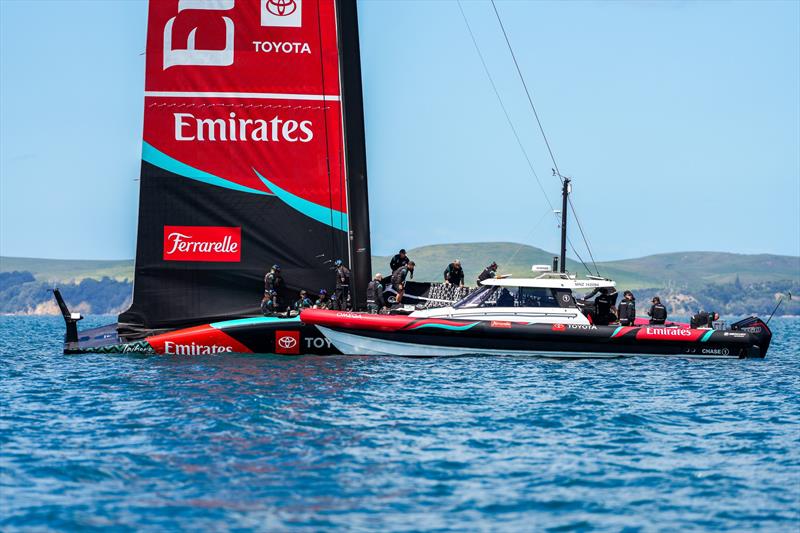
Design, Engineering and Shore teams work with the Sailing team during a test session - Emirates Team NZ - October 20, 2026 - Auckland © Sam Thom / America's Cup Recon
Four Emirates Team New Zealand designers talk about various aspects of developing the repurposed AC75 - and finding the significant seconds.
As technology continues to advance at an accelerating pace, part of the multi-discipline America's Cup design team's role is to selectively adapt that capability to the current AC75 design thinking and objectives.
Unlike previous Cups, the teams are restricted on the number of test sailing days available - meaning that every day is valuable. Getting tests to work on the water is now vital, rather than cancelling the session and scheduling an overnight fix at the team base.
"We're down to about looking for a 10th of a second per race in AC 38," explains Design Chief Dan Bernasconi. That chase is maybe more intense given that in the 2027 Cup the teams have to use a hull, or hull shape, that was used in the 2024 or 2021 America's Cup. "That doesn't mean any less work for designers, "Bernasconi continued. "The areas that do have a huge impact are the foils, the rudder, the sails, and the control systems, and that's what will be the differentiator in AC 38."
"We might start the campaign with a huge list of ideas that might have come from the design team, the sailing team or the shore crew. "We collect all of those ideas and sit down as a group and work out which one of those we think actually has some potential," explains Dave Olsen, a Structural Engineer for ETNZ. "We just don't have time or resources to explore all of them. So we've got to work through those ideas and just figure out what's actually going to produce the performance that we need to take the next step on for this time."
"That's very much a sort of brainstorming approach, where as a design team sit in the room, sketch ideas on a whiteboard, start looking at simple 3D models on CAD, and eventually sort of whittle it down," says Bernasconi. "Sometimes we build prototypes, which get tested in the shed or get put on the boat and tested."
The AC75 is governed by the current version of the Class rule, which has changed significantly from the 2021 and 2024 America's Cups, where some features legal in the two earlier cycles are not permitted in the 2027 America's Cup in Naples. A good example is the pressurising of hydraulic systems: in 2021, only arms/grinders were permitted; in 2024, arms or cyclors were permitted; and in 2027, the AC75s will use only battery power, and the cyclors/grinders have gone along with their associated hardware. The three generations of AC75 have seen a substantial all-up weight reduction, which opens up numerous opportunities. The crew reductions mean more has to be done with less, opening the door to increased use of mechatronics, which are also restricted. Also restricted is the available battery power - the application of which has to be mimicked to the same level of power that would have previously been produced by a manually powered team.
So unlimited mainsail pumping, for instance, possible with unlimited battery power, is restricted to the extent that would be possible with manually pressurised hydraulic systems.
"You got to think about difficulty, the actual gain you get, how much it's going to cost, and the rule," explains Martin McElwee ETNZ's Mechanical Engineer. "There might be some things that think,"Oh, that'd be a great idea, and then you look at the rule and oh, you're not allowed to do that"."
The level of design refinement, and the individual gains are so infinitesimal that the designers and sailing crew have had to rely heavily on computer assessment to say which is the faster, or better, and accept that verdict. Of course, the small differences all accumulate into a significant total margin produced by the whole package of sails, wingfoils, rudders, and electronics.
In monohull days, the design teams would happily chase a gain of 1/10th of a knot, and be confident that they had the gain in the boatspeed bag. But with the foiling boats that has all changed.
"If we had an idea which gave us a one second per race, that was really significant," explains Bernasconi. "When we're looking at design changes that might give us one or two seconds per race, that's realistically not something that the sailors are going to pick up on in terms of a feel, and it's not even something we can pick up in the data."
"We're going three or four times the wind speed, and if the wind picks up by 1kt, the boat speed will pick up by 3-4kts. We can't measure the wind speed accurately enough at all heights to really know exactly how much fuel is going into the engine, so we can't measure the performance differences directly. We have to rely on the computer simulation to actually say whether one foil is better than another, or one sail is better than another."
For the full interview:
Part 1, of Inside the Shed was broadcast two weeks ago and can be viewed here:
.