America's Cup Recon: French turn on the nav lights in Naples
by Richard Gladwell, Sail-World NZ 2 Nov 22:56 GMT
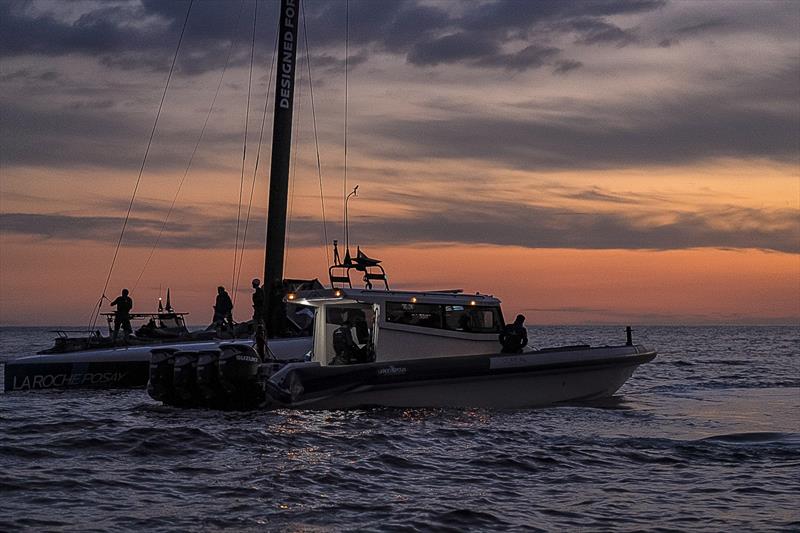
La Roche-Posay Racing Team - Day 17 - October 30, 2026 - Naples, Italy © Pierre Bouras / America's Cup
After a rig setup session, on the previous day, Thursday, La Roche-Posay Racing Team took to the Golfo di Napoli, late on Friday, before a contrary breeze became established.
Just over 90 minutes of sailing was achieved in light winds - which is still a counter against their quota of 55 days. The French team are up to Sailing Day 17, with little chance of burning through their quota.
However, the breeze came right as daylight began to fade, switching 180° to the NE and freshening to 11-13kts, enabling the French to get 28minutes of sailing time, hitting speeds of 41kts - which maybe answered some of their questions following the rig measurement and setup session on the previous day.
Three teams are now located in their Naples bases, only one of which is sailing. They will be hoping for better days than the French enjoyed on Friday - with light winds requiring a start on each of the five runs, and with the team being forced to finish their session in near darkness, with the street lights glowing ashore and the chase boat navigation lights on the water.
La Roche-Posay Racing Team - Sailing Day 17, October 30, 2026 – Naples, Italy
Weather Conditions:
- Summary: Sunny
- Wind: PM gusting 6-8kts increasing to 15-16kts
- Shifted from 255° - 265° initially and then 20° - 30°
- Sea State: Flat
Crew List:
- Port Helm: Diego Botin (ESP)
- Starboard Helm: Quentin Delapierre (FRA)
- Trimmer/Flight Control: Jason Saunders (NZL)
- Trimmer/Flight Control: Florian Trittel (ESP)
- Position 5: Maelenn Lemaitre (FRA) Position 6: Thibaut Campas (Electronics Engineer)
Session Stats:
- Time Sailed: 1hrs 55mins
- Started sailing: 1516hrs End 1711hrs. 5 runs sailed – 5 tow starts
- Tacks: 9; Fully Foiling - 6; Touch & Go: 3 ; Touch Down: 0
- Gybes: 9; Fully Foiling - 5; Touch & Go: 3; Touch Down: 1
Recon Unit Report:
La Roche-Posay Racing Team sailed B1 off Naples for a short late Friday afternoon session, on the day after the D20 rig tune.
The morning was sunny with a blue sky and no wind. While the mast was still lying down after roll out, Thibaut Campas, an electronics engineer who had been on deck through the D19 and D20 mast steppings, appeared to check the yellow fibre optic lines at the top of the cap shrouds, at the mast fitting, before moving on to work around the mast step.
B1 rolled out of the shed at 11:36. The protective film seen on the foils on D20 had been removed, and the white marks on the outer wing leading edges, three on port and two on starboard, were still present. New today, lighter matte patches appeared on the upper surface of the elevator, on both semi-wings near the root, which would be consistent with local sanding.
As on D19 and D20, the mast stepping appeared to take longer than on a usual sailing day. Once the forestay was tensioned, the usual control system checks ran with the mast rotated to each side, and the mast rake was measured with a digital inclinometer, the stabilised reading being 85.4. B1 was then lifted and launched. MN3-1 was loaded on board, with J2-1 and J3-3 on the chase boat.
A long wait followed at the dock in very light air, a light south westerly sea breeze filling in from around midday under a few patchy clouds. B1 docked out at 14:38. B1 was briefly towed on the foils outside the marina, then J2-1 and MN3-1 were hoisted just west of Nisida, Campas getting ready to board as the day's guest in the starboard aft pod. Run 1 followed a long bow tow on the foils to the east, released at 15:16 downwind on port, B1 bearing up onto port upwind before stopping around two minutes later.
Run 2 was sailed upwind on starboard off Posillipo in a south westerly of around 6 to 8 kt, with two fully foiling tacks. The breeze then died to under 2 kt from around 15:30. Two further tows followed, the second heading west of Nisida, apparently looking for wind, before turning back east toward the Bay of Naples.
Both were released with the windward foil not fully raised and the boat not set up to foil under sail, B1 settling back immediately, so that neither looked like a sailing attempt. During the wait that followed, Timothé Lapauw, Antoine Rucard and technicians went aboard.
A north easterly of around 11 to 13 kt then filled into the Bay of Naples off Posillipo from around 16:30. Run 5 started from a bow tow, released upwind on port, and B1 stayed in the breeze close to the shore for around 28 minutes of upwinds and downwinds, with 7 tacks (4 fully foiling, 3 touch and go) and 9 gybes (5 fully foiling, 3 touch and go, 1 touch down), reaching around 41 kt downwind on the RIB track.
The sun set around 17:00, so the last minutes were sailed at full speed in failing light, the run ending downwind on starboard at 17:11. Sailing ran from 15:16 to 17:11, for a total sailing time of 37 minutes. The sails were dropped in full darkness, and B1 was towed back, docked in at 17:50 and was back in the shed at 18:39.
In the interview, Campas said the session was stopped because it was late and the crew were tired. He described his role as covering all the electronics on the boat, and said that from the guest pod he mainly felt the boat rather than saw anything new, having to lean out to see the starboard foil. He confirmed that load cell values at the top of the mast had been read during the previous day's rig tune.
With little sailing time and no drills apparent, the session appeared mainly aimed at making the most of the late breeze. Coming after two days of rig work built around load tension measurements on the cap shrouds, the presence aboard of the electronics engineer involved in that work would be consistent with checking, under sailing load, what had been set up or calibrated, possibly relating shroud loads to the fibre optic lines or other rig sensors.
The jib choice may tie in with this. No J1 has been seen on any observed day, and the team has tended to choose the smaller of the plausible jibs, J3-3 in very light air on D19 and J4-3 on D18 as the breeze softened, with J2-1 and J3-3 taken today.
This would be consistent with a commissioning approach, which the team may still be in after all, keeping sail and rig loads on the conservative side while the rig loads and systems are still being characterised, rather than pushing the boat to its full potential yet.
Recon Unit Report - October 29, 2026 - Naples:
La Roche-Posay Racing Team rolled B1 out at the Bagnoli base for what the team had notified as a rig tune session, with no sailing planned. It was sunny under high pressure, with a light sea breeze from the south west filling in the early afternoon. The mast rolled out around 12:00 with a load cell fitted at each cap shroud to mast fitting, and B1 rolled out of the shed at 12:15. Both foils appeared covered in a plastic protective film from the white to black paint delimitation on the foil arm down to roughly half of each outer wing, the bulb shaped cameras on both foil arms left uncovered. The starboard new design tip was fully taped, while the outer port legacy winglet tip was left bare with only its flap taped. Two white marks were visible on the uncovered part of the starboard outer wing and three on the port, the protection appearing consistent with paint work, possibly to apply these marks.
The mast stepping took longer than on a sailing day and appeared to continue the rig set up seen during the previous day's mast stepping. On each cap shroud, the usual link at the mast fitting appeared replaced by an in-line load cell with a cabled handheld display, the signal cable coiled below. Once the mast was stepped with all shrouds fitted and the forestay only partly tensioned, a shore crew member was hoisted to the cap shroud fittings and stayed up the mast for most of the session; the reason he was sent up was to do the mast load readings from the display connected to the load cell through a cable. Only the cap shrouds appeared loaded, the lower shrouds staying soft throughout, and the mast sat with more rake than usual. At around 13:00, up the mast, he held both displays, which read 6860 on the port cap shroud and 6752 on the starboard (unit not legible, most plausibly kg). Antoine Carraz, Antoine Rucard, the team member responsible for camera installation and the shore crew spent long periods around the mast step, crouched over laptops, and Quentin Delapierre joined the discussion on deck at some point. The forestay was later eased off with the mast held on the jib halyard, the rigger came down and the mast was unstepped, B1 returning to the shed at 14:46, later than the ~14:00 roll in the team had notified.
Taken with the previous day, when the lower shrouds were removed and refitted and the rake was measured repeatedly, the session appeared aimed at characterising the rig, the rig tune having been notified the evening after that stepping. Loading the cap shrouds alone, with the lowers soft and the forestay first partly tensioned, would give a simple load path and several load cases. This would be consistent with calibrating the rig load monitoring, possibly the fibre optic lines running along the cap and lower shrouds since the first observed days in Lorient, against reference load cells. The camera specialist's involvement on both days would suggest these loads were also being related to camera or sensor readings of the mast rake, bend or position in space. Such a link between rig loads, mast geometry and sail shape would be a key input to the sail development seen on recent days, when sail designers sailed as guests, and possibly to sail trim presets or automated control sequences tuned to how the rig responds. The white marks on the outer wings could likewise serve as visual references for the bulb shaped cameras on the foil arms, possibly to follow wing deflection under load.