
America's Cup Exclusive: All is not Quiet on the Western Front – Part 1
by Richard Gladwell Sail-World NZ 24 Sep 19:43 HKT
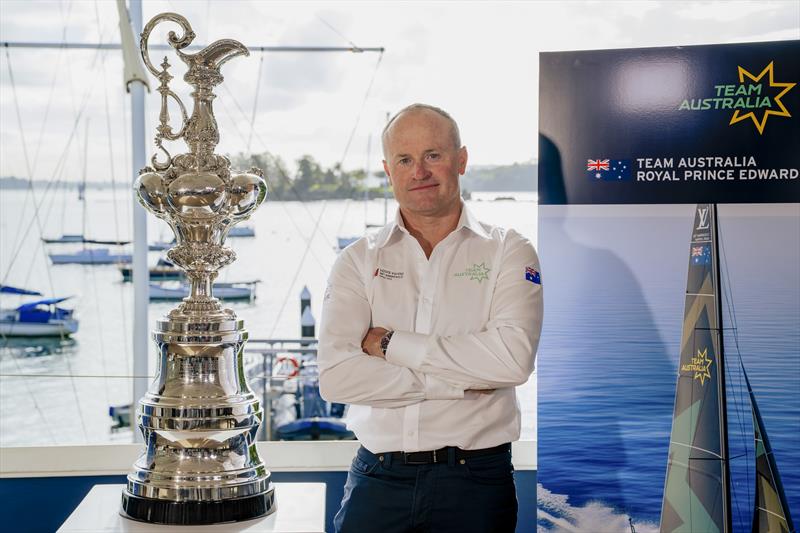
Glenn Ashby - Head of Performance & Design - Team Australia - Royal Prince Edward YC - May 14, 2026 © Team Australia
Currently, three of the seven America's Cup teams are sailing AC75s, while the other four are in various stages of rebuild.
Over on the Western Island (Australia, if you are a Kiwi), the Australian team is coming together, and unusually for the Aussies, without a lot of fanfare.
Three-time America's Cup winner, Glenn Ashby is the Head of Performance and Design for the new team which will represent Sydney's Royal Prince Edward Yacht Club. Next month he will be inducted into the America's Cup Hall of Fame at a ceremony in the Model Room of the New York Yacht Club.
Ashby is part of a Cup team that spans both sides of the Tasman Sea.
Team Australia has an operational base in Sydney, but their AC75 is being repurposed in Auckland as part of a partnership with current America's Cup champions and Ashby's old team, Emirates Team New Zealand.
The two components of Team Australia will come together at the America's Cup venue of Naples, in the first quarter of next year.
"We're launching in Naples. There's really no secrets around that," Ashby explains. "We're shipping the boat directly from New Zealand straight to Naples."
"The official first day of sailing will be around March 1."
Ahead of that date, the 2021 America's Cup-winning AC75 will be splashed in Naples for a week of dock and systems testing.
"We're not hiding the fact that we're getting over there pretty late. But that's hitting the target when we can."
That time frame leaves just under 12 weeks (83 calendar days) between the Australians' first sail and first race of the 38th America's Cup, which is the third Preliminary Regatta, sailed in AC75s.
"It's a really tight time frame to get everything commissioned and get the sailing team up to speed - which is the biggest task."
"We will do quite a bit of commissioning work in New Zealand, and liven the boat up by putting oil through all the rams and all the systems, and check everything before we ship the boat.
"There's a lot of systems calibration we'll tick off in Auckland, but there'll still be plenty to do in Naples".
"We won't be able to put the rig in the boat until we get to Italy - so there'll be a lot of tasks and tests revolving around that. It's basically going to be a massively compressed schedule for us. But we've got great people and have put the right sort of program together."
"It's going to be a scramble, but we think we're going to get there in good shape."
Big changes to the AC75
Repurposing the 2021 America's Cup winner to be a competitive boat six years later is no simple task. However, all seven teams must go through a similar process, which at its simplest involves making the boat lighter and replacing all manually powered systems with battery power. The deck layout is also rearranged to reduce the cockpits from eight down to six.
The repurposing process also involves stripping the interior from the AC75, aside from the structural framing, and doing the same in the working areas of the deck, then installing a completely new electronic and hydraulic package. These third-generation AC75s have no control lines, sheets, winches, or grinding/cycling stations.
Everything is controlled by a combination of various trigger devices, hydraulic rams and mechatronics - with the whole orchestra capable of performing multiple pre-set operations from a single trigger action by the crew.
"We end up pretty much with just a bare shell inside the boat. We've put a new bow on the boat (to comply with America's Cup constructed-in-country rules). So that's old bow cut off, new bow on."
"We've removed a lot of the runner structure in the back corners of the boat to take out some weight.
"Obviously, the cockpit modifications have had to be done as well to meet the new rules with the cockpit openings. Effectively, the boat starts off as a bare shell.
"We're just going through the paint process now, and all the electronics and hydraulic dry fit has happened over the last couple of weeks.
"What is now just a bare shell will get turned into a class-legal AC75 over the next three months. It's a busy program with a lot of people involved for sure."
"It's multiple departments: electronics, hydraulics, composite, paint, engineering, structures. There're probably six or seven different departments all putting effort in at the same time to get the boat up to a position where it can get measured and then put on the ship."
While Ashby is coy about confirming the hours, he says we'd be "somewhere reasonably close" with our estimate (by others) of 20,000 hours, or 10 man-years for the rebuild.
Joint design/build program with the Kiwis
When he talks about "multiple departments", Ashby's referring to a joint team comprising the in-house Emirates Team NZ build team based in Auckland, along with the Sydney-based Australian team members. The Kiwi team have built all three of their team's AC75s and performed the repurposing for the 2027 Cup of their 2024 Cup winner.
"We've been reliant on the Team New Zealand structures and composite guys. We've sent some of our guys over to Auckland, but they've got an operation set up over there, and were happy to do a lot of the modifications because they know the boat well, as do I from the 2021 Cup win."
"We've got a lot of our electronics, mechatronics, and hydraulics guys working on the internals of the boat. It's the mechatronic side of things - all the hydraulics, the systems, computers and batteries that are all going down inside the boat-that really makes the AC75 what it is.
"We've certainly had a collaborative approach with that, with some of the Team New Zealand guys and some of our guys working closely together on that design package, to get it all happening for later in the year."
Compared to the French La Roche-Posay team, who also have a partnership with Team New Zealand going back to the 2024 America's Cup, Ashby says the Australian relationship has been "more hands-on with the structural side of things because we've got the boat in their build facility compared to the French team building a copy of their Boat #3 over in Europe a few years ago."
"A lot of our guys are fully immersed in our boat, and that relationship is massively important. We know that we need to put our team together, and they need to know the boat extremely well.
"There's definitely a lot of communication back and forth at the moment to make sure that comes together well."
While many are quick to dismiss the 2021 America's Cup winner as too old to be competitive, the Australian Challenger some exemptions from the budget cap rules restricting design and construction, because of its 2020 launch date.
The external hull form can be altered to a limited amount (which the Australians are doing). Their main advantage over the other teams is that they don't have to use legacy sails or a mast. (The French are the only other team allowed a new mast for the 2027 Cup.)
"You are allowed to build new sails, build a new mast, and that sort of thing if you are using a 2021 Cup boat. As a team, we're starting with a shell and then actually putting a lot of new gear in. We can reuse some of the hydraulic rams and other parts, but many of the systems we're installing are new.
The boat's been designed around certain systems. A lot of those systems are being replaced with new, very similar systems allowed under the latest rules."
"We didn't get a mast with the boat. We literally just bought the platform," he explains.
"Southern are actually in build at the moment, on our new spar."
"Once the boat goes on the water, it should be as good as a new one, effectively."
"It's going to be turned into a very competitive nice package going forward."
"Seeing that boat back on the water again after being successful in 2021 will be a great story."
Future of the Cup under discussion
Looking forward, Ashby says he "is part of the technical group that's looking to the future with the America's Cup. A lot of those discussions are happening now for AC39 and AC40."
Like Team Australia, four teams are starting late on their 2027 America's Cup campaigns. With the certainty the fledgling America's Cup Partnership is expected to bring, some 2024 Cup teams openly admit they face a tight timeline for 2027, and their focus is really on the 2029 Cup, expected to be held again in Naples.
Ashby denies the Australian team are more focused on the 2029 paradigm.
"We're 100% focused on 2027," he replies. "My 100% focus is on next year and making sure that we're absolutely successful there."
"It's always nice to think about the future, but really, my focus, and the team's focus at the moment, is fully on Naples next year."
Asked if he believed the team could get themselves and the AC75 race-ready for a knock-out series in just under 12 weeks of sailing time, Ashby said: "I don't think there'd be too many sailing teams or shore teams that could do it."
"But I think we've assembled a pretty good squad. It's a big ask. Looking at the sailing team and the shore team that we're putting together - if there's any group of people that can do it, I think that's it's them."
Of the sailing squad announced by Team Australia, four of them are past America's Cup winners. Three of the squad sailed together on Oracle Racing in the 2013 comeback win in San Francisco.
Ashby sailed with Team New Zealand in their winning 2017 and 2021 America's Cup campaigns. He denies they have made any decisions about who will sail where, but the obvious conclusion is that this highly credentialed group will form the core of the Australian AC75 sailing squad.
Others named are active on the SailGP circuit and will be factored into Australia's crew selection process. From the experience with injuries in SailGP and the last America's Cup, the squad needs depth and breadth - of which it has plenty.
Once the AC75 is launched in Naples, Ashby describes the Australian program as "fairly intensive".
"Reliability is going to be a really big focus of ours, when we do launch, and obviously we're going to be on a near-vertical learning curve."
He says they are not unexpectedly "doing a lot of simulator work and spending a lot of time pre-launch talking about systems. There's training camps towards the end of the year, just on the operating systems of the AC75, before we get over to Naples."
"The sailing team are obviously spending a lot of time together already and doing a lot of camps. I think our focus, once we launch the boat, will be getting the sailing team familiar with how the boat actually feels. And then, quite quickly, we're hoping to be able to go straight into race training."
The AC75s are now effectively into their Third Generation. "It's not like you're launching a brand new class. There's a lot of knowledge that's already there as a base."
"Collectively we can pool our knowledge, and it's almost the perfect time to come in, because a lot of the hard work has already been done. Now we can sort out what works and what doesn't.
"We know where the pointy end of the spear lies a bit more clearly than is the case, for example, when you're launching a new class."
He says reliability is a focus to avoid downtime during the commissioning process.
"It's how we react as a team in those first two or three weeks on the water that will probably dictate our early results when we start racing."
Looking at changes in the 2027 Cup racing tactics
The former Emirates Team NZ wingsail trimmer is still recovering from a leg injury suffered in Bermuda in early May when he was a super-sub for the French SailGP team. Despite the injured leg he is still travelling to New Zealand to check on the boat's progress. He is using the enforced layoff to rest, after undergoing two operations,. The downtime gives him plenty of time to plan and review reconnaissance footage from the three teams sailing AC75s.
Of his competition, Ashby says, "The bar is obviously extremely high. "We're under no illusion that we need to get to that level really quickly. I think that it's now a real refinement game of not only the boats, but I think of the racing and the tactics."
He expected pre-start techniques to play a much more significant part in the 2027 Cup than in 2024.
"The teams are going to be trying to pull off some wild manoeuvres in the pre-start, to potentially get their opponents on the back foot. I think the biggest thing that we're going to see in the next Cup is a difference in the pre-start - with more aggressive boat handling - compared to what we've seen in past Cups."
"With the boats now having new foils and being quite a lot lighter than they have been in earlier Cups it opens a few doorways. [The 2027 AC75s are 1400kgs lighter than the 2021 version and 500ks lighter than the 2024 generation.] I think it opens a few doors," he adds.
"We now have extra glide and extra controllability over the boat. In that sense, it will open up new manoeuvres that previously weren't possible.
"How a team can utilise that opportunity will depend on how they set up their systems and the AC75, and how brave the sailing team are to actually push the limits of what the boats can actually do."
"To me, I think is probably where we'll see the biggest difference in Cup racing going forward compared to Barcelona."
While the Australian team won't be sailing until March, they can run their AC75, in its new configuration, through their simulator, get their crew up to speed, and check sailing routines.
"Obviously, the weight reduction is probably the biggest change and also having a different power source - being batteries versus cyclors - brings a slightly different power management program, compared to human power."
"You can run your hydraulic models through the simulator as well as your power management, all those sorts of things, which we'll be looking at over the next two or three months."
Ashby explains that they learn a lot from watching near daily Recon videos of competitors who are sailing in Italy, France and Auckland. "You can really see what the teams can do. Ultimately, it helps us fast-track, as well, because we know that if they can do something, we should be able to do it as well - within a certain degree."
"We can learn a lot - watching the recon is very interesting."
In Part 2 of this story, we will cover:
- How the team is using AI;
- How the design partnership with Emirates Team NZ works;
- Purchasing an AC40 and running that program into AC75 testing and SailGP;
- The base at Naples and on-the-water assets;
- The sail design program;
- Eventual team size and more.