
America's Cup: Luna Rossa now level pegging with Kiwis
by Richard Gladwell, Sail-World NZ 2 Sep 02:05 PDT
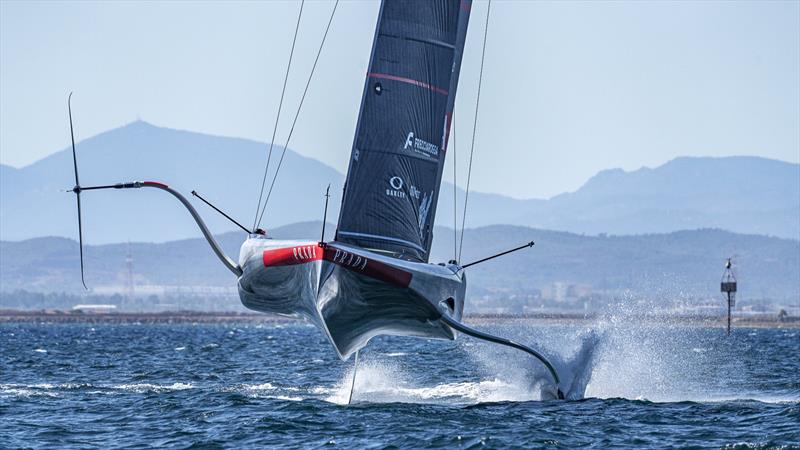
Luna Rossa (ITA) - Day 20 - August 31, 2026 - Cagliari, Sardinia © Ivo Rovira / America's Cup Recon
On Monday, Luna Rossa drew level with Emirates Team New Zealand in terms of days sailed - both now have 20 days of AC75 sailing in their logbooks.
The only other team sailing an AC75 - La Roche-Posay Racing Team (France) is on 10 sailing days, after losing a month following their capsize on July 7, 2026.
The Recon Unit posted their report too late for the first version of this story but has now been added below.
However, they did provide a great interview with Daniel Jowett, a New Zealand instruments and rules engineer, who graduated from the University of Auckland with an MEng (1st Class Honours), where he specialised in yacht aerodynamics.
Jowett had a measurement role in the 2021 America’s Cup in Auckland, before joining Luna Rossa. On Monday, he was one of the design team rotated through Position 6, on the aft starboard side of the AC75.
"It's great to go out with such a long, smooth session", he told the Recon team's, Michele Melis.
"It was really nice. Beautiful day, going through a building sea breeze, through to the other end, the sea breeze dying now. So we've seen everything, and it was great to tick off a whole lot of stuff. Plenty of hours on the water. We're able to cycle through three different members of the design team on board."
Melis, a naval architect, was asked why the team had been performing alignment checks on their AC75. (Alignment checks involve levelling up the AC75 and then checking by measurement that various components are equidistant on each side, or are in their designed position.)
Jowett skipped around the question. "Basically everything's been refined all the time, so we're always looking for incremental gains anywhere we can find them. We're just constantly checking everything, trying to get things better, do things smarter. So there's incremental gains all the way through."
Asked if there was "any particular offset in the boat which needed some correction?" "Nah, we were all pretty happy," Jowett replied.
He was more candid about the evolution of the repurposed AC75 - the same hull that the Italians sailed to third place in the 2024 America's Cup in Barcelona.
"There's plenty of development that has been done. The boat's a big change from Barcelona. Obviously, they are no longer the same boats. They've evolved a lot, but there's plenty more to come."
Asked what the take-outs were from his time observing from the back of the boat, behind skipper Peter Burling and trimmer Vittorio Bissaro.
"The interesting thing for me being a passenger today is just seeing the coordination between the sailing team and the shore team," Jowett replied.
"Everything is super smooth, super precise. We're doing plenty with the boat, throwing around in circles, and everything feels really good and locked in, and we're able to change things fast and develop quickly.
"So overall, it's pretty impressive to see. Hats off to the shore team and to the sailing team to be able to put out days like this, which are really long, hot days.
"It's been a very hot August. We've had many, many days, 40° plus here," he added.
Today, Luna Rossa tried a new mainsail from their legacy sails stock. They also continued with their new rudder, also from their legacy stock. More on this and some of the issues in the Recon team Report below.
Luna Rossa - Sailing Day 20, August 31, 2026 - Cagliari, Sardinia
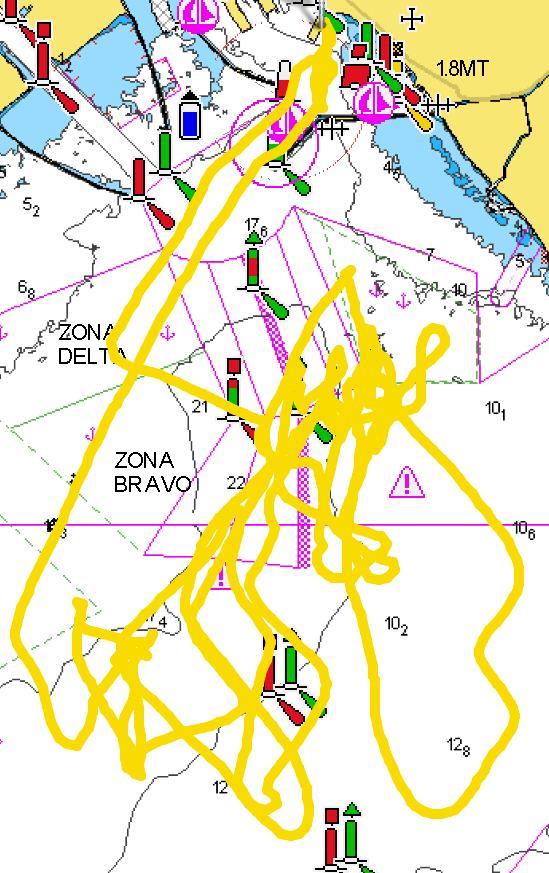
Recon Unit track - Luna Rossa - Sailing Day 20 - August 31, 2026 - Cagliari - photo © Luna Rossa Recon Unit
Crew List:
- Port Helm: Marco Gradoni (ITA)/Ruggero Tita (ITA)
- Starboard Helm: Peter Burling (NZL)
- Port Trimmer: Gigi Ugolini (ITA)
- Starboard Trimmer:Umberto Molinaris(ITA)/ Vittorio Bissaro (ITA)
- P5: Maria Giubilei (Port) P6: Daniel Jowett (NZL) Design team and others (S'bd)
Wind & Sea Conditions:
- Sunny all day 30°C
- Wind: @13:15 4-6kts 165°, @14:05 5-6.5kts 160°, @14:40 8-9kts 175°, @16:05 11-13kts 180°, @17:55 9.5-11kts 180°
- Sea State: Flat
Times and Tacks
- Dock Out: 1230hrs
- Dock In: 1830hrs
- Time sailed: 5hr 40min
- Foiling time: 205mins (3hrs 35mins)
Recon Unit Report: Luna Rossa - Sailing Day 19, August 28, 2026 - Cagliari, Sardinia
For their 20th sailing day, the LR team rolled out the boat at 9:15 and spent six hours on the water. The wings were still equipped with slim camera poles on the pressure sides at mid-span, rudder with its newest iteration, R05-E. At the dock, alignment checks were conducted and quickly wrapped up, as apparently the boat was well aligned without any offsets.
Awaiting for the remaining offshore Maestrale to die off, dockout was postponed to 12:30.
After three weeks of sailing on the legacy M1-8, the team hoisted back on the newest skins, M2-1, at 12:50. Some changes were suspected in terms of area, sheeting system and batten hardware, yet to be confirmed.
In addition to the spreader cameras, a new one was placed on starboard at a third mast height, pointing downwards, while an additional one was placed on the port side at masthead.
Considering the light air filling in the largest jib, J1-1, was paired with the main at 13:02hrs. The starting crew consisted of Marco Gradoni (helm), Gigi Ugolini (trim), and Maria Giubilei (5th) on port, and Peter Burling (helm), Umberto Molineris (trim), and an engineer (6th) on starboard. Later in the day, Ruggero Tita replaced Marco Gradoni, Vittorio Bissaro replaced Umberto Molineris, and several engineers rotated through position 6.
Once the towline was spiked at 13:11hrs, the sea breeze was still quite light, 4–6 kts from 165°, with a flat sea state. As usual, the boat commenced sailing shorter boards, executing some warm-up tacks on the first upwind, with very quick transitions and lower building angles once exiting the manoeuvre and slower board rises.
Targets in VMG mode included significant windward heel, achieved also with windward board cant. After the first bear-aways, the team dug into some light-air gybes, with the breeze not exceeding 5.5 kts on the anemometer held 2 m above the waterline. An additional upwind and downwind followed, unfolding very similarly to the first two, with overall very few touch-and-goes on upwind and downwind manoeuvres. The most noticeable mistake appeared to be a splashdown on the first tack bear-away before planning the first pre-start manoeuvring session in 4.5–6 kt at 175°.
Good consistency in the light air with very few mistakes and controlled catches on gybe exits, managing to stay alive foilborne through sharp turns. Sailing stopped at 13:53.
The sea breeze had increased slightly at 14:06, reaching 5–6.5 kts from 160°, and J1-1 was dropped at 13:55 to hoist the legacy J2-9. The second foiling stint commenced at 14:13 with a self-takeoff, estimated at 16 kts at 80° TWA. The boat sailed upwind and very composed tacks were executed. Occasionally, a crew member was observed sitting up on deck and observing the jib head. As the boat bore away on port tack, it quickly rolled into the first gybe, with bulb-to-bulb times of approximately 6.5 seconds being counted. Manoeuvring appeared successful also in this wind range. On the next roundup, the team conducted the usual bow-up trim modes, loading the rudder for some longer upwind boards.
Later, the team seemed to focus on performance, as the boat was again locked bow-down and endplating the hull on the water. On the next downwind, the boat sailed quite deep on a broad reach on two boards, lost control, and had to restart with a self-takeoff. During the last part of this session, the breeze had risen to 8–9 kts from 170°. The boat practiced some one-board bear-aways and roundups before focusing on pre-start manoeuvring, with a major focus on full circles, managing to execute some of these successfully and exit the manoeuvres sharply without too much deceleration. The boat was stopped at 14:53.
Before the third session began at 15:59, the sea breeze had increased further to 8.5–10 kts from 175°. On the first attempt to self-take off on two boards, the rudder stalled and the boat had to reset. Some longer boards were sailed upwind before executing some tacks and stopping suddenly after the first downwind for a shorter while.
Technicians worked on the jib track while sailors assisted in moving the jib car. Back foilborne shortly after, the boat bore away and sailed a long downwind on two boards before launching another pre-start manoeuvring practice. A series of sharp manoeuvres, including hard roundups, tack bear-aways, double tacks and gybes, were practiced before decelerating at 15:57. Crew rotations took place, and the first new set of batteries was passed onboard.
For the fourth session, sailing resumed at 16:15 and, now with the freshly swapped crew, the team locked in some additional training, beginning with several longer upwind and downwind legs. Compared to the earlier sessions, more touch-and-goes and mistakes were observed in this session. A major mistake while trimming up and stalling the rudder led the boat to splash hullborne with significant bow-up trim, having to resettle completely. Before concluding this session at 16:55hrs, the team had switched to pre-start manoeuvring, looking consistent in medium-range breeze; the major focus appeared to be on double tacks and gybes, alongside the usual full circles.
A second set of batteries for the day was passed onboard for the fifth and last session. The latter began with some additional pre-start manoeuvres before extending towards Sarroch, where the remaining pressure was.
With the breeze now at 9.5–11.5 kts, longer upwind boards were sailed with occasional tacks before bearing away on port tack and heading towards the harbour on a long downwind. The boat stopped just metres from the home base inside the harbour.
The day was called with six hours spent on the water, starting in light air and building into a medium breeze. It was a productive day for the team, with a high success rate in manoeuvring and approximately 205 minutes spent foiling.