
America's Cup Recon: Emirates Team NZ rolls out new wing foils in surprise sail - Update
by Richard Gladwell, Sail-World NZ 8 Jun 20:48 PDT
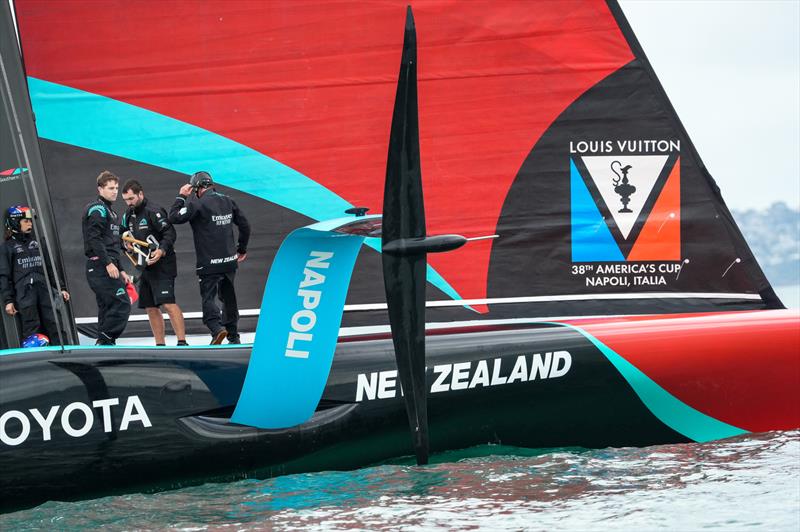
Taihoro - AC75 - Day 14 - America's Cup Recon - Emirates Team New Zealand June 4, 2026 © Sam Thom/America's Cup
Emirates Team New Zealand unexpectedly resumed their AC75 testing and development program on Thursday after returning from the first America's Cup Preliminary Regatta in Cagliari.
The Recon Unit assigned to the team noted that the America's Cup Defenders had declared a new set of wing foils. These are likely to be legacy foils from the 2024 America's Cup, with one being modified and the other retained as a test foil. They are foils that have not been used to date, or since the team began on the water testing on March 13, 2026.
By our count, this was Day 13 of their 2026 sailing Quota in the AC75 - the NZ team is restricted to 45 days in the period to January 15, 2026 - by the current America's Cup Protocol.
The session started well with a useful northerly breeze, overcast skies, and a flattish sea state, but the breeze faded as they moved into the Gulf, resulting in just 90 minutes of sailing.
The team appeared to have a series of issues relating to hydraulics and control systems. These types of issues often arise after the AC75 has been in the shed for a substantial period and are only highlighted during live testing. The Recon unit reported the AC75's outhaul remaining very tight all day, and was not adjusted.
As Jo Aleh noted in her interview, it is now winter in New Zealand, and the breeze is not as reliable as in summer. Also the NZ is just over a fortnight away from the shortest day, and daylight becomes an issue.
Testing Session Summary
Emirates Team NZ unexpectedly sailed their AC75, after having last sailed at the end of April. In the intervening month or so, it is expected that a lot of development work will have been done on the boat, which emerged with two new wingfoils. There were issues below decks which were dealt with several times by the technical team. Several unusual manoeuvres were undertaken which appear to have been wing foils or rudder testing related. However the session was cut short at 1525hrs and the AC75 towed home in little wind.
The session duration was only 90minutes and was very expensive in the context of the allowed 45-day sailing quota.
Crew List:
- Port Helm: Chris Draper (GBR)
- Starboard Helm: Nathan Outteridge (AUS/NZL)
- Port Trimmers: Iain Jensen (AUS)
- Starboard Trimmer: Andy Maloney (NZL)
- Tactician: Jo Aleh (NZL)
Wind & Sea Conditions:
Summary: Overcast winter day.
AM Wind: 010° 8-14kts
PM Wind: 010° 5-6kts
AM Sea State: Choppy with a medium swell
PM Sea State: Choppy with a medium swell
Dock Out: 1056hrs
Dock In: 1600hrs
Time sailed: 90minutes
Key Points:
- New front foil wings
- Long stoppage due to mechanical issue
- Several unusual manoeuvres.
Taihoro rolled out of the shed at 0915hrs with new front foil wings declared as FW7D and FW8C. All available sensors appeared to be attached. Lidar, Pitot tubes, mast and bowsprit sensors and foil cameras. Mast went in at 0930hrs, and the boat was in the water by 0949hrs Aleh, Outteridge, Maloney on Starboard and Draper, Jensen on Port. Foils were tested at 1020hrs and left the dock at 1056hrs.
ETNZ towed out to North Head, hoisting up Main2-0 and Jib3-3 at 1139hrs. Up and foiling at 1145hrs.
Starting in the lee of Rangitoto with a wind of 8-10kts wind at 336°. Once up and foiling, long tacks up the channel in the moderate swell and choppy waters kicked up with the wind against tide. ETNZ spent noticeably longer on port, perhaps to follow the channel and test the foils in a bigger sea state. Wind was slightly stronger, at 12-14kts, further out near Motutapu. Heel remained reasonably steady but with noticeable adjustments to boat pitch fore and aft and considerable depth in the top of the mainsail at times. ETNZ would also ease to a reach and then back up to close-hauled. Whether this was part of testing or to keep in the waviest part of the channel.
After sailing near the end of Motutapu. ETNZ then sailed over to the lee of Whangaparoa. The sea state was considerably flatter here, and the wind was a more settled 10 knots. It was at this point that ETNZ performed several windward board drops and raises of the starboard board only. It was curious that they did not alter course during these board drops, perhaps suggesting that the goal wasn’t to test gliding but was done for other reasons. Possibly to analyse entry and exit of the foil in consistent conditions, or another possibility could be related to the subsequent mechanical failure of the mainsail system. After performing board drop and raises, ETNZ sailed briefly downwind before stopping, ending the first session at 1224hrs.
ETNZ then had lunch and switched to the J2-3. During the lunch break, several technicians went on board and took tools below deck near the mast and main on the port side. Over an hour was spent on this unknown issue.
At 1402hrs, a VIP was loaded on board, and ETNZ towed up in a much lighter 5-7kts of breeze. They performed multiple manoeuvres and noticeably struggled coming out of the gybes. Suggesting the unknown issue could be related to the mainsail or mast hydraulics. After 10 minutes of sailing, ETNZ stopped, made some quick changes, then towed back up onto the foil for another short sail before ending the second session at 1431hrs. At this point, more technicians came back on board, looking both below the deck, next to the mast, port side, and also through the traveller at the back. During this time, the bottom of the main was considerably tight and never eased.
After an hour of trying to solve the issue, rain built over the city and the wind died off. ETNZ ended their day at 1525hrs. Dropping sails and arriving back at the dock at 1600hrs.
Overall, what began as a strong testing session in light wind but high sea state conditions seems to have ended early due to mechanical issues.
Additional Images: