
America's Cup Recon Diary: April 28 - End of the Beginning?
by Richard Gladwell, Sail-World NZ 30 Apr 19:38 HKT
30 April 2026
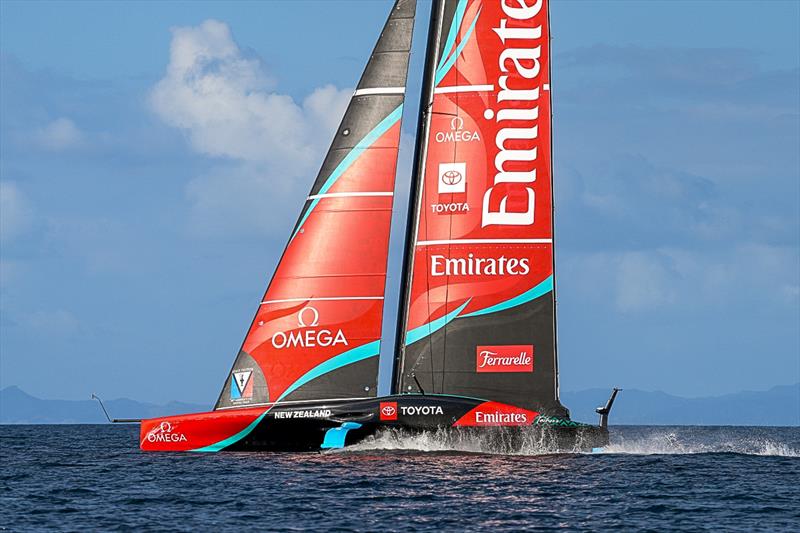
Emirates Team New Zealand - AC75 - Day 13 - August 28, 2026 © Sam Thom / America's Cup
Emirates Team New Zealand continued their second block of testing on Tuesday (Monday being a public holiday in NZ).
They went well into the Outer Hauraki Gulf, beyond Stony Batter, the WWII gun emplacement, on the NE corner of Waiheke Island, chasing a viable breeze for what is possibly their last day of AC75 sailing before the first Preliminary Regatta in Cagliari in three weeks.
While the various AC boats often pass through this area en route from the Hauraki Gulf to The Paddock, off Auckland's eastern beaches, it is an unusual spot for them to train - extending well out into the Hauraki Gulf.
It was in this area that Team NZ nosedived their then-new AC40, twisting the bow to the point of fracture, resulting in internal structural changes. In short, it is not a nice area of water - except on a day like Wednesday, but even so, the seething currents remain.
It was a strange day in Auckland, with much of the inner Hauraki Gulf being glassy until early afternoon, when a seabreeze slowly unfolded, but never amounted to much. The breeze started to retreat as the team towed in after the end of the session.
To underline the oddity of the day, despite brilliant sunshine, there was a lot of haze out to sea and around the peripheries of the course. The Kiwis were fortunate to have found sufficient breeze to maintain foiling - a tribute to their weather forecasting team.
It appears from the video that the angles being sailed were geared toward maintaining foiling and boat speed, rather than necessarily racing angles. However, with the apparent focus on capturing foil performance and flow data alongside accurate water flow/speed data, the day was a good one for low-speed foil and rudder assessment.
It was interesting to see Emirates Team NZ stick with their J3 jib for most of the session. While teams, and Kiwis in particular, always use the minimum jib that they think they can get away with. But it could also be a nod to preserving their inventory to save lighter breeze sails for testing and maybe racing - with all sails - "Legacy" and "New" now being controlled by a strict quota.
The other points of interest were the Legacy Rudder - R5A - from the 2024 campaign. The Recon Unit seems to think that a thin-span rudder has been made even smaller, and it got a workout today. Earlier this year, we saw the French spectacularly break a rudder on their F50 while testing ahead of SailGP Fremantle. No doubt the rudder load data will be poured over in the coming weeks by the ETNZ. The gains can be significant - a reduction in surface area on the smaller rudder is a speed gain because of reduced drag. In the light airs expected off the 2027 Cup venue in Naples, less drag means the A75 should find it easier to "pop" onto their foils earlier - which could be a Cup-winning advantage.
The learning from the modified rudder will no doubt be carried over into the design of the single new rudder that all teams are permitted to build for the 2027 Cup, which is just over a year away.
Clearly, the Kiwis are back on their usual development path - never content with anything that is fast. There is always a chiselling process to make incremental improvement. It is a fair bet that the process has been applied to other areas for potential development. However, with the use of repurposed hulls and gear from the 2024 America's Cup, changes are less easy to spot.
Pitot tubes are now fitted on both foils, with cameras on the wingfoils.
Recon Unit Report - from the team assigned to ETNZ - 28 April 2026:
Testing Session Summary
Today was a day of inches, minimum ride height being maintained with the hull bustle kissing the water in super flat conditions. The team focused on bedding in the smaller chord rudder, testing reduced drag at maximum immersion and the limits of grip in high rates of turn. Positive and negative [fore and aft rake]- rudder trim accurate and active through all manoeuvres.
Crew List:
- Port Helm: Chris Draper (GBR)
- Starboard Helm: Nathan Outteridge (AUS/NZL)
- Port Trimmers: Iain Jensen (AUS)
- Starboard Trimmer: Andy Maloney (NZL)
- Oversight: Jo Aleh (NZL) and Serena Woodall (NZL) - Starboard
- Observer: Josh Armit - Port
Wind & Sea Conditions:
Summary: Very light conditions. Found a moderate breeze with some short chop in the middle of the session
AM Wind: 135° 6-8kts
PM Wind: 135° 4-6kts
AM Sea State: Flat/Small chop
PM Sea State: Flat
Dock Out: 1100hrs
Dock In: 1630hrs
Time sailed: 5hrs
Key Points:
- Rudder losses were recorded multiple times during gybes
- Foil tip changes (finish and repaint) with cameras focused on this area
- New rudder configuration (smaller chord) in use
- Light-air session (~5kts) with J3-3 then J2-3
- Rig note: lower diagonal loose late in the session
The team rolled out at 09:15hrs with Mast 3, and a smaller chord rudder fitted [S-W: the same R5-A from the previous session]. Cameras were mounted on the foils, with specific focus on the outboard foil tip, which had been repainted, indicating possible modification. A different foil tip surface finish was also noted during setup.
The M1-0 mainsail was set with high batten tension, paired with J3-3.
Sailing began at 12:01hrs following a tow-up (12:11hrs). Early running included bear-away and round-up sequences. Upwind, the boat was sailed low to the water with consistent rudder input.
At 12:52hrs cameras were turned on ahead of a self-take-off, which resulted in a sudden stop.
At 12:57hrs the first rudder loss in a gybe was recorded.
Mid-session (13:00hrs–14:30hrs) focused on manoeuvring and handling:
- Aggressive maneuvers targeting foil/attachment loading
- Double tack practice (13:16hrs)
- Repeated rudder loss in gybes (13:18hrs, later again at 15:47hrs)
- Note: two boards down allowed completion of harder turns
Multiple battery changes were completed throughout the session (12:35hrs, 13:32hrs, 14:08hrs, 15:10hrs). Activity remained around the bottom end of Waiheke.
Pre-starts began at 13:46hrs, followed by jib adjustments (14:13hrs).
At 14:43hrs, a tow-up preceded a gybe with touchdown in approximately 5kts of wind. The boat was noted as underpowered with the J3-3 jib.
From 15:08hrs onwards, the session shifted to light-air handling:
- Light-air gybe practice
- Focus on heel, traveller, board position, and rate of turn
At 15:18hrs, a jib change to J2-3 was made.
At 15:35hrs, the lower diagonal was noted to be loose.
Final runs included two-board-down soaks, with a further rudder loss in a gybe at 15:47hrs and a touchdown at 15:51hrs.
Component Usage:
- Hull: AC75 Hull03-B
- Mast: MT3-B
- Port Wing: FW7-B Starboard: FW8-B
- Port Foil: FF10-A Starboard: FF11-A
- Rudder: R5-A
- Main: M1-0 (5hrs)
- J2: J2-3 (1hrs)
- J3-3: J3-3 (4hrs)
- Take-off: Self and Tow
- Est TWA: 80°-100° Speed: 15-16kts
- Sailing Time: 5hrs
Additional Images: