
America's Cup Recon Diary: April 17 - Kiwis resume testing and blow up jib
by Richard Gladwell, Sail-World NZ 18 Apr 03:58 PDT
18 April 2026
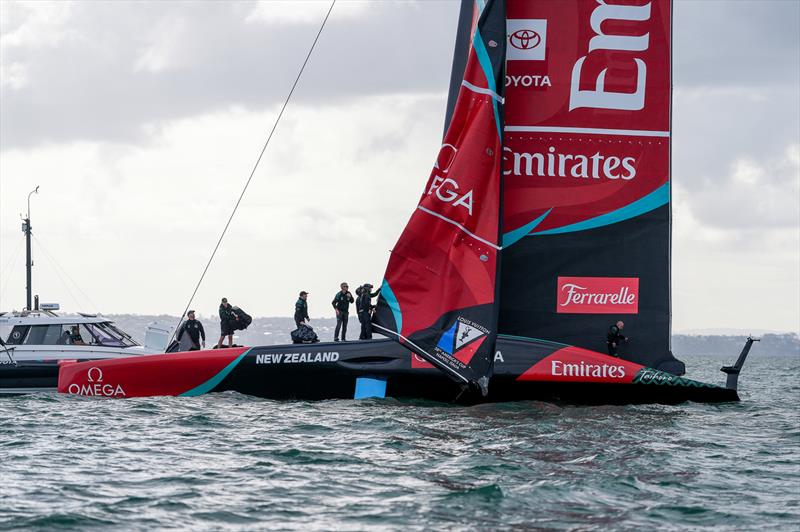
Emirates Team New Zealand - AC75, Day 10 - April 17, 2026 © Sam Thom/America's Cup
Emirates Team New Zealand started their second block of testing today in a modest breeze and flat sea state on the Hauraki Gulf.
The start was earlier than expected, with team design chief Dan Bernasconi indicating at the end of the last session on April 1, that they would resume on Monday, April 20.
A little surprisingly, given the mild conditions, the Kiwis blew the tack out of a jib. Gear breakages are very rare with the Kiwi team, but may increase acroos all teams - given the Protocol required use of legacy gear - originally intended to last just one Cup cycle, now being stretched to a second.
The jib incident was dismissed by co-helm, Chris Draper, as being "annoying". The session ended prematurely with the AC75 being towed up the harbour at 3.15pm, with the crew seeming to favour doing a rig check instead of setting a new jib and continuing with the session. They towed into Auckland a couple of hours early at 1515hrs.
There appears to have been no structural or rig damage, in the incident and this type of failure, although rare, has occurred previously. As is noted by the Recon Unit this type of failure is "on" when testing to the designed limits and beyond of sails, in particular.
Fortunately, the AC75s carry an independent forestay, which saves the rig in these situations. The jib is expected to have been a legacy sail from their 2024 America's Cup campaign.
The ACP curated Recon Unit report below identifies the specific changes that have been made over the past couple of weeks, in the shed. A small vertical fin has been fitted mid-section on one of the wing foils. We have seen these before, it contains a camera. The Pitot Tubes (to accurately measure the speed of the water passing over the wings) remain from the first testing block. The rudder appears to be the same one they fitted towards the end of the first session.
One of the crew ventured out onto the foil arm and clambered down the side of the wingfoil using a very clever soft ladder that had not been seen before.
Testing Session Summary
Crew List:
- Port Helm: Chris Draper (GBR)
- Starboard Helm: Nathan Outteridge (AUS/NZL)
- Port Trimmers: Iain Jensen (AUS); Jake Pye (NZL)
- Starboard Trimmer: Andy Malone (NZL)
- Oversight: Jo Aleh (NZL)
Wind & Sea Conditions:
- AM Wind: 270° 6kts
- PM Wind: 270° 5-15kts
- AM Sea State: Very flat
- PM Sea State: Flat
- Dock Out: 1000hrs
- Dock In: 1600hrs
- Time sailed: 4hrs
Recon Unit Report - ETNZ assigned team - 17 April 2026:
Key Points:
- Monitoring foil stall and T-foil flow interaction between foil arm and wing foil.
- Addition of increased data capacity on communications tower
- J2-3 Tack failure believed to be a result of the sail being used outside of its designed range
The team rolled out early this morning, with initial setup revealing a number of small details:
- Camera and telltales were noted on the port foil, looking at flow over the vertical foot and horizontal foil surface and this interaction.
- New fairing was added to the top of the mast
- Extra Starlink unit had been mounted on the stern-mounted communications pod, reinforcing the continued push toward enhanced data capture and live communication capability.
Dock-out occurred around 1000hrs with the boat configured with J3-2 Jib and M1 Mainsail. After a long tow out, the team transitioned into a long foil tow up, eventually releasing from the Chase Boat in the inner Hauraki Gulf.
The early phase of the session, conducted in lighter winds of 6–8 knots while heading towards Little Barrier, was clearly focused on controlled warm-up and system checks. During this period, a couple of rudder ventilation events were observed, although it was unclear if this was an aggressive test of rudder rake range or a forced ventilation. Notably, the boat was consistently sailed high on ride height. This set the tone for the day: a deliberate exploration of limits, specifically the lower-speed foiling envelope.
As the session progressed, the team repeatedly engaged what appeared to be a defined “high slow mode.” The boat was sailed at elevated ride heights and comparatively low speeds, suggesting a targeted effort to better understand stability and control at the margins of sustained flight. This included deliberate testing of deep and slow configurations, with the crew appearing comfortable pushing the platform into less efficient but highly informative regimes.
Performance data during this phase showed a wide operating range. Downwind speeds reached into the mid-30 knot range, while upwind numbers sat in the 20s. However, the emphasis was less on outright performance and more on control fidelity—particularly during transitions between modes.
A key focus emerged around takeoff and stall behaviour. Low takeoff speeds were observed in the 14–15 knot range, indicating continued refinement in early flight capability. More importantly, there was clear and repeatable testing of the port foil’s stall limits. The boat consistently dropped out of flight in the 16–18kt range during these tests, suggesting a structured effort to map the boundary conditions of foil performance and control system response, forcing the stall and observing this process.
Manoeuvre work later in the session highlighted some asymmetries. Tacks exiting onto starboard appeared “thin,” with the boat aggressively catching, while port gybe exits tended to be low with consistent hull splashes. This may point to differences in foil behaviour, control calibration, or crew confidence across modes.
The breeze gradually built into the 12–15 knot range, allowing for more dynamic sailing and a broader test window. Although the 5 knot lulls kept the team from changing down jib sizes. Despite this, the team maintained a strong focus on controlled testing rather than shifting fully into performance mode. There was a brief stoppage just after 1300hrs, followed shortly by the camera system being turned off, and battery changes were carried out at regular intervals throughout the day—further evidence of the heavy reliance on onboard systems and data collection.
The session ultimately came to an early conclusion following a major failure of the jib tack fitting. This was likely due to the jib being out of range and overloaded on tack cunno [S-W: cunningham/downhaul]. This issue effectively ended the day’s sailing, preventing any further testing despite the improving breeze. While the failure appears isolated, it highlights the ongoing load demands in these configurations, particularly when operating at the edges of the design ranges.
Overall, the session was highly methodical and development-driven. The consistent use of high ride height and low-speed modes, combined with targeted stall testing, points to a campaign focused on expanding the controllable flight envelope—particularly at the lower end. Supporting this, the addition of sensors, cameras, and fairings suggests an ongoing cycle of measurement, learning, and iteration.
In summary, this was a technical-focused session aimed at deepening understanding of the platform’s limits. The gains here are likely to translate into improved manoeuvre consistency, a broader usable wind range, and increased confidence in both control systems and hardware reliability—despite the day being cut short by the jib tack failure.
Additional Images: