
America's Cup: French have fire on AC75 after capsize
by Richard Gladwell, Sail-World.com/nz 8 Jul 07:03 PDT
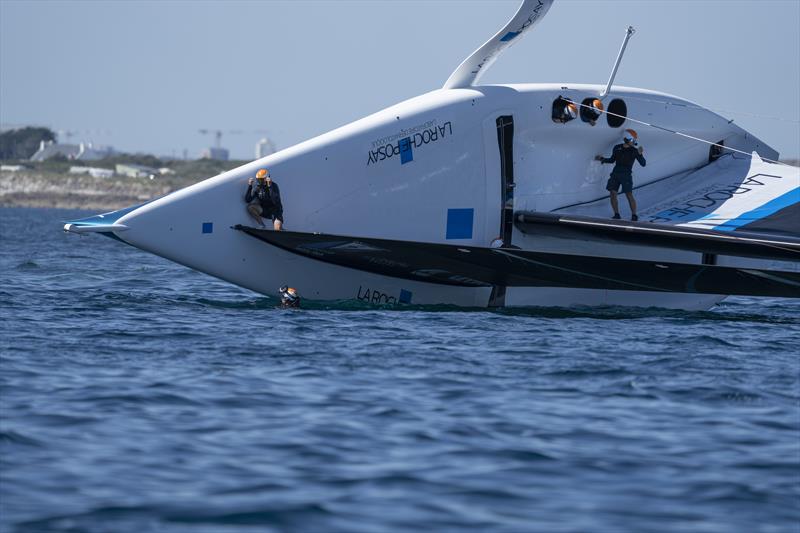
La Roche-Posay Racing Team - AC75 - Day 4 - July 7, 2026 © Pierre Bouras / America's Cup
French capsized their AC75 off Lorient during practice session, after they "experienced a systems issue".
The Recon Team reported that the AC75 "capsized on the third run, with water ingress and signs of a fire once upright."
"Several attempts were needed to right the boat, after which it sat low on its waterline, bow down, with water aboard.
"Smoke then came from several deck hatches and pods; no flames were seen from the water, though the smoke, a burnt smell and the attendance of SNSM (Société Nationale de Sauvetage en Mer) crews with firefighting equipment were consistent with a fire on board.
"The team and SNSM worked to make the boat safe and pump it out before B1 was side-towed towards harbour, the water taken off found to be contaminated once ashore."
After the AC75 was righted, it was very bow-down, indicating a major ingress of water into the bow area. It would seem the water entered through the port-side crew cockpits, as these were completely immersed. The three crew swam free of the AC75 hull.
A statement released on social media from the team, was the only initial confirmation of the incident.
"During a training session off the coast of Lorient on Tuesday, July 7, La Roche-Posay Racing Team's AC75 experienced a systems issue causing the boat to capsize.
"All crew members are safe, and the boat has since returned to base.
"The technical team is now working to identify the cause of the issue and complete the necessary repairs on the boat as quickly as possible."
The team was in just its fourth day of sailing in the AC75.
Since the 2024 America's Cup, where the French team was excused after just nine races, the AC75 was "refreshed" with a raft of new systems - a mix of upgrades from the 2024 design, and to accommodate the replacement of manual power with battery powered systems.
The team purchased a design package from Emirates Team New Zealand to fast-track their design development ahead of the 2024 America's Cup. Since 2024, they have maintained a design relationship with Emirates Team New Zealand, and fortuitously, they have a boat which is a sistership to the 2024 America's Cup champion.
It is not known at this stage if the capsize, a relatively frequent occurrence in the AC75s, was due to a system design issue, a mechanical failure or operator error.
La Roche-Posay Racing Team - Sailing Day 4, July 7, 2026 - Lorient, France
Crew List:
- Starboard Helm: Quentin Delapierre (FRA)
- Port Helm: Diego Botin (ESP)
- Trimmer/Flight Control: Jason Saunders (NZL)
- Trimmer/Flight Control: Leigh McMillan (GBR)
- Position 5: Maelenn Lemaitre (FRA) Position 6: Antoine Rucard
Wind & Sea Conditions:
- Summary: Sunny warm day
- PM Wind: 275°-285°: Calm building to 12-14kts
- Sea State: Slight chop later
- Dock Out: 1301hrs
- Dock In: 2030hrs
- Time sailed: 75 minutes
- Foiling time: 37minutes
Recon Report - Sailing Day 4 - July 7, 2026
La Roche-Posay Racing Team completed a long sailing day with B1 at Lorient that ended in a capsize on the third run, with water ingress and signs of a fire on board once upright. No injuries were apparent, and the sailing and shore teams recovered the boat together through the evening.
The mast was rolled out first at 10:06hrs and B1 came out of the shed at 10:22hrs, the foil and rudder configuration appearing consistent with prior days. The shore routine looked more practised than on earlier days, the mast stepped and the boat lifted in and launched at 11:10hrs. Once afloat, technicians boarded to install the cunningham ram and cabling and to run the usual dockside control-system checks, followed by the sailors' own systems check.
B1 docked out at 13:01hrs under tow and was taken towards the north-western end of Île de Groix, where the tow was released and the boat stopped to hoist sails in very light air. With almost no wind, the team stood by before hoisting the jib (J2-1) first and then the mainsail (MN2-1), the reverse of the order seen previously; both again appeared to carry luff-area reinforcement, which on J2-1 appeared to extend to the head. As the breeze filled from the WNW to sailable strength, the chase boat began preparing a bow tow, but this was interrupted when technicians went back aboard B1, marking the start of an apparent technical issue that held the boat on the water for over two hours before sailing.
The first run began at 15:34hrs, the chase boat towing B1 onto the foils before releasing. The boat worked upwind and downwind on both boards through a series of tacks and gybes, several fully foiling and others with touch-and-go or touchdown transitions, ride height and trim appearing unstable at times and steadier at others, before heading up and stopping.
Antoine Rucard occupied the aft starboard pod throughout the session in place of the intended guest, which, with the preceding hold, would be consistent with a systems-validation emphasis. A short second run followed at around 16:11hrs, on which B1 came up onto the foils without a bow tow, for the first time in the observed campaign, sailed a brief upwind and stopped. After a change from J2-1 to J3-2, a third run began, again self-starting onto the foils, working upwind on port before bearing away into a fast downwind.
The final run ended in a capsize at 16:50hrs, the boat going over onto its port side to around 90 degrees, the masthead resting on the water. Little appeared to move on the boat through the capsize, which would be consistent with a loss of onboard systems. In the post-session interview Dubois characterised it as a system issue, saying an initial issue early on had been worked on and the boat had resumed sailing, but the system then failed again while sailing downwind at around 35 kt, when the boat went over.
Several attempts were needed to right the boat, after which it sat low on its waterline, bow down, with water aboard. Smoke then came from several deck hatches and pods; no flames were seen from the water, though the smoke, a burnt smell and the attendance of SNSM crews with firefighting equipment were consistent with a fire on board. The team and SNSM worked to make the boat safe and pump it out before B1 was side-towed towards harbour, the water taken off found to be contaminated once ashore.
B1 docked in at around 20:30hrs, was lifted out at 22:15hrs and returned to the shed at 23:14hrs, the shore and sailing teams working together throughout the recovery. Dubois, briefed as guest for the aft starboard pod, said he had not boarded because Philippe Presti stood him down over the system issue, its cause not yet known, and that Antoine Rucard took his place; he credited Rucard with doing an excellent job to help put the boat back together and being better qualified for the role.
The team subsequently issued a public statement describing a systems issue that caused the capsize, confirming the crew were unharmed and B1 had returned to base, with the technical team working to identify the cause and repair the boat.
Conditions were sunny and hot with light air building through the afternoon from the WNW, from near-calm to around 12 to 14 kt by the final run. The sea state was slight, glassy early and building to a slight chop, with the tide near slack around low water.
The incident appears to have taken place in light winds. Optimistically, there would be no water ingress into the AC75, affecting electronic systems. In past capsize situations, with manually powered boats, in similar conditions, the teams have righted the AC75, and after a quick systems check have been able to continue sailing.
Additional Images: