
Fisho's Weekly Fishing Report – 27th February, 2026
by Fisho's Tackle World Hervey Bay 27 Feb 02:46 PST
27 February 2026
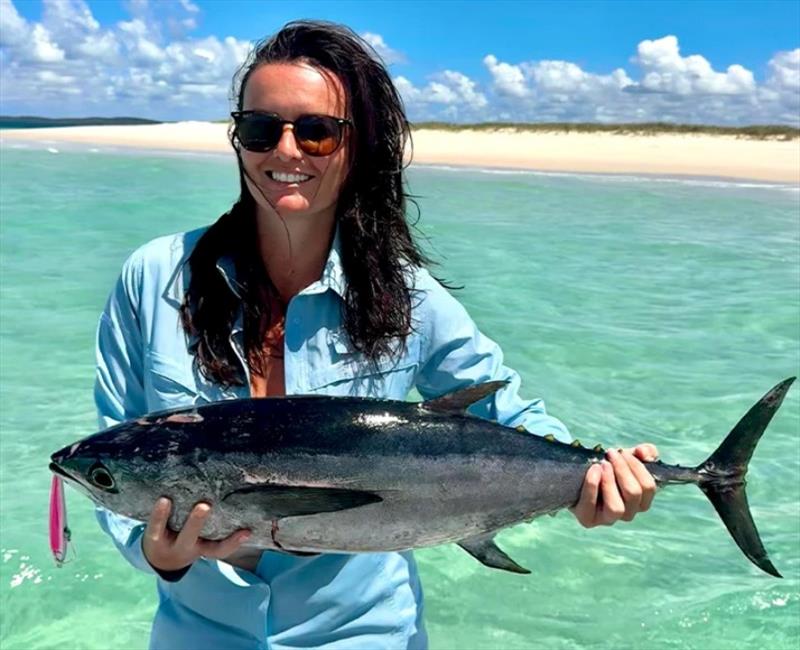
Amy's first longtail tuna was a ripper, caught on a Pink Bits coloured Daiwa Saltiga Over There stickbait excusive to Fisho's © Fisho's Tackle World Hervey Bay
Windy and unstable as blood moon approaches
The wind was better than forecast for pretty much all of the past week. Humidity increased as the current wet weather drew nearer, but all-in-all, it was a half decent week for bay boaties, whilst the fish offshore remained safe.
The week ahead doesn't look nearly as good sadly. If anything, it feels like that pre-cyclone weather; where stiff south-easterly winds blow for days on end and (thankfully) cool our warm waters enough to see storms deserving a name downgraded to 'ex' as they approach our world. With a high in the Tasman, a massive low in central Oz and lows in our cyclone generator, the Coral Sea, this time next week could be very interesting.
For now, though, it is all about the wind and showers. Today might see the 'worst' of the rain as 15-25 knot south-easterly winds buffet our coastline. The weekend doesn't appear as wet, though showers are still likely at some stage. Expect south-easterlies to 25 knots Saturday, and possibly similar for Sunday. There is a chance of slightly lighter conditions Sunday, but it is slim.
The working week looks like more of the same. Winds will hopefully be a tad lighter, yet 15-20 knots at least seems like a sure bet. Making the unfavourable forecast even more frustrating is the fact that it will blow out the otherwise productive full moon period. This one will be a 'blood moon' too as a total lunar eclipse commences about 11pm and offers an exhilarating view of the moon for about an hour. Here's hoping cloud and rain don't deny us the opportunity to enjoy the spectacle.
Small herring still drawing Pelagics to the Pier
A lack of credible reports from the pier meant it didn't rate a mention last week. Turns out there were broad-barred and school mackerel caught in small numbers, and someone landed a large spaniard. The GTs were there terrorising the baitfish and the mackerel, and queenies also put on a show.
This week, it has been more-so just the queenies and the chance of a wrangle with a GT that has kept the locals making the long walk. Daytime has seen a run of quite small queenfish, with much larger fish turning up after dark. A residual number of pencil squid might have something to do with the evening queenie bite. There is sufficient squid out the end to satisfy those requiring them for live bait, but gathering any numbers hasn't been possible.
Make the effort to catch a pier GT some time very soon if that idea appeals. Summer comes to an end this weekend and their presence may only be for a limited time only. Serious wet season rains will dirty those waters if local flooding eventuates, so have a crack at a GT while the water is still of decent clarity and the mackerel keep arriving.
No significant reports from local beaches suggest effort is minimal and the more cunning fishos are keeping their catches under wraps (as they should). Quality grunter are a chance for anyone tossing prawn baits or working plastic prawn imitations from our town beaches over the full moon period. The wind will create its own challenges, so most won't bother admittedly, yet grunter remain a very viable early flood tide option.
Tuna, tuna and more tuna out in the bay
Plenty of folks burnt some fuel as they chased tuna schools around the bay this past week. All were successful generally-speaking too, as the bay is alive with both longtail and mac tuna schools in very good numbers. The winds will deny access to open bay waters this week, though we should see a run of tuna closer inshore over these making tides pre-full moon.
Tuna working the shipping channels close inshore and into the straits may be an option for the uber-keen, but winds above 20 knots will make life difficult for even those folks. Your boat may be able to handle the wind and waves, but manoeuvring to within casting range and then battling the fish in a wildly pitching boat can be way less than appealing.
Maybe better to ride out the inclement weather and look forward to even bigger numbers of fish after this latest blow subsides. As you should all know by now, strong trade winds blow baitfish and pursuing tuna into Hervey Bay, so the current population could explode next week. East coast lows create an even bigger influx of tuna, so if the Coral Sea unleashes a proper storm, then there will be tuna galore.
Those out there catching them have claimed plenty of fish on the humble metal slugs and jighead-rigged jerkshads. Heavier tackle is required these days than what used to be deemed tuna tackle; purely due to the persistent depredation from sharks. It seems more folks eat longtails than ever before too, so cranking in a fish faster on more powerful tackle ensures better-eating fish due to less lactic acid build up and over-heated flesh.
Enough tuna schools are escaping the attention of the noahs to warrant a little extra fun with stickbaits. Avoiding the biggest melees and scoping the waters first with cheaper alternatives means you can toss your expensive stickies into the tuna schools with less fear of loss. There is an incredible range of red-hot tuna-tempting stickbaits adorning the lure walls of our tackle store these days; some very affordable, some very expensive. The tuna will decide which ones they like, and may only be tempted by the exy models when fussy, but all are fun when big black barrels of muscle explode all over them mid-retrieve.
Spaniards wearing a toothy grin
A few tuna fishos have stumbled onto schools of spotted mackerel feeding amongst the tuna again this week. Not massive numbers, but sufficient to warrant attention if they could be found. As always, it was the simple slender-profiled slugs that tempted the spotties; most of which were somewhere around the 3-kilo mark. We will say goodbye to them for another season altogether soon, but we just might see another late run if an east coast low or cyclone forms next week.
Spanish mackerel were legally targetable for the past few days. They are grinning now though, as the window has been closed by the weather that would otherwise see spaniard fans out on the bay chasing them today or tomorrow. Come Sunday, the second annual 3-week closure kicks in that will protect spanish mackerel south of Stanage Bay until after the 21st March.
Does it seem counter-intuitive to have two 3-week closures when a simpler plan would just close the fishery for a period from X date to Y date? After all, the closure must be designated to protect spawning fish, so why the week in between closures is left open when fish are still aggregated in spawning gatherings is confusing. Not that we have any determinable shortage of spanish mackerel in these parts these days anyway, but worth pondering perhaps.
For the record, the spaniards caught this week were all fairly large fish that we heard about. Typical mature breeding fish in the 15-30 kilo weight range that are no doubt fecund individuals keen to pass on their genes. Fish that lurk around prominent structure and aggregations of fodder. Fish capable of blistering runs that will unload a reel in no time prior to a dogged battle back to the boat.
Risky fish for consumption here in our Hervey Bay waters those spaniards, as although we humans must honour the exclusion zone of Platypus Bay that protects them year-round due to unacceptable ciguatera risk, the spaniards pay no attention to such a border. Who says fish caught outside Platypus didn't swim through those waters and become "infected". Best to rethink keeping and consuming any large spaniards caught in Hervey Bay folks, as you most certainly don't want a case of ciguatera poisoning. This reason alone has 'protected' spaniards that migrate through the bay for eons, so fish here in the bay need little more protection really.
Inshore options limited by winds
Heading out wide will be a no-go this week, and even close inshore missions will be restricted. Gatakers Bay boat ramp will be busier than Urangan this weekend. Die-hards keen to try their luck over the building full moon tides will be best served hitting the water at dawn or even earlier. It may not be 'pleasant', but the protection the landfall creates will make those waters very much fishable.
Coral trout will be numero uno on the hit list for most folks. Some will troll diving lures, whilst others drift and flick softies just shy of the lure-stealing coral below. Others will anchor up and try their luck with baits such as pilchards, hardy heads or large prawns. The wind will restrict them to the more sheltered stretch of reef, which will limit catches undoubtedly, so if you get the chance to wander a little further 'around the corner' safely than consider doing so.
Grunter are due to gather around the Pt Vernon / Gatakers Bay reefs this full moon. There were fish caught in small numbers over the recent neaps, so better catches are on the cards with a more favourable moon and tide. Bait fishos soaking prawns, squid or baitfish flesh will do so on the pick, whilst others drift by hopping their favourite grunter lollies. Prawn imitations continue to be the stand-out grunter slayers and that isn't likely to change in that water depth. Squid imitations might give them a nudge in deeper waters (where nannygai also lurk) so keep that in mind for better weather in coming weeks.
Our deeper inshore reefs are home to a better class of coral trout and ample estuary cod and sweetlip. They will get a substantial reprieve this week and might even do a little relocating over this moon. The sharks have been giving them and us grief all too regularly of late, and that is certainly not going to change any time soon.
School mackerel are turning up at various inshore reef sites beyond 'the banks' and a few spots within our shipping channels. Beacon-bashing efforts paid dividends on occasion recently, and may again. A few broadies continue to feed mackerel fans fishing Urangan Channel and the Outer Banks, but they are not abundant.
Inshore GTs continue to trash folks lowering live baits to shipwrecks and other artificial reefs. Their brutal strike and determined runs result in more bust-offs than cheers around those gnarly big structures, so some though to boat position and your intentions if you hook up are necessary. Being to the side in lieu of directly in front of a structure can improve your chances of tricking a GT into running wide, but you still need lady luck on your side.
There has been GTs caught at River Heads very recently, so those waters might be worth investigating. Working big poppers or stickbaits across the prolific current lines and eddies could see you hooked up, groaning and sweating. GTs at the heads and at the artificial reefs suggest the islands in between deserve some attention if you can manage a session in this weather. The full moon tides will have them on the chew there when the tide is low.
Dirty mary fishing best downstream
Those that decided to traverse the upstream waters of the mighty Mary River found the water to be dirty all the way and generally unappealing. Fish were ultra-scarce too which means the lower reaches are your best bet for the time being. Big full moon tides will enhance the muddy stain in that river as silt is once again lifted from the bottom by the raging tides to make the already dirty waters filthy.
Dirty water specialists such as barra and threadfin salmon won't mind the conditions at all though, taking the opportunity to feed on fodder unable to sense their approach in the filth. Live baiters may have an edge over those favouring lures in coming days, but all will have to deal with the weather. Tucked up against a bank out of the wind soaking a live bait waiting for that next run will appeal to some folks, whilst others actively hunt feeding fish spotted working drains or on a sounder screen.
Small prawns are amassing in their millions down there in the Mary at present and they are starting to get more mobile. This weather event may well trigger a significant movement closer to the heads that will see prawners capitalising as soon as the wind is light enough to throw a cast net. They will be 'boilers' more-so than 'fryers', but small prawns are sweet and can potentially be prolific. Sorting those that are too small can be a real pain, so if you aren't into that pre-mature prawn then save your efforts for now, but be ready very soon. Things are about to get very interesting.
Burrum alive with fodder and fish
The whole Burum river system hasn't looked as alive or as fishy as it does right now for a long time. It is generally cleaner than the Mary for now too, which is a bonus. Past spills from Lake Lenthalls replenished the Burrum's barramundi population and those fish were finally afforded a degree of protection from netting effort. Big barra now wander the four rivers of that system offering budding fishos ample opportunity to tangle with them in a huge range of environments.
Snag-bashing is even more popular than ever nowadays with the advent of livescope sonar, and the Burrum system is littered with prime snags and rock bars of all types. Big full moon tides will have the water racing along way too fast for productive lure fishing anytime other than the tide changes or last couple of hours of the ebb tide upstream, so consider heading for more open waters down where the other rivers meet this week.
Livescope will help many find the barra, and the threadies, though talking them into biting when they simply don't wish to will be just as challenging as ever. Scopers do 'enjoy' the advantage of getting to see the visual denials and follows that non-scopers must imagine or remain unaware of when fishing. Lure changes can be made and the target fish's reaction gauged in an instant, so multi casting outfits is a great idea for anyone serious about this caper. Bigger barra (and salmon) are caught more regularly than ever before, by folks that may not have been in that race prior to spending the big bucks on tech, so the outlays and fancy fit-outs are easily justified by an increasing majority these days it seems.
Chasing jacks is a different story. Livescope will certainly aide you in your quest, particularly in relation to lure position in a given snag, but the vicious strike out of nowhere and generally smaller size of the fish equates to more guesswork. Truly great river fishos catch jacks regularly and do so because of time on the water and casting skills amongst other factors. Quality tackle is a must when targeting the Burrum's jack population as they are quite large on average and all are determined to trash you should they feel the sting of your hook. They will be on the bite again this weekend, so try your hand at jack fishing if you are up to the task.
Masses of baitfish are calling the Burrum system home for the time being, as are millions of small-medium sized prawns. Queenfish are being observed crashing into schools of rippling baitfish that send them showering in all directions. Good distractions on bigger tides for those struggling with other estuary species this week. Grunter could be another fine full moon target species, as could the Burrum's bigger whiting. Plenty of options in a system largely protected from buffeting winds at a time when inbound wet season rains could put paid to the whole fishery in the very near future. Enjoy it now as it may not be an option very soon.
Great Sandy Straits is Aptly Named
We should relish the fact that we have the Great Sandy Straits on our doorstep. It surely is a great option for when the Mary runs dirty and even better should the mighty river go into flood. Right now, the straits are fishing well for a host of estuary species, as well as a surprising number of reefies and pelagics.
Recent catches of large barra and decent numbers of threadfin salmon keep their captors and those that wish to mimic them keen. The waters of the straits are very clear compared to what is found in the Mary system, so lure fishos in particular are drawn down that way. Ample baitfish are also gathered at the usual sites, so predators of all types are attracted and can be caught at key times.
In open waters, herring and hardy head schools milling about on the surface are often crashed by queenfish or stray mackerel, whilst GTs size up their prey with evil intent. Smaller GTs are happy snatching baitfish whilst their bigger, bolder and badder brethren eye off the lesser predators working the bait schools. All sorts of estuarine predators also capitalise on such baitfish abundance along the ledge country, between visits to nearby creeks. Include jewfish, barra, salmon, grunter, cod and flathead in that list and you can see why some time spent around such a bait-rich fishery is justified.
Prawns are still small down the straits, but they too are amassing into what is looking like the precursor to a ripper prawn season. The crabbing has been good too, even though sharing the resource with non-local pros is a limiting factor. The muddies have been active throughout our creeks and rivers since recent rains, so expect great things from them over this full moon. If only we had better weather, eh?