
Ocean Graders' Delight in the Sydney Hobart Race
by John Curnow, Sail-World.com AUS Editor 24 Dec 2025 22:03 PST
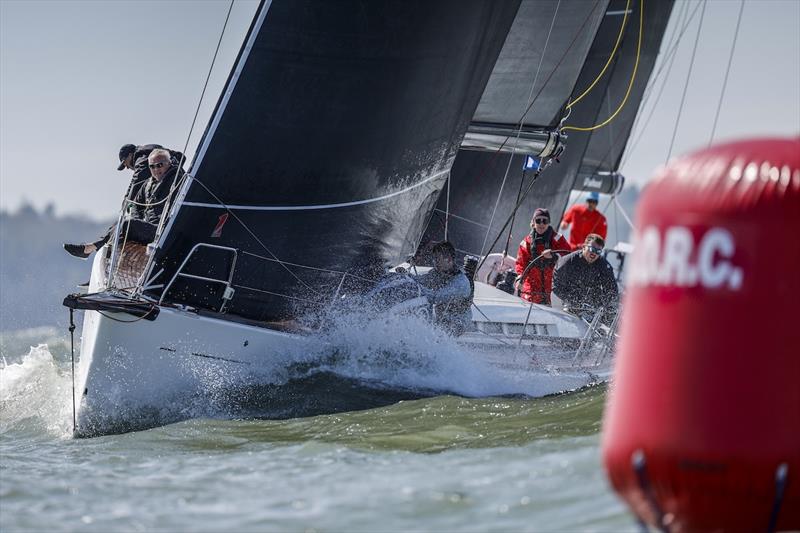
First 50 Checkmate XX - 2025 RORC Easter Challenge Day 2 © Paul Wyeth / RORC
What’s in a gradient, and what’s that got to do with the Sydney to Hobart race? Consider a path up to a picnic spot with a grand view – think gentle slope. One that makes you crane your neck back as your eyes go skyward, and the clue was the chain handrail BTW – think goat track. That’s all terrific in the 3D world, but what about for when it is in 2D?
For cartography we use contour lines to show the elevation of hills and valleys. The picnic spot would be lines wide apart to indicate the next level of height was a way off, so nearly imperceptible change of gradient as you moved along. The goat track would have the lines nice and close, indicating each step would have a climb associated with it. The pitch of the staircase would be nasty, the rise for each one would be discernibly noticeable, and the tread (the flat part for your foot) might take just the toes, and no more. You want to be fit and agile for that stuff.
When it comes meteorology, we basically use the same lines, only call them isobars now to denote barometric pressure, as opposed to physical height. Wide lines, not much going on and the wind is gentle, often at best, other times it is scant. Tighter the lines, more pressure, more energy, and it all has to go somewhere. The corners can add 40%, so if you’re used to slot cars, you’ll know you have to come off the gas to make it around the bend, otherwise you fly off at a million miles an hour.
Wheels of fortune
So, in the Southern Hemisphere, low-pressure systems spin clockwise and the further South you go, the more meat they have in them. We’ll get to what that all means in a second. Conversely, a high-pressure system spins anticlockwise as it makes it way from West to East around the globe.
To denote their atmospheric pressure, they are still measured in Millibars of Mercury for Pilots and Meteorologists, and old Barometers on boats still show thus, but us wee commoners know them as Hectopascals, where oddly enough, 1hPa equals 1mb, and let’s just say 1013 is normal pressure at sea level. For the case here, a High is above that, and a Low is under that mark.
Especially at this time of year, here in dear old Oz they march across from Left to Right on the page or screen literally nose to tail, and their area of influence usually resides in the 25 to 50 degrees South of latitude. The Equator sort of always does its own thing, but you might argue that the Equator and its two Tropics kind of have the Conductor’s baton. Sometimes they are the same size as the island continent itself, so what happens in the Timor Sea can affect Bass Strait.
Now a Low drags air in from its surrounds to fill the void (its centre), as it were. The air on the outside has a wiggle on, and hence it feels like a bit of a punch. By contrast, a High brings air from the upper atmosphere down and spreads it with love, so it is gentle and warm. Temperature and density all play their part and as we have said over the years, change is a cornerstone of Australian weather at this time of year.
Take a look at the MSLP chart (Mean Sea Level Pressure) for just four hours after the start of the Boxing Day Classic, you’ll see the traffic jam of Lows and Highs, where the one in the Indian Ocean is utterly ginormous, and they will spend days all bashing into each other jostling for elbow room like some terribly overcrowded train with no A/C, and bars over the windows you could drop an arm or head out, only don’t do that lest you collect one of the sign poles flying past at a hundred clicks.
You got this far and here’s the deal!
Our interest is in the Western part of the Tasman Sea. There you’ll see a pretty high High of 1025hPa, and pretty low Low of 991. Next, the lines between them have been squished together, and virtually straightened or aligned, as if drawn by a parallel ruler. This is what is going to drive the 2-3m SSW seas the fleet will meet, essentially the moment they clear South Head (along with a Northerly ocean flow).
Next, you’ll spot two sort of humps on the top right of the 1025hPa High. The first is at the North coast of NSW, and we’ll just call that Yamba for now. The next is very close to the old Got A Bit On Island (Gabo), where NSW and VIC meet. It’s a 100-degree turn, and unlike the slot cars, the air hangs on a bit, so it is more like pulling neck breaking Gs on a Light Cycle from a Tron movie than it is losing traction on the plastic track with the metal insert.
This is where 20-30 knots average will become evident, and in the squirt it might get to 35 or so, and the seas will have every chance of being 3-4m now, plus you’ll begin to meet the confluence of the water that has just been pushed through the relative shallows that is Bass Strait proper, which mercifully should not have too much venom injected into it, but you never can tell, especially from the desk. Rule #1 – head out of the companionway hatch! Called GABO for a reason…
Icpota - Fascinating reading
So now if the Sydney to Hobart is a 628nm Windward/Leeward, then for a long time there has been a hell of a lot of Leeward, and not so much of the Windward. 2025 looks to reset the meter somewhat. A boat like Wild Oats XI, now Palm Beach XI, has excelled at this for two decades, and they have religiously always been on or near the Rhumbline. Expect nothing different this time. Sensational, new North Sails 3Di working rags, and an ultra-grippy daggerboard mean it will be interesting to see how many tacks they make, which will of course depend on the exact angle that Huey delivers, which for now looks like SSE 20-30 knots, and as it all unfolds it may go SSW depending on where you are on the track and the exact elapsed time.
If it is predominantly one, then there are a lot of checks to forestay, chainplates, shrouds, sheets and so forth, as bouncing off waves adds to compression. All the Larry has to go somewhere!
Right. A Supermaxi might be looking at two days and possibly some change for the trip right now. So, they are out of contention for the overall prize (Tattersall Cup). TP52s and other sleds just won’t have the time to skedaddle, so chances are slim there. A Volvo 70 holds a high VMG in a strong blow, and Sportscar (now LawConnect) is a sledgehammer with a talented crew, so they should be frontrunners. Comanche is a power gobbler, and if they get enough squirt to heel her over properly it may not be comfortable, or even pretty, but she will charge. Just point the nose and shoot. They'll be up for that, as this is the current charterers' last stoush.
As a gambler, I am going to be looking at things like a Beneteau First 45. Designed by Farr, and when sailed by the likes of the crew from Ikon, it is a very potent formula. They are not there, but Cool C4ts is. A DK46 is another one that could be something that Huey anoints. Team WhiteWave form China would love to think so. There is every chance Huey has settled on Division Three to get the nod. We’ll know in a few days, and yes, the other rule is, ‘I’ll tell you who has won the Hobart when all the boats are tied to quay at Constitution Dock’.
There are some impressive speed 40s in there too, like Titlespace Yeah Baby, and Sean Langman’s Back 2 Black, but lumps and bumps means a heap of water on the deck, and that is not fast when you’re bashing into it.
No, you’d have to think it could well be the year of the Ocean Grader where LWL counts for a lot. The displacement craft rides better, so the crew is looked after more, and this will offer the alert crew with good steerers the chance to shine. Yet another rule – in order to win the Hobart, first you have to win your Division!
Who said Propellorhead Cap?
Often, having a look at Adelaide and Melbourne’s weather can give a clue as to what lies ahead. Melbourne has been cold, with a ‘feels like’ temperature often five degrees below that stipulated amount. Reasonable Southerlies have prevailed (15 maybe gusting 20), but the UV index has struggled to often get past 8 – i.e. not much heat being induced, and it is dry, with relative humidity in the 40% zone.
Adelaide is a similar tale, but maybe more East in the Southerly, and the humidity often just 30s. In short, whatever is to come will be derived from the valley, and an ocean grader might need to have four days of food sorted.
The answer is don’t look to the West for the answers, they are all in the South, and whether a 50 foot ocean grader, or a 40 foot one is more likely could well be answered on Saturday night.
Merry Christmas to all and best of luck to everyone racing.
Thanks for tuning into Sail-World.com