
Debriefing the 2025 Mini Transat with American Classe Mini skipper Ambre Hasson
by David Schmidt 18 Dec 2025 08:00 PST
December 18, 2025
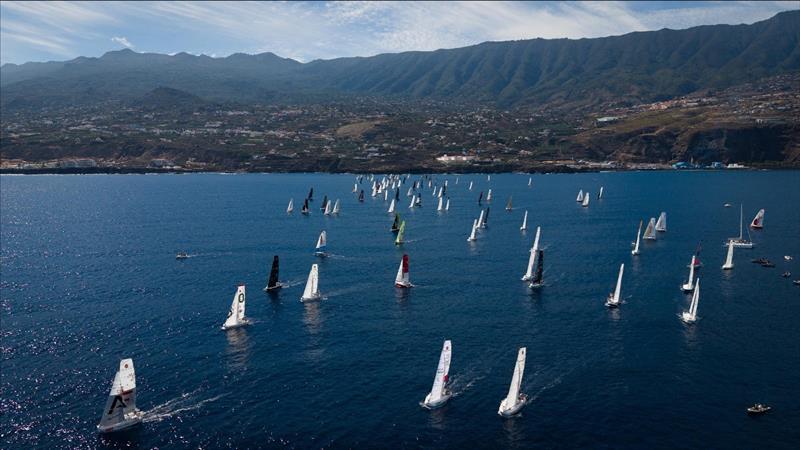
Mini Transat start in Santa Cruz de La Palma © Matthieu Honoré - Mini Transat
It's been a massive few years for Franco-American Classe Mini skipper Ambre Hasson. Six years ago, Hasson was living and working in New York City and enjoying the trappings of city life. Sailing wasn't part of her world view or skillset, nor was the thought of racing across the North Atlantic, alone, aboard a 21-foot offshore speedster. But when the pandemic hit a few months later, Hasson found herself living in Florida, and the sailing bug bit.
Hard.
Her first acquisition was an old and tattered cruising boat, but she soon started dreaming of singlehanded offshore sailing.
Flash forward some years and Hasson, who was born in France, moved to Brittany and got involved in the Classe Mini scene. She bought a prototype Mini on a shoestring budget and began racing on the local circuit.
Her initial results weren't exactly the stuff of legend, but Hasson pressed on, despite setbacks including losing her first Mini to the rocks and a cruel tide, and her learning curve rapidly steepened. Her goal? To compete in the 2025 Mini Transat, which she just completed last month.
The first leg of this year's Mini Transat, which stretched from Les Sables d'Olonne, France, to Santa Cruz de la Palma, was cancelled due to the arrival of Hurricane Gabrielle, which was churning out 60 knot winds and 20-26-foot seas. The second leg, which took the fleet from Santa Cruz de la Palma to Saint-François, Guadeloupe, was a different story, and Hasson finished this adventure spending 19 days, 18 hours, 9 minutes, and 54 seconds racing alone across the Atlantic Ocean aboard her 2008 generation non-foiling whip.
All told, Hasson finished in 27th place out a starting fleet of 33 prototype Classe Minis, despite dealing with some significant steerage issues. Newer, foiling designs might have proven faster, but Hasson accomplished something that most sailors will only daydream about.
This is the seventh interview with Hasson about her transatlantic adventure, and I checked in with her, again via email, to debrief her downright impressive campaign.
The first six interviews can be found here:
Can you please start us off by describing the best sailing that you experienced on your adventure?
[It's] so hard to answer that question...those nights where the sky was clear and the moon lit up the way. Watching the stardust of the Milky Way blend in the bioluminescence from your wake. You're completely alone yet some you feel so connected to the universe. Those images will stay with me forever.
How well do you think the first leg of your adventure prepared you for the race's second, bigger leg?
Ah man so, so different...especially because the first leg was cancelled due to a hurricane, we had to seek safe refuge on the coast of Portugal.
But nothing could have prepared me for the second leg...it is so much longer than anything else [I] had ever done yet and you truly are all alone out there...when you haven't seen another competitor for days, or even another boat, you realize how small we really are and also how vulnerable. If something goes wrong there is only you to fix it, and you can't even limp your way to the nearest coast because it's at least a week away.
Can you please describe the biggest conditions that you encountered on your adventure? Also, which leg was this on?
Ahh Cap Finistere was so impressive...on the first leg right before they cancelled the race. I decided to go outside the Traffic Separation Scheme. There wasn't that much wind, the most I saw was 32 knots, but the sea state was wild.
At one point behind me I saw four waves crash into each other and literally form a mountain and then collapse onto itself. I had just the jib and one reef in the main at this point; a second reef would have been nice but I was glued to the helm. And I did surfs at 15 knots...on one particular wave I felt like I was going down a black diamond [ski] slope and my bow crashed into the next wave. It was impressive to see that much power
How did your boat hold up? Any equipment issues?
On the first leg I had some problems after a big broach, water got in the boat and messed with my electronics, but I got out ok. I managed to not break my boat and sped up once the sea state calmed down, because it was violent—competitors were dismasting, breaking bowsprits, and rudders. Carnage.
So, I really focused on preserving the boat and then started attacking, until they cancelled the first leg.
The second leg was more complicated technically...I had pilot problems right from the beginning, which slowed me down but then managed to fix... but the biggest thing was breaking my rudder right in the middle of the ocean.
[I was] just as far from Africa as I was to the Caribbean. It took me 2.5 days to dismount my entire rudder system, do the composite repair, and re-install everything.
And even after I stayed conservative to not force the repair too much... until I got about 300 nautical miles from Guadeloupe and I started speeding up.
Well, in a little 12 knot surf I heard a crack, a bang, and a final crack [as my] rudder system ripped off. Thankfully the other rudder was fine, and I gave him sweet words of encouragement to make sure we made it all the way to Guadeloupe.
I tried to remind myself that a lot of the preparation on the boat went right, my rig, my keel, my spares were on-point, but you never really know what's going to happen out there.
What do you think were your biggest and most important racecourse decisions? Also, why were these calls so important to your race?
Well overall I'm pretty happy with my weather strategy. I managed to avoid the huge high-pressure system that was blocking our route in the beginning. And then as we got settled in the trade winds, it was fun the play with the shifts...and then finally understanding how the squalls behave and how to actually start using them to your advantage was a lot of fun to learn.
It definitely made me want to do a Transat race to keep working on this weather and strategy...unfortunately even though I still made a strategy every day and followed the weather, I wasn't racing as much as I wanted to due to my technical problems.
You spent a couple of years preparing for this adventure. How well-prepared so you feel you were for the race, and what—if anything—would you have done different in retrospect to prepare?
I really beat myself up for a while when I was out there dealing with pilot problems and rudder problems. I mean they're two of the most important things and I was very hard on myself, told myself I should have spent more time on those things.
But the reality is that [a fitting] that broke I had [had] machined a year ago to be a perfect fit, so it would strong and have zero play, and my pilot backing plate shearing off was just wild. I reminded myself that a lot of things on the boat were very well-prepared.
And also looking back, I realized that over the last two years I also gained the technical skills to deal with these problems. Two years ago, had this happened to me, I probably would have had to abandon the race because I would not have the skills to repair or enough control over my boat to know how to sail it safely in those conditions.
Would you do a Transat again on Mini? Or, have you gained appreciation for the wisdom of only going to sea aboard vessels with more feet than one has years?
I definitely want to do another Transat race...but I think on something slightly bigger and more powerful.
I'm so happy my first Transat was on my little yellow boat, solo — this is exactly how I wanted it to happen. But now I'm ready for the next step. I say this while responding to you [on delivery back to France] from a Class40 in the middle of the ocean, so that's perhaps a hint for what's to come.
Is there anything else about your Mini Transat adventure that you'd like to add, for the record?
Even though I was alone out there, it took a whole village to get me across that ocean. I owe so much to my family, my friends, and the sponsors who believed in this wild idea. On the hard days—and there were plenty—I leaned on all that support to keep going.
And now, the next project is starting to take shape. If you're reading this and want to be part of what's coming next—let's talk.
[Editor's note: Hasson's website is www.ambresails.com, her email address is ambre@ambresails.com, and her Instagram handle is @ambre_sails.]