
The Gameboat Brotherhood Week 3 - Where craft becomes legacy
by Release Boatworks 19 Dec 07:45 PST
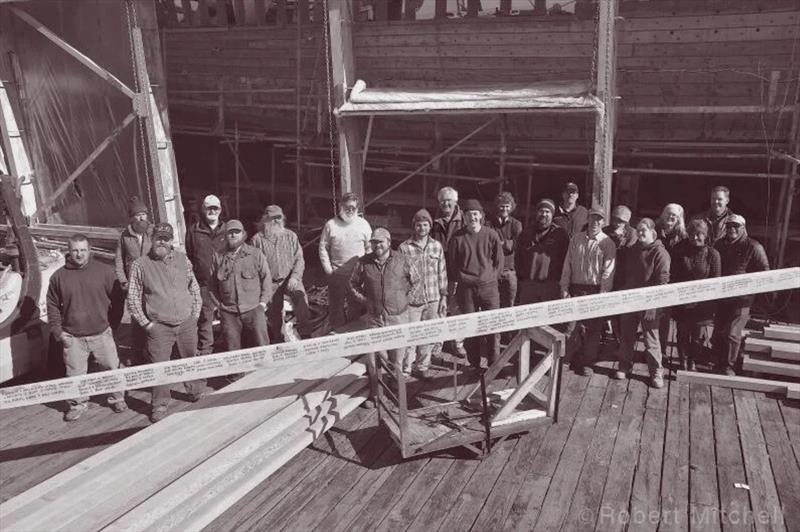
A hull isn't born until the men who built her gather to recognize what they've made © Release Boatworks
Before fiberglass.
Before infusion pumps.
Before laminates, vacuum lines, and resin chasing through cloth like a tide over reef.
Boatbuilding lived in a different world.
A world of wood, fire, salt, and hands that told more truth than any manual ever could.
Back then, a boat didn't appear suddenly in one piece.
She grew.
She grew the way a tree grows. Slow. Deliberate. Ring by ring. Plank by plank. Until one day she held the shape of something alive.
Men didn't talk about tolerances or resin systems. They talked about feel. About the way a plank seated against a rib. About the sound a mallet made when it struck just right.
A hull whispered to the men shaping her.
The ones worth a damn learned to listen.
And among all the ribs, planks, seams, and fastenings that went into a wooden hull, there was one moment that mattered more than any other.
The last plank.
The Whiskey Plank.
Not because it was structurally special. Any sound board could close the hull.
It mattered because of what it meant.
It was the moment a builder crossed the invisible line between work and creation. Between a collection of parts and something with a soul.
When the final plank came out of the steam box, warm and stubborn, smelling of sap and smoke, everything stopped.
Hammers went quiet.
Saws rested.
Salt-stained aprons wiped on trouser legs.
Someone uncorked a bottle.
Rum in the Caribbean.
Whiskey in New England.
Mead in the Viking north.
They weren't toasting completion.
They were honoring responsibility.
They were acknowledging that after that moment, the boat was no longer theirs. She belonged to the sea and to the men who would trust her far from shore.
Different oceans.
Different rituals.
Same truth.
A tradition born in sawdust and salt
In the old wooden yards, shipwrights knew the exact moment a vessel took her first breath.
It wasn't when the keel was laid.
It wasn't when the masts were stepped.
It was when the whiskey plank, the final board sealing the hull, was fastened in place.
A hull isn't born until the men who built her gather to recognize what they've made.
That belief followed shipwrights across centuries.
Egyptians burned incense to wake the river gods.
Polynesians carved symbols into outriggers to guard canoes crossing empty blue.
Greeks poured wine over keels so courage would follow hulls into battle.
Vikings raised mead horns as the final board drove home.
New England yards splashed rum over schooner ribs, whispering, "Bring them home."
Across thousands of years and thousands of coastlines, different men raised different bottles.
Every one of them paused long enough to honor the moment when a vessel crossed from the world of men into the world of the sea.
The Whiskey Plank was never really about wood.
It was about meaning.
It was about ownership.
It was about saying, without needing to say it:
We built this.
And we built it with intention.
Inheritance in a composite world
We don't fasten planks anymore.
Our hulls aren't cedar and copper nails. They're vacuum-infused composites. Glass. Core. Resin. Engineering.
The old shipwrights wouldn't recognize the materials.
They would recognize something else immediately.
The way the room feels when a hull is about to be born.
The sea hasn't changed.
Her expectations haven't softened.
Boats still have to earn their way.
What's changed is how we answer that demand.
In our yard, the Whiskey Plank lives on in a different form.
Our ritual isn't tied to a wooden board.
It's tied to a day.
Infusion day.
If you walk into the shop early that morning, you can feel it in your teeth. The air is different. Quieter around the edges. Sharper in the middle.
The crew isn't rushing.
There's no wasted motion.
Every man knows his job.
Every man knows there are no do-overs.
This isn't just another step.
This is the step.
I've been there for every single infusion. I'll keep showing up as long as my legs work and my heart still kicks at the sight of a hull in a mold.
Because infusion day is the closest thing a boatbuilder ever gets to watching his kid graduate.
You stand there knowing how many hours went into this moment. How many choices. How many corrections. How many nights someone stayed late to make sure a detail was right that nobody on the dock will ever notice.
And now all of that either locks together clean.
Or it doesn't.
You might think it's solemn. Silent. Monastic.
It isn't.
It's focused.
And quietly competitive.
Every man on that crew has his phone out. Timer app running. Not to text. Not to scroll.
To measure.
They remember how long the last hull took. How quickly the resin ran. How clean the flow was. Where the hang-ups were.
That's the benchmark.
They aren't racing the clock because they're in a hurry.
They're racing themselves because they have pride.
A clean infusion isn't about going fast.
It's about running a perfect line.
No dry spots.
No surprises.
No ugly moments hidden where no one will see until it's too late.
The timers are there for one reason.
To prove the craft is getting sharper.
Resin starts to move.
Lines darken.
The hull begins to drink.
Someone calls out a time.
Another eyes the line, then his screen.
There's a nod.
A half-smile.
The kind of look men share when they know they're in front of the curve.
I stand there with them, watching the resin chase the vacuum through the hull. Filling every corner, every curve we sweated over on paper and in foam and in fairing compound.
It's a strange thing, seeing a boat take on her strength in real time.
Like a skeleton becoming a body.
Like a drawing becoming something the ocean will eventually have an opinion about.
When the resin finishes its run and the timers stop, nobody pumps a fist.
Nobody yells.
That's not how this works.
They look at each other.
They look at the hull.
They know.
They know if they did their jobs.
They know if they beat their last effort.
They know if they earned the right to sign their names to what comes next.
Most days, quietly, they have.
The moment she lets go
From there, the hull cools.
Bulkheads go in. Pre-infused. Bonded. Stitched into her bones. The structure tightens. Strength flows from stem to stern.
Then comes the next moment that never stops feeling like the first time.
The mold bolts come out.
The hoists take their places.
Straps kiss the hull in all the right spots.
Anyone who's done it remembers their first demold for the rest of their life.
Some remember the smell of fresh resin.
Some remember the way the light slants through the shop doors.
Some remember only the heartbeat thump of adrenaline in their ears.
What I remember is the sound.
That soft creak.
That sigh.
That low, ancient murmur of a hull letting go of the shape that held her.
Light hits her for the first time.
Someone whistles low.
Someone shakes his head and grins.
Someone says, under his breath, "That's a good one."
You can polish gelcoat.
You can fair a hull.
You can measure numbers on a spec sheet.
But that moment, when the hull separates clean and puts her weight on her own skin for the first time, is where you find out if you built a boat or just assembled parts.
A hull only leaves the mold once.
Every man in that room knows he'll remember that sound long after the details fade.
That's our Whiskey Plank.
The plaque that holds the promise
We don't have a board to sign anymore.
What we have instead carries the same weight.
We have the Whiskey Plaque.
It's one idea cast in two bodies. Like a coin struck twice from the same die.
One plaque stays with us, hung on the wall in Egg Harbor City.
Its twin goes with the boat.
Together, they aren't two plaques.
They're witnesses to the same moment.
After the hull is free and the dust settles, the plaque comes out on a clean bench.
The bottle opens.
The shop shifts from tension to a different kind of silence. The kind that belongs to respect.
Nobody gives a speech.
Nobody makes it a show.
Men step forward one at a time.
Lamination crew.
Bulkhead guys.
The ones who pulled peel ply, checked lines, and minded the timers.
Steady hands.
Scarred hands.
Hands that have been in this trade longer than some of the younger crew have been alive.
They put their names down.
A signature is a strange thing when you think about it.
It isn't just letters.
It's a claim.
A line in ink that says:
I was here.
I touched this.
I stand by what we did.
The Whiskey Plaque carries those names. The men who turned materials into a hull that will be asked to run hard and bring people home.
The plaque that stays with us goes on the wall. Another link in the chain of boats we've built.
The one that goes with the boat ends up on an office wall or in a salon or a study somewhere. A place where an owner can look up and see exactly who stood behind his hull the day she was born.
Same day.
Same ritual.
Same signatures.
Two places.
It isn't decoration.
It's proof.
Why ritual still has a place here
In a world that worships speed and automation, you could argue that moments like this are unnecessary.
That computers and sensors and quality checks are enough.
The ocean doesn't care what the spreadsheet says.
A hull isn't just geometry and chemistry.
A hull is accountability made physical.
Ritual doesn't make the boat stronger on its own.
What it does is tune the men.
It forces everyone to remember this isn't about hitting a deadline or closing a job ticket.
It's about building something that will face forces no human can negotiate with.
One day, a family will cross the Gulf Stream inside that hull.
One day, a captain will push into a squall because there's no safe way around it.
One day, a mate will stand barefoot on that deck, trusting every layer he can't see.
Those moments don't care about marketing.
They care about whether, way back at the beginning, somebody took the time to give a damn.
That's what the Whiskey Plaque is for.
To make sure we never forget to give a damn.
The soul of a release
A Release isn't born the day she splashes and phones come out at the marina.
She's born the day the mold lets go.
The day light hits her bare hull.
The day the timers stop and the crew nods to each other, knowing they did it right.
She's born the day the plaque comes out.
The day the ink hits wood.
The day the men who built her pause long enough to say, in their own quiet way, this matters.
Some traditions are meant to be preserved in museums.
This isn't one of them.
This one is meant to be lived. Over and over. Hull after hull. Until the wall in our lobby and the walls in our owners' homes are full of names, dates, and stories no one can fully tell, but everyone can feel.
And here's the truth.
A boat doesn't earn her soul from the ocean.
She earns it from the men who built her.
Men willing to sign their names to the moment she came alive.
Everything after that is just sea trials.