
Communication transforms loneliness into inspiration in the Global Solo Challenge
by Margherita Pelaschier / Global Solo Challenge 14 Dec 2023 03:22 PST
14 December 2023
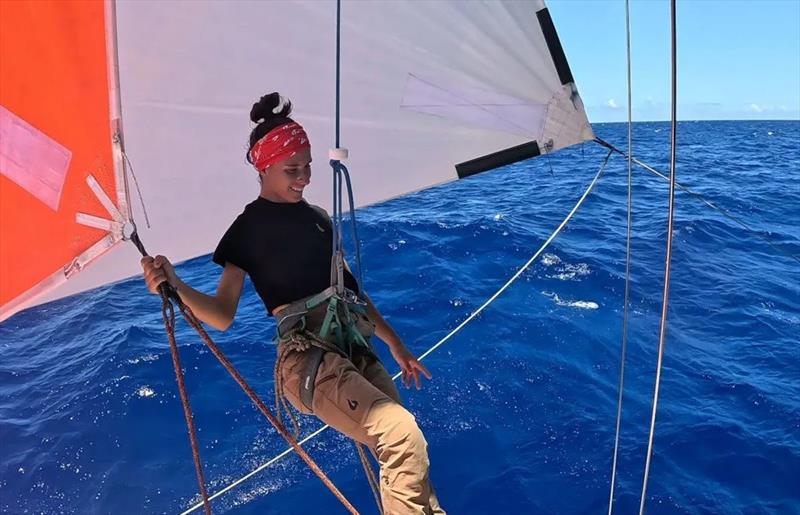
Cole Brauer - First Light © Cole Brauer Ocean Racing
The days of skippers engaged in their adventure at the GSC are punctuated by intermittent sleep, and the perception of time at sea expands.
Each awakening is like the start of a new mini-day, sometimes brightened by breathtaking landscapes and fast navigation, other times complicated by technical problems and delays. In this constantly evolving environment, which surpasses our "fluid modern times" in variability and uncertainty, sailors try to establish small comforting routines, evoking smells, tastes, and memories of home. Pavlin Nadvorni and Louis Robein, for example, have spoken of baking bread on board to recreate a familiar atmosphere and indulge in a special meal. Cole Brauer remembered the importance of hot water to recreate a moment of pleasure and intimacy, either by preparing a good tea or washing with a small towel as her mother used to do when she was a child. Communicating with land, even just to reassure loved ones, thus becomes for some a habit to recreate and the antidote to the voluntary solitude that the skippers have chosen as part of their challenge.
In everyday life, we are constantly connected with others, sending and receiving messages continuously. At sea, communication methods are evolving and adapting to this speed. Many skippers, including Riccardo Tosetto and William MacBrien, believe we are witnessing a real revolution with the advent of the new fast, broadband satellite network offered by Starlink, which has been added to the two main satellite networks with global coverage, Iridium and Inmarsat, which are more reliable in terms of security and established in the market but slower and more costly. How do these networks work? Various companies with space launches deploy satellites into low Earth orbit, forming "constellations" at various levels, and transmitting a signal to boats and ships around the world. This signal is then transmitted to a ground station, which provides the Internet connection.
Inmarsat is a historic network in the field of satellite communications, having been the first to offer individual satellite telephone connections. It uses satellites positioned in geostationary orbit. The coverage of these satellites excludes the poles but is more than sufficient for any yacht race. Iridium has global coverage and uses 66 "Low Orbit" satellites, allowing data connections ranging from just 2.4Kbps for dial-up connections via satellite phone or Iridium GO! to just 22Kbps upload and 88Kbps download for the Iridium GO! Exec. Moving up the range, there are services like Iridium Certus that reach 352/704 Kbps upload and download speed respectively. The costs for using Iridium GO! are low, around $150 per month, but the speed only allows sending and receiving emails and some small files attached, in the order of tens of kb. With Certus, larger files can be sent, but the costs are prohibitive, around $5 per Mb sold in data packages costing thousands of dollars per month.
Starlink Maritime, on the other hand, represents a true revolution that has only recently become available for an event like the Global Solo Challenge with the new 'Mobile Global Data' contracts launched last summer. Before the event started, there was little information available on the actual coverage and performance once at sea, especially when sailing in rough seas and in remote areas of the southern Atlantic and Indian Oceans. The surprise of seeing it work so far incredibly reliably has been shared by all, especially considering that it reaches broadband speeds of up to 100 Mbps! This network relies on thousands, not dozens, of satellites. The cost of the antenna is about $3000, a third compared to a very expensive Certus system. The monthly subscription cost is just $250 per month for 50 gigs, making the comparison with any other system meaningless. It's clear that in the future this system will become the standard for all boats involved in events like these. The only observation made by competitors is related to the high power consumption of the antenna, but certainly seems a negligible flaw compared to what it allows to do.
On-board electronics and telecommunications have become indispensable for decades to receive and analyze meteorological data, choose routes, automatically send location, transmit distress signals in emergencies, and more recently, share photos and videos on social media for the public. Technology allows sharing these unique experiences with the outside world, thus extending the impact of these sea adventures. For instance, François Gouin and Philippe Delamare have committed to developing educational projects, organizing calls and video conferences to share their navigation with schoolchildren following them from land. Others, like Ronnie Simpson and Kevin Le Poidevin, have brought drones to capture their vessels in favorable weather conditions, offering splendid images and videos.
Continue reading the full article here...