
Mark Foy, More than just the father of 18 footers
by Frank Quealey 13 May 2023 20:26 PDT
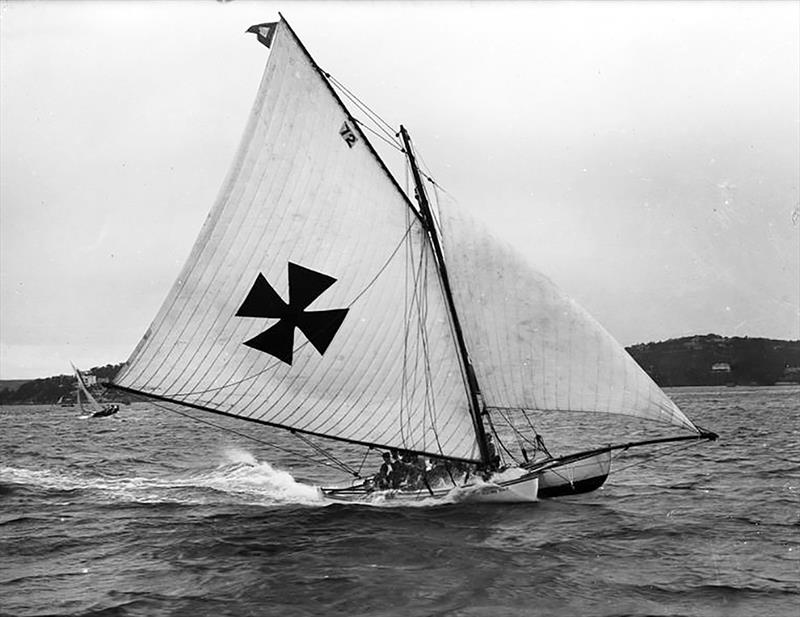
Flying Fish © John Steamer Stanley
Mark Foy fathered the sport of 18 footer racing when he staged a regatta, featuring his spectator-driven concept, on Sydney Harbour in January 1892, but Foy was far more than a 'one-trick pony'.
Born in the southern Australian state of Victoria in 1865, Mark, who was a retail businessman and entrepreneur, came to Sydney NSW with his older brother Francis and in 1885 established a new business under his father's name, 'Mark Foys'.
The business expanded rapidly with more surrounding stores opened and a London buying office set up in 1890. Four years later, a 'Mark Foy's Fair', sale usually staged twice a year, became a highly anticipated event on the Sydney shopping calendar. (the first 'half-yearly sale')
A large retail department store was opened in 1908 near Hyde Park in the Sydney CBD area.
Described at the time, "Mark Foy's massive new store, known as 'The Piazza' and designed by architects McCredie & Anderson, is a three-storey store (two floors plus basement) with turreted mansard roof and partly modelled on the grand Bon Marche department store in Paris."
Foys' preference for grand 'style' had already been on display in 1904 when he created the Hydro Majestic at Medlow Bath in the Blue Mountains, west of Sydney.
The hotel featured recreation facilities and amusements and was one of the most fashionable resorts in Australia. The hotel had its own electricity plant, library, hotel shop, billiard room, grand dining room, art gallery and a telephone in every guest room.
From 1906 it was advertised as a luxury hotel for the rich and fashionable providing fine food and entertainment. It was patronised by many famous people like Sherlock Holmes' creator Sir Arthur Conan Doyle. Dame Nellie Melba sang at the hotel a number of times as did English Opera singer Dame Clara Butt and Nellie Stewart.
Additionally, Mark Foy was a keen sportsman with interests in rifle shooting, boxing, sailing and motor racing.
As a motor car enthusiast, he owned numerous vehicles and participated in many motoring events. One of his vehicles was a Panhard, which was described by a local newspaper in 1905 as "the first of the powerful French motors to reach Australia". During the interview he told the reporter that at that time he had fourteen cars in his stable - two Daimlers, two Panhards, seven De Dions, one Liberia, one Firefly and one Oldsmobile.
The highly-motivated Foy was only in his mid-20s when he soon realised that the wonderful Sydney Harbour sailing area attracted little, or no, public interest.
Combining his professional business acumen with his promotional awareness, he saw the potential of creating a popular public sporting event and set out to solve the problem.
In 1891 he founded the Sydney Flying Squadron and challenged the sailing conventions of that time by introducing coloured sails and prize money, and the SFS boats were banned from the national 1892 Regatta because they carried the coloured emblems. It was claimed that the emblems spoiled the look of the white sails on Sydney Harbour.
In response, Mark Foy organised an opposition regatta which he financed himself and advertised it as a spectacle which could be enjoyed by all members of the public regardless of their social status.
His boats had to be more colourful, more easily identified for spectators than by a small number and the racing had to be more exciting and faster. The winner also had to be the first boat which crossed the finish line.
He whipped enthusiasm to a fever pitch with high-pressure publicity, hired bands to play at ferry terminals, on spectator ferries and on a specially chartered flagship. He also hired a band to play on Clark Island, which was Foy's 'grandstand' for the day's racing.
Clark Island was packed to capacity, as were the moored spectator ferries along the course, and every available vantage point on both sides of Sydney Harbour. The crowd was unprecedented, yet most of the spectators knew little about the sport.
Three races were staged on the day and the success guaranteed the future of 18-Footer racing. Foy had demonstrated that it was the most exciting participant and spectator sport ever seen on Sydney Harbour.
A vast majority of the people were there to thrill to the excitement Foy had promised. By the end of the day, they were 'sold' on Foy-style sailing races on Sydney Harbour, and are the forefathers of the 18 footer competitors and spectators of today.
In 1898, as Commodore of the SFS, he took his 22 footer Irex to England to participate in Australia's first International Race. Although he didn't win the race, it was a ground breaking event as it began a long history of international competition.
Foy was convinced that the Australian 22-footers could beat any similar-sized boats in the world and had a silver shield, the Anglo-Australian Shield, made up for his challenge.
Foy negotiated with the Medway Yacht Club, East of London on the type of boat they would use, and they eventually agreed that the combined hull length, waterline and beam should be the same total.
Maid of Kent, the boat the Medway Yacht Club chose for the challenge was considerably different to Irex. The only similarity was that the combined deck length, waterline length and beam totalled 53'6" in both boats.
Medway Yacht Club Commodore W.Wylie was a well-regarded amateur sailor and financed the boat and was the nominated skipper, but his wife Marion, a sailor in her own right was to steer. Foy was unable to take any of Sydney's crack skippers with him and steered Irex himself.
Over the 13 mile course, Maid of Kent won by 11 minutes. Foy was gallant in defeat, but it must have been a huge disappointment when he had to hand over the silver shield he had commissioned and expected to take back to Sydney.
Foy had trouble getting the Medway Yacht Club to allow the next challenge to race on different waters. Foy wanted no more than two races on the Medway, but the club, as the holders of the trophy, insisted that according to the original document, the winning team had the right to decide where to race.
Foy made regular announcements between 1904 and 1910 that he was going to England but it wasn't until April 1910 that the Medway Yacht Club finally accepted the challenge with the original rules and Foy announced again that he was going in June and taking Chris Webb and a crew of three with him for the scheduled contest in September.
The Medway Club then announced in June that all contestants had to be amateurs and by British standards anyone who accepted prize money for racing was a professional. Australia didn't have the same definition and even Foy himself was considered professional by this definition.
Eventually Foy sent them an ultimatum and they replied that the challenge could not proceed and in July the Medway Yacht Club handed Foy the Shield.
With 18 footers racing in New South Wales, Queensland and Western Australia during the early 1900s, Foy introduced a new interstate trophy, the Mark Foy Challenge Cup, at the beginning of the 1911-12 season.
His original intention was for the trophy to be presented to whoever won five times, but when he realised this was not going to be possible, he reduced the number of wins to three and the legendary Chris Webb eventually became the winner of the trophy.
The inaugural event was held in Perth in 1912 and, after a thrilling race, Chris Garland's Westana (WA) defeated Nimrod (NSW), by just 5s in front of a crowd estimated at 10,000 spectators. That victory is now recorded as the first official winner of the Australian Championship.
In 1935, Foy next introduced the Mark Foy Australian Challenge Cup for competition between open or half-decked Australasian boats from 18ft-24ft and would be won outright after three wins by the same owner.
The trophy was never contested and remained in the Foy family's possession until Mark passed away in 1950 at the age of 85, when it was presented to the Sydney Flying Squadron.
Mark Foy is regarded as one of the most significant historical figures in Australian sailing and in October 2019, was inducted to the Australian Sailing Hall of Fame.
John Winning and class historian John Steamer Stanley wanted to honour Foy and his determination to make the sport international, and came up with the concept of the Mark Foy Trophy competition, which is now sailed at various locations around the world.
Credits: John Steamer Stanley, The Open Boat Website, Robin Elliott's 'Galloping Ghosts', Wikipedia