America's Cup- Significant win for Emirates Team NZ in Jury Room
by Richard Gladwell on 9 Oct 2012
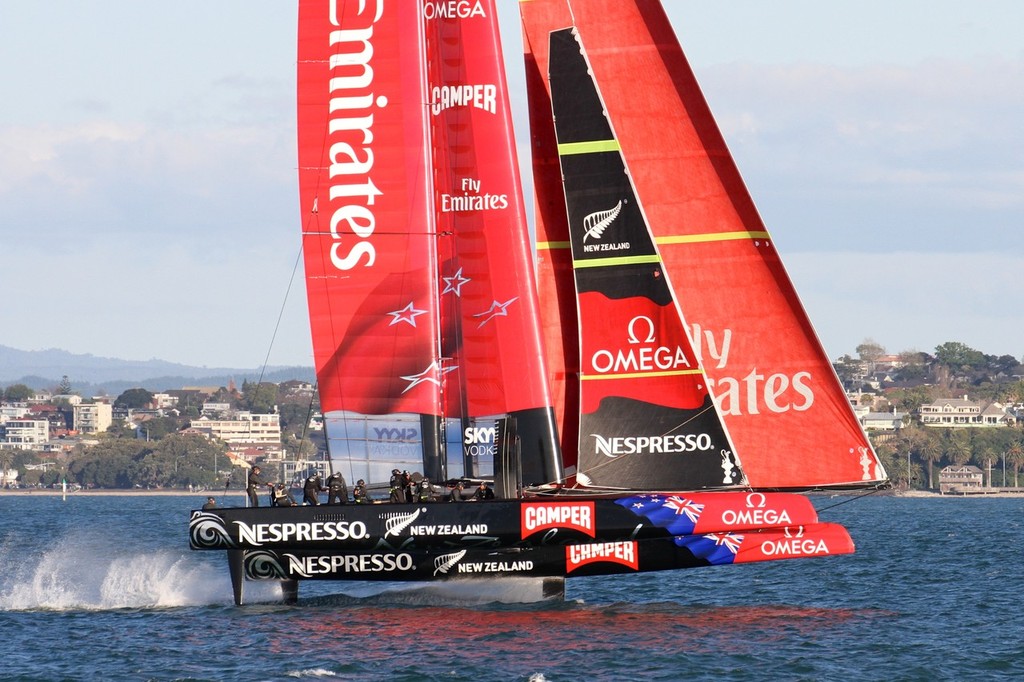
Emirates Team NZ’s AC72 sailing on hydrofoil daggerboards. the bigger volume boards permitted under the Jury Interpretation will allow her to foil earlier and in a more stable flight. Here she is sailing almost directly downwind in a light 10-12kt breeze Richard Gladwell
www.photosport.co.nz
Emirates Team New Zealand have been handed a small but very significant victory by the International Jury for the 34th America's Cup.
In a decision dated October 7, 2012, the Jury has ruled on an application lodged by the New Zealand team on September 24, 2012, which queried a Public Interpretation given by the Measurement Committee.
That in turn was a clarification of an earlier Interpretation given by the Measurement Committee on July 12, 2012 - a week before Emirates Team NZ's AC72 was first unveiled and launched. She has now been sailing over two months, foiling on her fourth sail.
It is that foiling ability which appears to be at the heart of the very intricate rules interpretation given by the International Jury.
The simple question centred around whether an AC72 had to be presented in her measurement condition, with the daggerboards raised or lowered.
The Measurement Condition is an official phrase for a state of floatation of the AC72 where each hull must displace 45% or more of the total volume of the catamaran.
Emirates Team NZ's view was that the rules stated there were two measurement modes - one with the AC72 in Measurement Condition to determine the volume of water displaced by the hulls (which has to be at least 45% each).
The second measurement is MWP (the floatation plane when the AC72 is in Measurement Condition - effectively the Loaded Waterline Measurement - which is used to calculate the maximum wingsail height and other measurement points above the MWP datum).
Due to sloppy rule drafting the class rules could be literally interpreted to read that the AC72 was in one mode for the Measurement Condition calculations (ie checking that the hulls each displaced more than 45% of the total displacement).
The boat could then be remoded for the second measurement calculation of the MWP.
The point at issue being that in the first measurement (Measurement Condition) Emirates Team NZ argued that their daggerboards could be raised, and then lowered for the second calculation (MWP).
Positive Flotation
Daggerboards produce positive flotation when lowered, and it had been calculated that if the AC72 was measured (for MC), with the daggerboards in the lowered position then the volume of the daggerboards could be no more than 225 litres - which is quite minimal for hydrofoiling, and would make flight more difficult.
If that daggerboard volume was exceeded, then it was likely the the hulls would not meet the 45% minimum displacement requirement.
By being able to measure the AC72 with bigger daggerboards, designed to allow the AC72 to hydrofoil more easily, and for those daggerboards to be raised - therefore not affecting the MC calculation to the same extent, Emirates Team NZ have gained a significant advantage over teams who have opted for smaller daggerboards in the lowered position.
The International Jury agreed with Emirates Team NZ's literal view of the rule, the Measurement Committee had erred, when they had made an interpretation based on their 'perception of the intention of the original authors'.
The International Jury took the view that teams were entitled to take a literal reading of the rules rather than have to take into account the perceived intention of the rule writers.
Oracle and Artemis oppose
The America's Cup Defender Oracle Team USA and the Challenger of Record, Artemis Racing sided with the Measurement Committee's view.
Oracle said in part 'ETNZ have built boards whose volume is greater than what is allowed in rule 1.4(k). It seems that after failing to have the measurement weight of the yacht increased for calculating displacement to make their hulls and appendages legal, they are now trying to create compliance by having the weight of the appendages count but the volume of the appendages set aside. '
Artemis Racing claimed that the 'Application was an attempt by ETNZ to change the AC72 Class Rule to suit their own interest'.
Luna Rossa, who have purchased a basic hull design package from Emirates Team NZ, believed to be similar to the AC72 currently sailing, which would have been orientated for bigger volume foiling daggerboards, agreed with the position taken by Emirates Team NZ.
Team Korea, although entered as a valid Challenger, did not make a submission that was reported by the International Jury.
America's Cup Race Management backed the Emirates Team NZ case saying the case had 'arisen due to inconsistencies in the drafting of the Class Rule.' The race organisers submitted that 'when drafting the Protocol it was considered important the competitors be able to rely completely on the Class Rules as drafted ......and not to be prejudiced by new rules unless they have consented to them, even if the outcome of applying the plain language used in the Class Rule has an unintended outcome.'
'CRM also submitted that the history of the America's Cup had many examples of technical innovations exploiting provisions of the Class Rule not considered when it was drafted 'and is often accompanied by determined efforts on the part of other competitors to outlaw the innovation. Innovation of one competitor is rule breaking to another.'
ACRM noted that in issuing the latest Public (Rule) Interpretation the Measurement Committee had 'acted in good faith and endeavoured to interpret the AC72 Class Rules in accordance with their view of the intent of the Rules and avoid an outcome that was not intended.'
Jurisdiction exceeded
In its Decision the International Jury found that the Measurement Committee had exceeded its jurisdiction when it had effectively amended a class rule, by way of an Interpretation, and was directed to withdraw it.
The Jury concluded by saying that that daggerboards may be retracted when calculating the percentage of displaced volume of the canoe bodies when determining compliance with the definition of 'hull'.
ACRM submitted that as the issue had arisen from a drafting oversight that competitor's costs should lie where they fell, and not paid by the erring party - as is normally the case.
Had the decision gone against Emirates Team NZ, they would have been forced to discard two of their daggerboards, believed to cost $400,000 each, and would have wasted two of their count of 10 foils permitted under America's Cup Rules.
Their AC72 would not have been able to foil as easily and steadily as it does currently.
Waterfront scuttlebutt has it that the ETNZ AC72 has been able to gybe while fully foiling at speeds of 40knots - which if true is rather impressive.
Oracle and Artemis are now in the situation where they have to consider the value of going to bigger foils.
The http://noticeboard.americascup.com/wp-content/uploads/2011/08/JN051.pdf!Decision_of_the_International_Jury cannot be appealed.
For Martin Tasker's report on TVNZ http://tvnz.co.nz/sailing-news/jury-decision-boosts-team-nz-video-5124078!click_here
If you want to link to this article then please use this URL: www.sail-world.com/102755