America's Cup- Ex-Oracle design chief looks at the Class of 2013
by Richard Gladwell on 15 Jan 2013
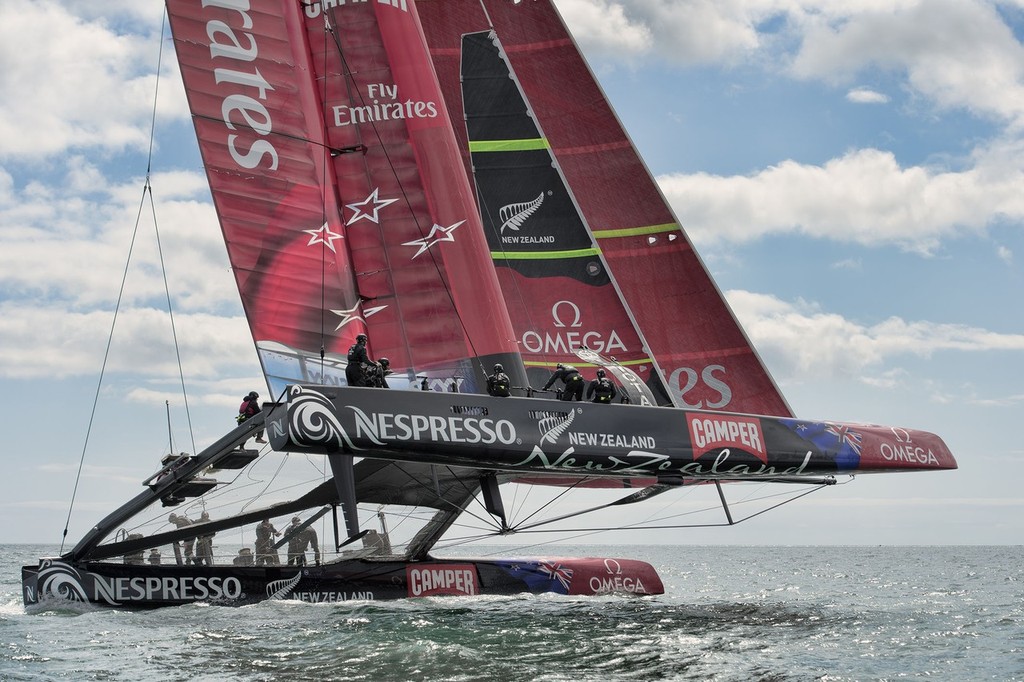
Emirates Team New Zealand. shows the Y-structure used to support loads on their AC72 Chris Cameron/ETNZ
http://www.chriscameron.co.nz
Mike Drummond has been involved in the design side of four winning America's Cup campaigns, starting with then Team New Zealand in 1987-2003, before joining Alinghi in 2007 and latterly was the Design Director for Oracle Racing in the 2010 America's Cup, and heavily involved in the development of the wingsailed 120ft trimaran USA-17.
That America's Cup regatta was his second Deed of Gift Match (sailed between just a single Defender and Challenger under the terms set out in the 19th century Deed of Gift which governs the America's Cup), Drummond was also involved in the design of the Big Boat for Sir Michael Fay, in the 1988 America's Cup.
[Sorry, this content could not be displayed] He was admitted to the America's Cup Hall of Fame in 2010 in recognition for his achievements in design.
Drummond left Oracle Racing to pursue other interests, during the current America's Cup cycle. He's also an excellent catamaran sailor in his own right, with several top performances in the singlehanded A-class catamarans and two handed one design catamarans.
Sail-World caught up with Drummond and asked his overall impression of the four designs currently working up towards the 2013 America's Cup regatta.
'From the design point of view there are three and a half groups,' he counters. 'Emirates Team NZ and Prada look like they have identical hulls and wingsails, but with different foils.'
'Overall I think Emirates Team NZ has a good, straight forward, conservative boat with lots of volume, and a well proven structural arrangement. The wingsail is straight out of a C-class evolution. They have correctly focused on foil over wing development.'
'Although they have added fairings, it looks like Emirates Team NZ still have a high windage platform - with their centre spine and rigging and so forth. That is not critical at this stage, but it’s a safe assumption their second boat will be similar, so there is a limit to the amount of drag reduction they can achieve.
The flip side is they’ve had a good robust package where they have been able to go sailing from Day 1 and learn about this new class of yacht which they can then feed into their second boat eventually.'
'These boats are very high speed and high on apparent windspeeds. Their windage as a proportion of their total drag is much higher than in monohulls and so it needs to be a higher priority in the design'
[Sorry, this content could not be displayed]He expands to say that the windage issue is not just turbulence around the rigging and the platform (multihull-speak for the combination of hulls, beams and decking) but also relates to aerodynamic efficiency. There is a very large gap between the Emirates Team NZ wing and the surface of the water (which Oracle Team USA have resolved somewhat with their central pod structure which forms an 'extension' to their wingsail and improves the effective span below the platform.)
'In light airs that drag and inefficiency is very large - of the order of 5% compared with a perfect seal - which is close to 5% of boat speed. The drag percentage reduces in strong winds but there is still a gap ', he adds.
Hence Oracle’s solution with a centre pod doing double duty as a structural member and forming a solid aero barrier, together with a horizontal deck surface. The effect is that Oracle is able to carry the lift from the wingsail much closer to the water surface. Beyond that Drummond wouldn't discuss further specifics of the pod or how it was designed to work.
Efficiency over structural stiffness
Emirates Team NZ and Oracle Team USA have taken quite different approaches in their first AC72's.
'Oracle has gone for an emphasis on the high efficiency and the greater speed potential. The tradeoff is in the structure. The class rule has a maximum weight and even lightweight fairings weigh something, so you can’t just add laminate without reducing material elsewhere'
Emirates Team NZ have opted for a Y-type structure (with two tubes running aft forming the top of the 'Y' and joining at the mast with a center spine which is also the prod, or sprit, running forward). Drummond explains that this Y-structure, similar to that first used by the 40’ Alinghi cat and later the 120ft Alinghi 5 catamaran in the 2010 America's Cup, is very stiff in torsion.
'Oracle dispense with that, so that the torsion is carried from the windward hull to the leeward hull through the twisting of the cross beams. The Oracle beams are much smaller in section and materials in torsion are less stiff than materials in tension or compression.
'Simplistically, Oracle's twist is coming from the fact that windward shroud has more load than the leeward shroud because it is supporting the wing and sails. That windward shroud is aft in the boat because it has to provide forestay tension. That offset results in twisting the beams.
'Everything deflects under load.'
Drummond's view is that the platform twist, which is a notable feature of Oracle's AC72 is stemming from the design choice made in the structure to support and distribute the rig loads into USA-17's platform. Oracle have decided to accept a less stiff structure to achieve lower aerodynamic drag.
'That is primarily where Oracle's twist is coming from. Emirates Team NZ will twist as well, of course, but that Y-structure has the loads being transferred by a structure that is in tension and compression rather than being one of torsion, which Oracle are running.
'Also on the Emirates Team NZ AC72, the truss-type structure naturally has a shorter path between the load points, whereas Oracle’s load path is longer and indirect going along the hull and then along the beam from shroud to mast step.
As the boat starts to heel the load difference between windward and leeward shrouds rockets up until the windward hull is clear of the water – when righting moment is maximum – thereafter the shroud loads don’t change very much. 'As soon as you start flying a hull, you begin twisting your platform, and when you are flying a hull the twist should be nearly constant. The boat winds itself up, but stays fairly constant in that wound state', he adds.
'There is some issue with the wings on the rudder, as to whether they are in the water or out of it. That is something for the designers and sailors to figure out - and get the right balance of heel angle or pitch angle of the winglet, and then just set up to that mark.
'Any load on the windward hull eventually gets reacted to by the leeward hull. If the windward hull is moving, the only thing causing that hull to move would be the load on the windward shroud.'
Drummond goes on to explain that if the load on the windward shroud is changing, then that can only be caused by changing aerodynamic forces from the wingsail being transmitted down the windward shroud, and into the after end of the windward hull which twists upwards in response.
Addressing platform twist
[Sorry, this content could not be displayed]Turning to the twisting forces on the leeward hull, Drummond says 'the leeward hull is reacting to water loads, such as buoyancy and foil forces. If you hit a wave - that wave is trying to pitch the bow up, or a change of angle of attack on your board, that will lift or drop the hull. Those loads will still get reacted through the windward hull.
'You would expect to see the windward hull follow the leeward hull, but there will be an inertial lag because the wing and windward have mass, so the crossbeams wind up a little bit before the windward hull moves.
'From what I have seen of the movements and the loads, I think that everything is coming from the leeward hull, and you see that in the behavior of the windward hull.
'I don’t think the windward rudder going in and out of the water has any significant effect on the platform structurally, but it must have a greater effect on the foiling balance and behavior.'
Of the 'three and a half' designs seen so far in the build up to the 2013 America's Cup, two seem to be foiling successfully, with the other two, not foiling at all, or having unstable flight.
So far, Luna Rossa and Emirates Team New Zealand are foiling very easily, but Drummond's view is that none of the teams are certain to the degree to which they are going to foil.
Artemis look like a semi-foiling boat – their boards and lack of rudder elevators mean they can’t fully fly. They can improve with new foils and large elevators but I don’t know how far they can go. Overall they seem to have emphasized wing development.
[Sorry, this content could not be displayed]'Oracle are expecting to fully fly but have a different solution to Emirates Team NZ in the fore/aft position of the boards as well as the foil design. Emirates Team NZ have found a stable foil design and my guess is this has allowed them to place the board further aft.
'When they launched no one would have been completely sure about how much time they would be foiling. It is mostly be dependent on boatspeed – upwind there will be less foil loading in all windspeeds, and downwind in light airs. The crossovers are what everyone is trying to find out, at present. Because multihulls get very little dynamic lift from the skinny hulls the wetted area drag is very significant at high speed, so foiling is essential to improve top end speed.
'They all know they will be foiling to some degree, whether that is 70% of the weight of the boat is on the foil, and 30% is by hull displacement, or 100% is on foils.
'The aim has always been to 100% foil, but it is hard to manage without a control system. And you can foil at much lower speeds by having more pitch angle and more camber and more area on your foils. But the big question is 'is it faster?'
Drummond estimates that the critical speed to achieve foiling flight is around 18-20knts of boatspeed, but he stresses that is only a guess. In windspeed terms, and given that an AC72 will sail at around double the actual windspeed. It means that downwind foiling should be possible in 9kts of breeze or more, but upwind it would take substantially more wind to achieve the almost 20kts of boatspeed necessary to lift up onto the foils.
The question of upwind foiling in the AC72, while spectacular is not necessarily efficient in terms of getting upwind to the next mark as quickly as possible.
'On the AC72, you have this long slender hull which doesn't displace very much. Below 20kts it is very hard to beat that hull shape for drag. These boats are very efficient.
'When you are sailing at speeds over 25kts, that is when it really pays to get rid of wetted surface area', he explains.
In Part 2 - to be published tomorrow, we cover the trade-off with foiling and second generation AC72 issues and options, and Oracle's capsize.
If you want to link to this article then please use this URL: www.sail-world.com/105594