Sailor of the Century- Eight solo circumnavigations for Minoru Saito
by . on 23 Sep 2011
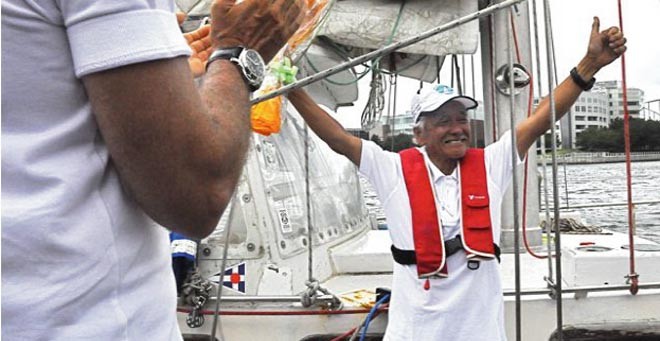
Saito finally arrives triumphant SW
He has done it. Minoru Saito, seventy-seven year old Japanese solo sailor, has completed his eighth solo circumnavigation. There were times when it seemed as though the famed hardy sailor would never make it, but that would be to underestimate the incredible toughness of this gentle hero. He is now the first - and oldest - sailor to make eight circumnavigations solo.
So, flying both the Japanese and U.S. flags, his yacht, Nicole BMW Shuten-dohji III and her beaming skipper this week eased into Yokohama Harbor to be greeted by a throng of supporters, well wishers, and media.
It was one of those moments that are recorded forever in memory. And this was definitely Minoru Saito's moment.
Feted in Japan as a national hero, revered in all cruising sailing circles, his arrival was recorded by Fuji TV, Japan's top TV network, and the morning news carried an unusually long interview.
After an incredibly tough trip, Saito's much-repeated admonition of 'Never give up!' is just what Japan needs to hear in the aftermath of the Great East Japan Earthquake on March 11, the tsunami devastation, and the nuclear-reactor(s) disaster that followed and is still very much a national crisis.
Japan has never needed a hero as it does now, someone to admire and see as an embodiment of the nation's ability to cope. Someone just a bit bigger than life who can say something to the effect that 'See, I could do it, and it wasn't easy, but so can YOU…' as the country gets back on its feet again, bowed, shaken, but still unbroken.
Even before he set out Saito-san has an amazing record of achievements in sailing:
He participated three times in the single-handed, around-the-globe competition originally called the BOC Challenge, then Around Alone, and renamed the 5-Oceans Race in 2006.
He has started and finished eight solo circumnavigations of the Earth, the seventh non-stop, achieving several international honors and world records.
In his continuing career, he has become the most experienced blue-water yachtsman probably on earth but certainly in Japan, with transoceanic voyages totaling more than 265,000 nautical miles — almost exactly the distance to the moon.
In January, 2007, Saito was named the winner of the highly vaunted 2006 Blue Water Medal, considered the top international award for adventure sailing. He was also inducted in 2006 into the Single-handed Sailing Hall of Fame in Newport, Rhode Island. In both instances he was the first Asian sailor to be chosen for the honor.
So why was his voyage so difficult?
Just for starters, it was the 'Wrong Way Around'. Sailing west-to-east to circle the globe in a wind-driven craft is no small feat but rarely is the plan to go westwardly instead — the 'wrong way around' — against the prevailing winds, currents and waves. This route puts immense stresses on the vessel and crew, and for solo sailors, days can pass with little or no sleep when the going is particularly hard.
Few single-handers have attempted such a feat and certainly none near Saito's age He started in October 2008 in Yokokama and when he finished his voyage he had already turned 77.
Saito's vessel had problems. He stopped for repair in Sydney, Australia in November 2008, in Fremantle, Australia in December and in Cape Town, S.Africa in February. He was disabled with rudder problems at Cape Horn, Chile in April, 2009. He was towed to the world's southernmost city, Punta Arenas, Chile, where he over-wintered and carried out repairs.
A second attempt around the Horn was successful, but sail and engine problems forced him to return to Punta Arenas, where he again attended to repairs. He restarted the circumnavigation in late January, 2010. He still had engine problems and stopped at Valdivia, Chile in February 2010 to get spare parts.
The epic story continues from there, as he over-wintered in frigid southern Chile, undergoing an emergency operation for a hernia, later narrowly missing an earthquake in Chile, then a year later an even more destructive earthquake in far-off Japan that sent waves washing into the Honolulu marina where his boat was undergoing repairs. While in Hawaii a motorist absent-mindedly turned as Saito used a pedestrian crosswalk, sending him back into an operating room for repairs to an injured knee. Police judged the motorist at fault.
Finally able to depart Hawaii in May, he crossed the Pacific to the Japanese island of Chichijima, where more repairs were done. He waited out four passing typhoons, and then a fifth typhoon directly hit the island. That one, named Talas, forced him to spend a solid week on board making sure his lines stayed safely secured to a big-ship mooring far out into the harbor. Even Coast Guardsmen staffing a station on the island were impressed by his fearless dedication witnessed through binoculars from shore. 'He’s the talk of the island, and many of the fishermen here are concerned about him,' a senior officer told Saito’s shore crew in Tokyo.
So now he's home to a hero's welcome, and there's no sailor in the world more deserving.
If you want to link to this article then please use this URL: www.sail-world.com/88813