Rolex Sydney Hobart Race – Left field, handshakes and buckets
by John Curnow on 22 Dec 2016
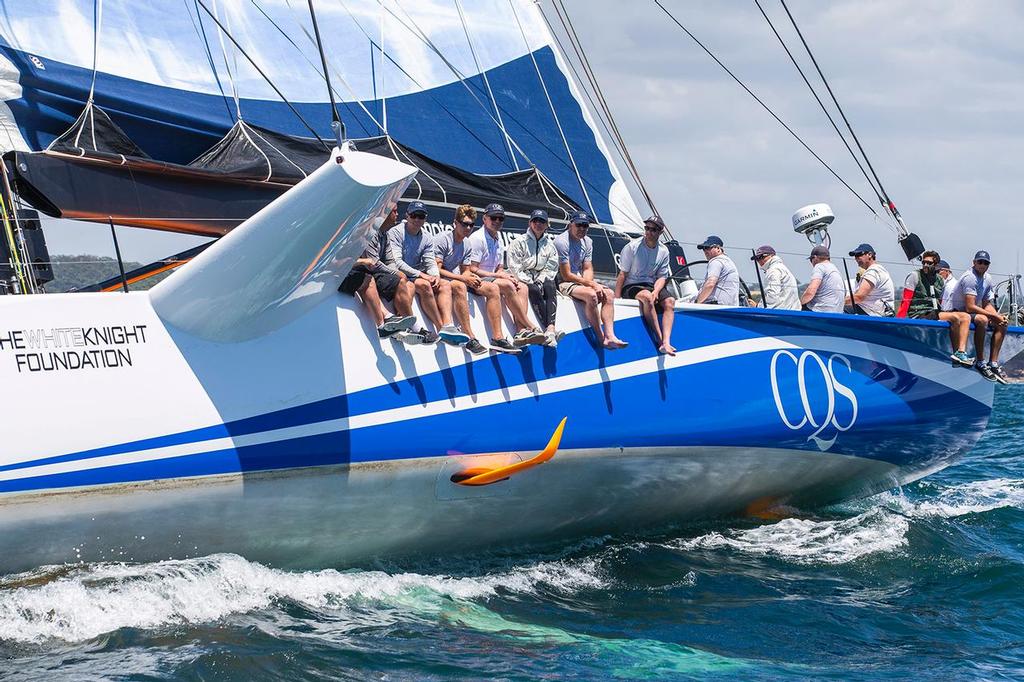
The full accoutrement of CQS. - CYCA Trophy Passage Series Andrea Francolini
Dual Hobart Line Honours winner, Ludde Ingvall, and his billionaire cousin, Sir Michael Hintze, are tilting at the windmill in the 72nd Rolex Sydney Hobart Race. They started on a handshake watching the famous Boxing Day start two years ago, and now for the 2016 race, they have the most radical supermaxi in the event’s history.
A Swedish born Australian, Ingvall firstly took his 78-footer to a Line Honours victory in the 2000 race, before repeating the performance once more with his 90-footer in 2004. Both vessels were named for the primary sponsor, Nicorette. However, Ingvall began to lose interest in the classic blue water event when the removal of the handicap ceiling in 2005 started an arms race.
In this three-part series, Ludde Ingvall opens up on the radical CQS challenge for this year’s Line Honours victory. “My cousin, Sir Michael Hintze, has never done the yacht race in his life, which is why we are doing it. Michael comes from our mother’s side. His grandparent fled from Russia during the Bolshevik Revolution in 1917. Michael was born in China in Manchuria, and then when Mao Tse Tung came to power, the family ended up in Australia. You could say as boat people, and of course my journey has taken me to Australia too.”
“Michael’s father was a lecturer at Sydney Uni in engineering. They grew up in Coogee, and with his family as everybody used to do; they used to watch the Sydney Hobart start year after year. Then after a stint in the Australian Army, he had a very successful career (he founded the British based Hedge Fund Manager CQS).
“In London, we were up watching the Sydney Hobart start together with our wives and our kids when Comanche was here for the first time in 2014. Comanche took off and Michael said ‘Wow that is amazing, looks like game over’, and I said ‘No I think that Wild Oats will still win. I was right, as history shows.”
“It was during that very television broadcast Michael said to me, ‘You know Ludde, going to Hobart has always been on my bucket list. It is one of the things that I want to do and I am retired now.’ I then said, Michael, with you, I will do it one more time, and that’s when it all started. We shook hands and within three or four months we had put the band together.”
Ingvall then pointed out that besides building a new boat, there were three things they could do with what they already had, in the guise of the existing 90-footer, Nicorette.
Firstly, they could look at what she could do as a boat optimised for IRC. She could be in the second group, hoping that our rating was low enough that we can do well in our division and also overall, just for fun.
Secondly, they could turn her into a significantly slower boat with a nice interior, and then cruise down. Ultimately they passed on that because they thought to themselves, ‘Why would you take a big boat and make it slow?’ So that was not very motivating.
The third option was to do ‘a little bit of tweaking on the boat we have got’, and that is exactly what they decided to do, originally.
However, Sir Michael has a strong engineering background, as well as business acumen, holding a Sydney University BSc. in Physics and Engineering, a Masters in Acoustics, along with a Harvard MBA. He loves technology, so they left it open for New Zealand Naval Architect, Brett Bakewell-White, and the design team to look at other alternatives.
Ingvall added, “I had done my first sketching on an underwater foil in about 2002. I was playing with the idea of what would a wing could do on the leeward side and so forth, and so I brought up several ideas.”
Brett said, “We proposed DSS foils for Rio 100, and because the boat was destined for the Transpac that could not be done, but I think your boat could be really interesting to play with that.”
“We thought what the hell. We will continue with the research, and in the end, that got so exciting that both Michael and I said, ‘Let’s do it, for better or worse, and then one thing followed another.”
“We were sure we were not likely to be in the class of Wild Oats XI. She is the fastest and best boat in the world. They have got the best crew, and they have got a fair bit of experience between them by now, but we said let’s do something different. Let’s have some fun, and maybe we can shake the apple tree a little bit with what we are doing.”
It was after they had done about half a year of work on DSS when the new IMOCA 60s arrived on the scene. Ingvall said, “Holy Mackerel. These are boats are on the same track, but why do they have a vertical foil? This was when we looked at the IMOCA rules. Of course they can’t have any more foils, so they have to do something like. Because we then knew that we were not the only ones who had chosen this track, the better they did, the more excited we got with what we had.”
“Brett was doing some amazing analysis on various options. So up came the concept of wings above the deck to bring the weight down of the rig, and also take the compression loads out of it. All the tests showed that the bow was lifting out of the water, and we said well look if the bow is lifting out of the water, then we don’t need to have a traditional bow.”
“We had done some research with the original Nicorette designers at Simonis | Voogd some years ago about how to improve the air flow of the bow. The problem is the only way that you can do this is to go with the reverse bow and have chamfer lines, and so now we have been able to do that.”
“It reminded me of the first world war battle ships, and I used to sit on my parent’s island in Finland in two metres of snow and glue together little modelling yachts and model boats when I was a kid, but gee that was a cool looking bow.”
“Also, with this new bow shape, the bow sprit would become impossibly huge, but then Mark from the Waterfront Engineering said, ‘We can triangulate a bow sprit to carry the strength of upwards loads and side loads.’ So, we have, but I can’t claim that I am smart enough of seeing what we ended up with from the beginning.”
“One day, Brett turned around and said to me, ‘Necessity is the mother of invention.’ Because we started with the 90-footer, and then started playing, we ended up with something that is totally different. Something that we would never have had the balls to draw and design, let alone fund and build, if we started with a white piece of paper.”
“With a white piece of paper you always tend to look at the best boats now, which means observing Wild Oats XI and Comanche. Then you see if you can tweak something to make something that is fractionally faster. However, we just went out on a totally different angle, and we have seen the research shows that this boat has amazing potential.”
Ingvall added, “Mostly we are going to have lots of fun with it, and we will learn a lot. I’m now 60 and to come back, have a bit of fun and to learn a lot sounds right up my alley. As you would know, I am not a good follower. I just think it is fun that we are doing something different. I hope people appreciate it, and at the end of the day we will learn a lot. Whether it is as successful as some people think, time will tell.”
“Now, we don’t think we will even reach 90% of the boat’s performance, but if we’re at 90% or near the other boats, then that means in the next ten months before 2017 race we are going to have a lot of fun”, concluded Ingall.
There are plenty more interesting revelations, explanations and comments in the subsequent parts two and three of ‘Left field, handshakes and buckets’. They will be here on Sail-World for you to read before the Rolex Sydney Hobart sets off.
Current routing, which has to be viewed in light of the changes that can and do occur on the East coast of Australia, especially at this time of year, has the supermaxis at 1 day and 13 hours, the maxis at 1:16, both of which are under record pace, which is 1:18 and some change. Note that this puts you at the iron pot at/near sunrise, which is not ideal. The TPs are at 2:1, displacement 40-Somethings at 2:19, older craft at 3:6 and small at 3:22. We’ll have more on all of this as the super all-important weather window first gets a frame, then panes of glass, well before any paint gets applied, let alone before any internal dressings, as the next few days unfold.
Ultimately then if you are looking for smiles yourself, then do keep a weather eye here on Sail-World.com for all the latest intel on the great, inspiring, captivating and very historic, blue water classic… The Rolex Sydney Hobart Yacht Race.
If you want to link to this article then please use this URL: www.sail-world.com/150605