The Boat Beaconory - almost AIS equivalent - and almost free
by Steve Bennett on 18 May 2012
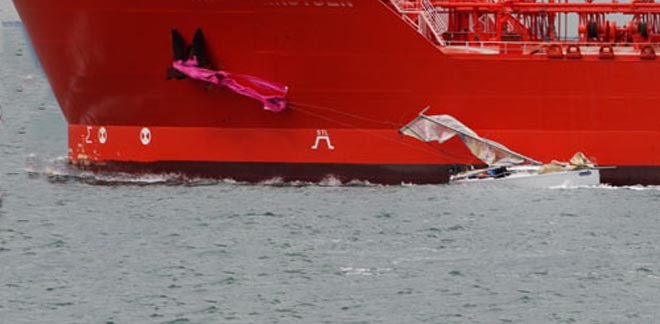
Don’t let it happen to you - photo John Forster SW
There are growing numbers of sailing Apps available, and here we bring you another one - Boat Beacon. If you do mostly coastal sailing within internet coverage , cannot or don't want to afford an AIS and possess an iPhone, this could be a useful App for you:
As long as you are within GSM coverage and there are AIS shore stations in your area then you can pick up AIS via the Internet and not only see over the horizon but anywhere in the world, and this is what Boat Beacon does. However, there were already some Apps doing just this, mostly designed for 'landlubbers'. So...
The beauty of Boat Beacon is that it also has a host of other additional 'Sailing' related features that any sailor would appreciate:
* A fully gimballed compass and rangefinder overlaid on the map so you can sight ships and shore stations, know their bearing and how far away they are.
* The ability to highlight other Boat Beacon boats around you so you can keep an eye on the race you are in or the flotilla you are sailing with and a ship-to-ship messaging feature so you can chat with them.
* The ability to overlay your planned route on the map (Waypoints) and show your track history. Its AIS transmit feature allows your family or significant-other to keep an eye on you wherever you are sailing, from a webpage on a computer at home!
Obviously, Boat Beacon should only be used for basic navigation reference in Coastal areas where there is internet and shore-based station coverage. It should not be solely relied upon to determine precise locations, proximity, distance, or direction. There is no replacement for the Skippers’ and their crews’ eyes and the Skipper’s ultimate judgement.
There are some possible drawbacks with relying on an Internet-based AIS for Coastal Navigation.
1. It relies on you having Internet coverage, however most popular coastal areas in the US, for instance, have cellular data access extending 12 or more miles out to sea. The UK has nearly complete coastal coverage out to 12 miles.
2. It relies on AIS shore stations covering your area. The network of stations Boat Beacon can access covers the majority of popular coastal and harbour areas. It typically has live data available on over 45,000 ships around the world and coverage is continually increasing. In the unlikely chance that there is no coverage in your area then club together, set up a shore station and join the network! (In some cases, shore-based receivers can be provided for free - see Marine Traffic's site.)
3. You won't show up on the big ships’ AIS systems unless they have an Internet AIS feed too. However, as all long range cruising sailors have learned, even if they can see you they are unlikely to be able to do much to avoid you in time!
To learn more, go to the http://boatbeaconapp.com/!Boat_Beacon_App_website. It is currently priced at $9.99. (Why don't they just say $10?)
How Boat Beacon came to be invented by Steve Bennett, in his words:
I sail a 30 foot Catamaran in the Bristol Channel, one of the most challenging areas of water in the World due to its high tidal range, currents and sandbanks - see http://www.bcya.org.uk/content/sailing-bristol-channel .
As with sailing in any waters, you need to keep in mind ports of refuge (most harbours dry), keep an eye on the weather (the channel faces West or South West, the direction of the prevailing winds) and keep a careful eye open for the very large vessels that use Bristol, Milford, Cardiff and Swansea.
With a following tide of up to eight knots these vessels can have a speed over ground (SOG) of over 25 knots (30 mph!) - 75,000 Tonnes approaching at 30mph! Judging their position versus yours as you approach the narrow Channel under the Severn Bridge is challenging even in good visibility - in poor it's beyond scary! It's vital you keep out of their way because they can't turn or stop quickly! At 25 knots they can appear from over the horizon in less than five minutes. Survival depends on you spotting them and getting out of the way. Even if they could see you they probably couldn't avoid you in time - you just 'don’t want to mess with them'!
The International Maritime Organization's (IMO) International Convention for the Safety of Life at Sea (SOLAS) requires AIS to be fitted aboard international voyaging ships with gross tonnage (GT) of 300 or more tons, and all passenger ships regardless of size. AIS works a bit like radar, but better. Ships continuously transmit their details and position and can be displayed on a live map display.
The Ship AIS units cost thousands of dollars. Small AIS receivers are available for around $400 which will allow you to show these boats on a computer screen including their course, speed and their MMSI - Marine Telephone Number - so you can call them up on VHF radio. But, that requires a large outlay and a computer screen or an even more expensive dedicated unit or Chart Plotter.
Worse than that there is also the horizon problem. An AIS receiver can only see as far as the horizon. For an aerial mounted at deck height as many are, the horizon is about one nautical mile away (http://en.wikipedia.org/wiki/Horizon). A ship with its AIS aerial at 10m above sea level has a horizon of about six miles. With an approach velocity of 28 knots it could be upon you from nowhere in 15 minutes. This is where the network of shore-based AIS systems come to the fore.
There were already a couple of iPhone apps available which will receive internet AIS data and plot ships' positions over a Google map. One such app, widely used by sailing fans (though not necessarily sailors themselves) love it for spotting, watching and learning about ships around the world from their desk or the harbour-side cafe. It has even been featured on CNN. I tried using it in the Bristol Channel and it was a decent app, but it's clearly aimed at landlubbers and there were several key features that, as a Skipper, I needed from an AIS app that this kind of app doesn’t provide. A couple of features that I would certainly desire in such an app are Collision Detection in the background and being able to transmit and share my position on global AIS systems being the next.
I wanted to be alerted if I was on a potential collision course with another boat that I might not even be able to see yet and I didn't want to have to keep checking a screen every five minutes.
There have been several collisions between small boats and ships reported over the last year. Fortunately no one has been seriously injured in the recent one below in the Solent at Cowes
I have been developing apps for mobile devices for over 15 years and decided to put that experience to the task of creating an ideal app for sailors like me - with the result being Boat Beacon. Not only will Boat Beacon display ships and their information on a Google map, it continuously monitors all ships within a 60 mile radius, five to 10 times further than a conventional AIS receiver on my boat could do, and calculates their Closest Point of Approach (CPA).
If any are going to be within 100m of me within the next 10 minutes, Boat Beacon alerts with an alarming Big Ship’s horn - plus a vibration and popup notification. We have tested it out in the Bristol Channel and on a misty day in the Solent and it has proved very reliable and accurate, with no false alarms and no missed alarms.
If you want to link to this article then please use this URL: www.sail-world.com/97339