Collision at sea, the unthinkable - Part III, Radar and Radio
by Nancy Knudsen on 5 Oct 2009
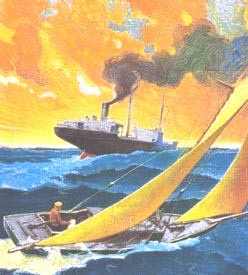
Sailboat and ship SW
Surely all else failing, a ship will be able to see a yacht on radar – especially if the yacht has a good radar reflector? Secondly one can call the approaching ship by VHF radio. These are ideas, understandably, often expressed, but both can be far from the truth, as the following small story will illustrate.(This is Part III of a four-part series)
So there we were, somewhere northwest of Darwin, on our way to Ashmore Reef, and travelling without an AIS.
Lazy day, sunshine, great visibility, wind behind us, lunchtime.
‘Ya reckon that container ship is on a collision course?’
‘Which one?’
‘The one on our starboard bow, about 1.00 o’clock, about three miles away’
‘O the BIG red one’
‘Yup’
‘Watch it for a minute’
Silence while we wait for the ship to shift angle…... No shift.
‘I reckon he’s going to hit us in about 10 minutes’
‘OK,’ I spring up, ‘changing course’
But the Skipper is either bored, or there’s a perverseness in the air today. ‘Just wait a minute, motor is meant to give way to sail, isn’t it?’
Sigh…. ‘You’ll never get an answer’
‘Maybe…’
'Ted how many ships have we tried to call for various reasons?'
Ted picks up the VHF radio microphone.
'Ted that's insane - they never never answer. What on earth are you going to say anyway?'
‘Red container ship on our starboard bow, this is yacht Blackwattle on Channel 16’
Very surprisingly, we do get an answer, and quickly. ‘Station calling Windhoven, please come in.’ It’s an Italian accent, well spoken.
Big smile from Ted. ‘Windhoven, this is yacht Blackwattle, do you read me?’
‘Yes, Blackwater, I read you – where are you?’
‘We’re on your port bow, and we believe we are on a collision course’
‘Just a minute, I can’t see you. Stand by.’
We wait.
‘Blackwater, Windhoven’
‘Windhoven this is Blackwattle – can you see us now?’
‘No, just stand by please, changing frequency.'
'Standing by.'
'Blackwater Windhoven – ah - I have a very small target on the port bow on my radar – is that you?’
‘Probably Windhoven. This is the Indian Ocean. We think we are the only vessel on your port bow, although we would rather not think of ourselves as a target. Could you change course please.’
I stare at Ted in disbelief. We've only been at sea a few days - has he gone mad or is he just enjoying himself?
‘Ah Blackwater, this is Windhoven – could you repeat?’
‘We are on a collision course and I asked you to change course.’
Pause. I don't know whether to grab the microphone out of Ted's hands or giggle.
‘We are a very large vessel Blackwater Sir.’
‘Yes I can see that. However,’ and now the Skipper is smiling, ‘the rule of the sea is that motor is meant to give way to sail, Captain, so, could you change course please?’
Now there’s a another silence. My hand is now covering my mouth to show that it's not me whose asking this. Will this poor captain even bother to reply?
‘Blackwater this is Windhoven.’ Very polite. ‘Er, it takes us five miles to alter course. Maybe you could be so understanding and change course for us please?’
‘Very well, Windhoven, with the greatest of reluctance, we shall change course.’
‘Thank you Blackwater Sir, have a good day.’
‘Thank you Captain and the same to you.’
We change course quickly and get to hell out of there.
This story illustrates, not only a little of the character of the skipper of Blackwattle, but also the reality of how little aware a ship can be of the existencce of a passing yacht. We would never suggest that one shouldn’t carry radar but they should not be relied upon for making the yacht’s presence known to a passing ship.
This is because, according to ship’s captains, except in conditions of poor visibility such as fog or rain, no constant radar watch is kept on a merchant ship. Quite frequently the radar is not even switched on at sea in clear weather.
Even if it is switched on, there are conditions that militate against the ship seeing a yacht.
Distance of Visibility:
To obtain maximum range a radar scanner is normally set high above the deck, the range obtainable being dependent upon the height of the scanner. It is obtained by the formula 2.2 times the square root of the height of the scanner in feet, gives the radar range in nautical miles. (This is a handy calculation, but means that you need to recalculate into feet if you are using metres.)
So say an island is 200 feet high, it would produce an echo on the screen of a radar set that had a scanner height of 125 feet at a range of 55.6 miles, provided the range of the radar extended that far and the island was large enough. Theoretically a yacht 40 feet high from the same radar set would be radar visible for about 38 miles. However, that is only theory, as the yacht blip would be far too small to be seen. A distance of around 10 miles in excellent radar conditions is about all that could be expected due to the yacht size.
Aspect of the yacht:
Much depends upon the aspect of the yacht and its radar reflecting properties. A yacht beam-on to the ship would produce a far better echo than end on, and probably a steel or ferro-cement hull would produce a better echo than a wooden or fibreglass hull.
Sea Clutter:
As the range diminishes so the echoes increase in the frequency of the ‘paint’ on the screen and become more visible to the observer, BUT the return from the sea clutter also increases in all but the calmest seas and this sea clutter tends to hide small blips in the ocean. As the anti-clutter control is increased to diminish the clutter, so the return echoes of small blips are easily missed in even moderate conditions. Should it be raining heavily then it is almost guaranteed that the small craft will not be seen, as in these circumstances even large vessels frequently disappear. Any yachtie who has used radar for tracking storms at sea will be able to confirm that any number of large ships could be masked by a decent size storm on the radar. (This is another excellent reason to avoid storms that show up on radar at sea).
Close Proximity:
Some ships have both a high mounted scanner for normal use at sea and a smaller and lower mounted scanner for use in harbours and proximity to ports where in fog it might be necessary to pick out navigation buoys, beacons, wharves and traffic at close quarters. But at sea, the larger set is nearly always used to give the maximum range for navigational purposes.
So, if a small craft is in close proximity to a ship at sea with a high radar scanner then the beam from the radar can pass OVER the yacht.
Use of Radio
One of the most common complaints of cruising sailors is now rarely heard, and that is the experience of calling ships and receiving no reply. This is because the introduction of compulsory Automatic Identification Systems(AIS) to all ships over 300 tonnes, means that the cruising sailor who carries one on board can CALL THE SHIP BY NAME and this has made an incredible difference to the number of ships who will answer the call. This does not negate the necessity to have the VHF turned on and the distress frequency Channel 16 monitored at all times....AND don't forget the the three minutes of silence on the half hour.
The other aspect that has improved as a result of the introduction of the AIS appears to be the fact that VHF radios are left on more frequently by ships than they were in the past. While it has always been recommended internationally, but it was not MANDATORY and unfortunately many ships were liable to turn radio off when away from ports.
The next difficulty is that there must be a common language with which to communicate. Now there is usually someone on a ship who can speak English, but they may not be on the bridge at the time that you call, and sadly, when this is the case, if you do NOT
If you want to link to this article then please use this URL: www.sail-world.com/61927