A Q&A with Don Adams about Sail Canada’s plan to win Olympic medals
by David Schmidt, Sail-World USA Editor on 8 May 2017
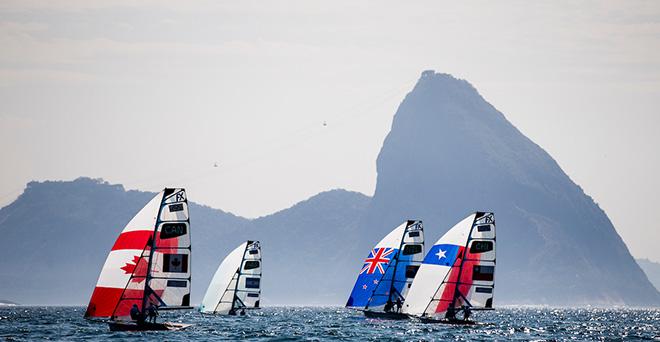
2016 Rio Olympic and Paralympic Games Sailing Energy/World Sailing
While Team USA has not been performing up to its historical competitive standards in the past two Olympic quadrennials, our neighbors to the north, Team Canada, have suffered a far worse Olympic-medal drought than the USA. In fact, ‘O Canada has not been played at an Olympic medal ceremony for sailing since the 2004 Athens Olympics, when Ross MacDonald and Mike Wolfs took a proud silver medal in the Star class. Since then, the team has sent talented sailors to the Games, but-for myriad reasons-they have not been internationally competitive (generally speaking) for the past three quadrennials.
In total, Team Canada has won nine sailing medals (three silver; six bronze) since they first competed in the sport at the Los Angeles 1932 Olympics, where they claimed silver in the 8-metre class and a bronze in the 6-metre class. For comparison, the two most successful Olympic-sailing squads are Team GBR, which holds a total of 58 sailing medals (28 gold, 19 silver and 11 bronze), and Team USA, which holds 60 medals (19 gold, 23 silver and 18 bronze).
Canada’s national sailing authority, Sail Canada, is trying to turn the tides on their performance streak, including implementing a new High Performance Plan that they hope will make Canada a world leader in high-performance sailing. This High Performance Plan consists of ten critical actions that are aimed at putting Canadian sailors on podium steps for the foreseeable future. These include a Talent ID system for identifying talented youth and helping them into the proper Olympic-development pipeline; fundraising, and celebrating success en route to Olympic wins and podium finishes.
I caught up with Don Adams, Sail Canada’s newly named CEO, to learn more about Sail Canada’s High Performance Plan and their multi-faceted strategy for helping Canadian sailors win Olympic medals while simultaneously helping to inspire younger generations of Canadian sailors to pursue the Olympic-sailing dream.
Can you tell me about Sail Canada’s new High Performance Plan? What was the impetus for this initiative, and how long do you realistically think it will be before the program starts to bear Olympic fruit?
Sail Canada is currently working on a High Performance plan. The impetus for the plan came through the realization that there was a lack of a clear direction moving forward with the national team program and a lack of performance results.
Over the past few quadrennials Sail Canada has not performed as well as it had hoped at the Youth Worlds and the Olympics, which called for an internal high-performance review. The internal review was conducted by a High Performance Sport Specialist and called for some major changes to the program structure and outlined a number of recommendations moving forward.
One such recommendation was the hiring of a High Performance Director that would be given the autonomy to run the High Performance Program in Canada. The High Performance plan will cover everything from High Performance Leadership, National Team Coaching, Development level Coaching, Goal Medal Profiles, Professional Development of Coaches, Athlete Pathways from Club to Olympic Podium, Canadian and North American Competition Structure, Daily Training Environment and Athlete Yearly Training Plans including “ on water” and “dry land” training, and Sport Science.
This will be a living document that will be modified as required moving forward. We hope this will provide the blueprint for Canada to get back on the podium.
Sail Canada has a small group of athletes that our coaches are working with for 2020. However, in revamping the system, we are working toward 2024 and 2028 when we think it will make a significant difference and we have a system that consistently produces athletes with medal potential
From your perspective, what is more lacking in Canadian sailing at the moment—dollars to fund the programs, or talented sailors and coaches?
The biggest issue at present is a lack of funds to finance the high-performance athletes and coaches to the level that is required to help the athletes reach the podium. This is being addressed.
We are focused on system development. We have a limited group of talented sailors coming through our current high-performance system. We are working with them to support them on their Olympic journey. However we are working to increase the number of sailors coming through the development pipeline [who] have the required skills to compete at the various competition levels along the athlete pathway such as Provincial Championships, National Championships, Youth Worlds, World Championship, Olympics and Paralympics.
We are building a system where the athlete will be confident that when they make the national team or are selected for the Olympics, they know they are the best in Canada and therefore amongst the best in the world and can compete for a medal.
What is the team’s fund-raising model? Do Canadian sailors receive help from the government (e.g., the “European model”), or are they responsible for significant amounts of their own fund-raising (e.g., the “American model”)?
Our current team-funding model is a mixture of the European Model and the American Model. Sail Canada gets a small budget from Sport Canada, the government agency [that’s] responsible for sport in Canada, to help fund our program. In addition the top-level athletes get a small stipend from the government that amounts [to] between $11,000 and $18,000 Canadian dollars per year, [which isn’t] sufficient funding to be a national team athlete and cover your cost.
The athlete unfortunately is responsible for raising sufficient funds themselves to cover the gap in their training and competition plan. Sail Canada is working to raise additional private funding through corporations and individuals to increase the funding made available to our top athletes.
Thus Sail Canada needs to have a clear Vision and High Performance plan in place to be able to partner with corporations and individuals to give our athletes the resources they need to be competitive on the world stage and compete at the highest international level.
How big of a problem is geography for Sail Canada’s medal-winning efforts? By this I mean that Canada—like the USA—is a physically huge country, making it logistically complicated for sailors to compete on national and international levels.
Geography is an issue. That is why we do not centralize and expect all our athletes to move to one central location. We believe this will disrupt the regional development and training of up-and-coming athletes.
Sail Canada is looking to develop regional training hubs, [including] one in the East, a couple in Central Canada and one in the West. High-performance athletes and developing athletes will be able to get the coaching they need through these regional Sail Canada Training hubs and at regional training camps.
What about latitude (read: low temperatures and limited training time)? Can this be overcome without lots of travel time?
Depending on the region of Canada, you can sail for seven months of the year to 11 months. Our high-performance plan will maximize “on-the-water” training combined with “dry-land” training [that will be] supplemented [with] training camps and competitions in the Southern USA and Southern Europe.
If you want to link to this article then please use this URL: www.sail-world.com/153472