
The tech curve…
by John Curnow, Sail-World.com AUS Editor 2 Jun 01:30 PDT
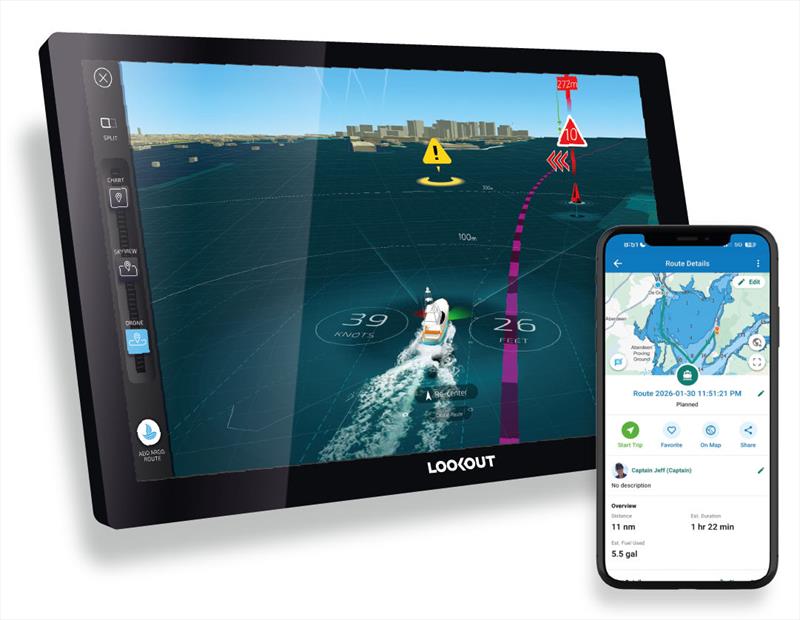
LOOKOUT and Argo Navigation Team Up to Deliver the First A.I. Adaptive Route Planning System © LOOKOUT
It just marches on. A wee look at the latest launchings for solo/crewed, mono/multi masterpieces are a tour de force when it comes to material science, electronics, engineering, physics and especially therein, hydro and aerodynamics. Slide rule and Hewlett Packard be damned. It's more like Cray meets data centre, and they have a love child.
Put simply, when you put it through the sieve to break it down into the oceanic exploits of mere mortals in defined and regulated spaces, is it outside assistance or not? It is a tough gig trying to firstly read it, let alone plan for it. Get the red paint out, and put the circles on your back type of stuff.
Good thing, then, that World Sailing's Oceanic and Offshore Committee has names like Stan Honey, Dee Caffari MBE, and Damien Foxall amongst its members. Its Chairman, Matt Allen AM, certainly knows a thing or two about arrows flying past one's ears, and you'd need to, for it is perilously nearly unnavigable, and a tough and thankless sort of a task.
Definition
"There's really a realisation now that technology in many forms is really starting to affect our part of the sport. It's coming in lots of different forms, and influencing outside assistance type rules. There are a number of issues, in terms of regulating the sport, and we just need to be able to make sure that different events can do different things," said Allen.
This is not about Vendée or Verne, nor offshore teams processing intel to transmit to those on board, nor LiDAR cameras and autopilots to trim sails/chase max VMG, which obviously enhance performance.
"So, to use some really simple examples like the Vendée or the Ultims can go and sail around the world, or do whatever."
"There are boats being built that don't have helm stations. That's proof perfect of totally embracing performance enhancing tech. What we are working on is ensuring that what filters down to the 'main body' enshrines inclusion. It is not about precluding those pinnacle achievements, but working out the demarcation."
"In short, how do we look at our sport and the technology development to make sure that when we come together in our sort of signature broader based events, like the Fastnet race and others, that we have fair competition. We don't want the sport to drift away from being a human endeavour sport that it is now, to being non-human activities. Lots of sports and pursuits have grappled with this, including F1, and chess. Especially with the latter, for now, the computer will always beat the human," added Allen.
"If you want to put a computer against a computer, that's fine, but if you want to put a computer against a human, that's not okay. So, I think we really need to protect the sport, and having reached that consensus that we want the sport to be a human endeavour, we don't want the LiDAR camera and the computer trimming the sail and steering the boat during the night. At that point, what are the humans for?"
Actuality
"So, we really want to get to the stage, within the architecture of the rules of sailing, where we've got the ability to, when organising authorities change various rules in racing rules, as they regularly do and they're allowed to do, that we have a way of ensuring fair competition and human endeavour. This really is the outside assistance rules, the propulsion rules, and manual power type rules. So how do we do that whilst we still have the main body of the racing rules pertinent to, say, Olympic competition and whatever else?"
See, if you go way back when, Ben Johnson blasted down the 100m track in record time, and with the drastically improved TV coverage of the time, viewers could watch him face on for the whole distance. Incredible stuff, and so was the juice he was on, so naturally, it was disallowed.
At the time, we pondered what it would be like to have clean over here, and do whatever you like over there, competing for their own medals. Best part of 40 years later and here we are with the Enhanced Games, only they are all about pushing longevity in the form of substances. Hhhmmmmm. Did someone say Dr Eldon Tyrell?
"I think that's a really good analogy, and the fairness of competition is really important. We want the sport to be inclusive of lots of different types of boats and ways of sailing, but if we don't have fairness, then the sport will dissipate. As for the human endeavour aspect, I don't think many people will want to build boats, buy boats, or sail boats, if it becomes a non-human endeavour. If we don't have boat owners, the sport's gone, and I think that's a real risk."
"We're not trying to stop the development of the sport, which I think is important, and somewhat inevitable. It is more about how we develop the sport and the rating rules will rate whatever. We are just trying to make sure that when boats come and do some of these really fantastic and special events, like the Vendée, which is probably one of the most watched sporting events in the entire world, with people tracking the fleet, and the general interest in the race is huge. It's fantastic, and we've got to allow those types of races to do what they want to do going forward."
"Thing is, if those boats and crews want to come in and race in other races, then we've just got to be careful on how that works. It's about coming up with maybe a code that if organising authorities want to change some of the rules, as they're able to now, then there's a series of options for them to pick and maybe some guidance of what they may be able to do, and what we would recommend that they don't do. How prescriptive we are in that, is subject to further debate within World Sailing," stated Allen.
Devil will always be in the detail
"So, we've got a technology group, which unanimously agreed as to how and what is needed and should be pursued by the Oceanic and Offshore Committee. We probably haven't debated about how prescriptive that working should be.
Obviously, we have talked with the Racing Rules of Sailing Committee. They can only change their rules very slowly. It's a four-year cycle, and you need to have probably your rules agreed about 18 months before that four-year cycle."
"Oceanic and Offshore have one representative on that committee, but its focus remains with Olympic sailing. When we go to other forms of sailing, you often go to a separate section, or code. Now there's a separate section for match racing, for example, which is part of the Racing Rules. What we are thinking about at the moment is then having a code for offshore sailing. So if you're doing Cat3 to Cat0 or in between, and you want to replace Racing Rule 52, these are your options. You can pick whichever one you want, whichever one suits your event, but it will be routed in enabling fair competition, so as to make sure that we continue to be a human endeavour activity."
So, the upshot is you have Vendée and the like, then an "...then an architecture of the sport allows us to have a very broad church of sailing." A modern term for this might be 'geofence' around the more traditional events.
Shorthanded and foiling are going to come up instantly, especially when it comes to some marquee events.
"They're both really good questions. So the development of the sport is the development of the sport. I see foiling as, OK, if you want to have a foiling boat, that's no problem. I see that as a rating system issue. That's the development of the sport. It's going to be an expensive development for the sport. It might not be good for the longer-term health of the sport, either. It's probably not good for the Fastnet fleets if you're going to have to have a foiling boat to win."
"What we are doing is protecting the sport from putting the human to the computer. Now, to what degree can we do that? Well, I don't think you can limit computing capacity on board. I think that's going down the wrong rabbit hole, just look at the power of our phones. Stan Honey has led our discussion in this area, to which we have gone great length, and this is his wheelhouse, after all."
"Now, we are convinced that the autohelm is performance-enhancing, and therefore to have boats that are sailing with autohelms versus boats that are not allowed autohelms is not fair competition. This has huge ramifications on the sport. There's certainly people who sail relatively unsophisticated boats who think the autopilot is generally performance-enhancing. There are some people who don't agree that it's performance-enhancing."
"We don't want to get into looking at the leech of sails, the luff curve, or mast bend, and whether their autohelm is using the intel or not. The tech is there and only improving/becoming more widely available. This is about being open-minded, and opening up the conversation to match the actualities of what has transpired into intervening few years since it began."
Chalk one up to AI, better autopilots and better software. In the same paragraph, take a look at the GenI AC75s versus GenIII, and then marvel at Gitana 18, where everything moves. It's fantastic, and yet how do you write a rule that's going to take maybe four years to put in place, and by that time the technology is going to be four years further down the line?
"If we do it as a code, it can be changed very regularly. Possibly, I wouldn't say it's going to change this frequently, but it could potentially change two to three times per year. So therefore, if there was wording that was deemed to be outdated or poorly written, then we could change that very quickly," stated Allen.
"So I think that is significantly different, because the way the sport is moving so quickly, we need to protect some parts of it, whilst allowing development of general technology."
"It's interesting you talk about America's Cup. I had this conversation with Glenn Ashby probably three years ago, and said, 'So Glenn, with Team New Zealand, when was the computer, when was it faster than a human being? And he said 2014.' So in America's Cup, so for anyone who says that the auto-helm is not performance enhancing, obviously sailing a relatively complicated boat, slight differences, possibly less wave influence, but the computer can learn the wave. The computer doesn't need to see the wave.
"With AI, it can learn the wave very quickly. So we're in a situation where we're now 12 years behind where the America's Cup was, in terms of the computer becoming faster than a human being. And then you've got all the other services that potentially can be controlled by the computer, from a trim tab, or we could go on and on and on with various things that could be controlled by the computer."
Now if we go back to our Ben Johnson discussion, we have to have people racing in the normal categories, and then we have the Ben Johnson categories. Is that what we need to look at? "I think that's up to organising authorities, to work out what suits their race. Ion short, if you're competing for the main trophy, we want to have human endeavour versus human endeavour, and fair competition for all."
"People take their boats all around the world to do different events. We don't want to have dramatically different rules in every single different race that are being cooked up by a local committee. We want to give some direction, and I think people are asking and expecting that world sailing gives some direction given the rate of change that's happening in the sport.
The way to consider
Treat it as a set of variations, as opposed to a change of rules. So, organising authorities can modify, under 86.1, a whole bunch of the racing rules. Potentially a problem. Now if the NoR is the contract between the sailors and the organising authority, then calling them variations is actually tapping us back into adhering to that contract, which means to play inside the rules, which talks about the fairness, the human endeavour aspect, and all the rest of it.
So, what we're talking about here is a set of variations that allows the contract to be adhered to, but does allow for the changes to suit the organising authority, and the location in which the race is being held.
"I think you've summed it up very well. It's a tricky balance, but I think if we sit here and do nothing, we'll wake up very soon and have a sport where a lot of the boat owners are going, well, I actually don't want to be involved because I actually want to steer my boat, and I want to trim the sails."
It's always in the timing. "I think we could potentially write a code towards the back end of this year. Therefore, if you're going to change rule 41 or 52, you know you need to refer to the codes we have created."
The codes, which won't be easy to write, per se, but they're easier to implement. Otherwise we are waiting until 2029 for the next set of Rules, which is too far down the line. The Rules Committee would assist Oceanic and Offshore to prep the Code, which by its nature is far more dynamic to keep pace with the marketplace.
Nota Bene - changing a code can be then done by Oceanic and Offshore with the final approval being the Council. WS Council meets multiple times through the course of the year. By no means a done deal, but far more frequent and open to discussion, shall we say. These codes could potentially meet the November '26 meeting, thereby allowing change to happen two years in advance.
Sailing is already complicated, and one would not want to see it become as arduous as Maritime Law. By being on the curve, and dynamic enough to adjust as deemed fit simply makes sense. The computing power on board is no longer the issue, with Starlink making onshore processing really possible.
As proposed, we have a framework that allows simplification of a very complex subject, and make sure we remember that input is requested now, so that the codes can reflect the intent. What you're looking at is a system that allows for a Cole 43 to share the same track as last year's Open 60, evenly, fairly, and squarely.
Now it is entirely possible that this whole development aspect can assist the growth of the sport by reducing crew numbers, for instance, which therefore means that an owner doesn't have to try and find 12, 15, 18, and, you know, 23 going back when there were six pedestals on board maxis or whatever.
"People will have a variety of views as to whether hydraulic winches, electric winches, water ballast and things like that were good developments or not, but they do allow you to sail with less crew, which is a positive. It's also a more complex argument than just that, but to reduce crew numbers, the complexity, and the cost, but there's just the sheer logistics of running a large campaign," said Allen on running a superman and TP style ocean programme.
So here's the transparency, here's the openers, and here's the opportunity influence, so as to assist with halting ocean racing's decline. Now I may not do it as much anymore, but the passion remains deep, like the sea itself. This is good for sailors and the industry itself.
Thank you for being a crucial part of Sail-World.com
John Curnow
Sail-World.com AUS Editor