North Sails' Burns Fallow reflects on 25 years and five America's Cups
by Tim Kelly / North Sails on 14 Mar 2016
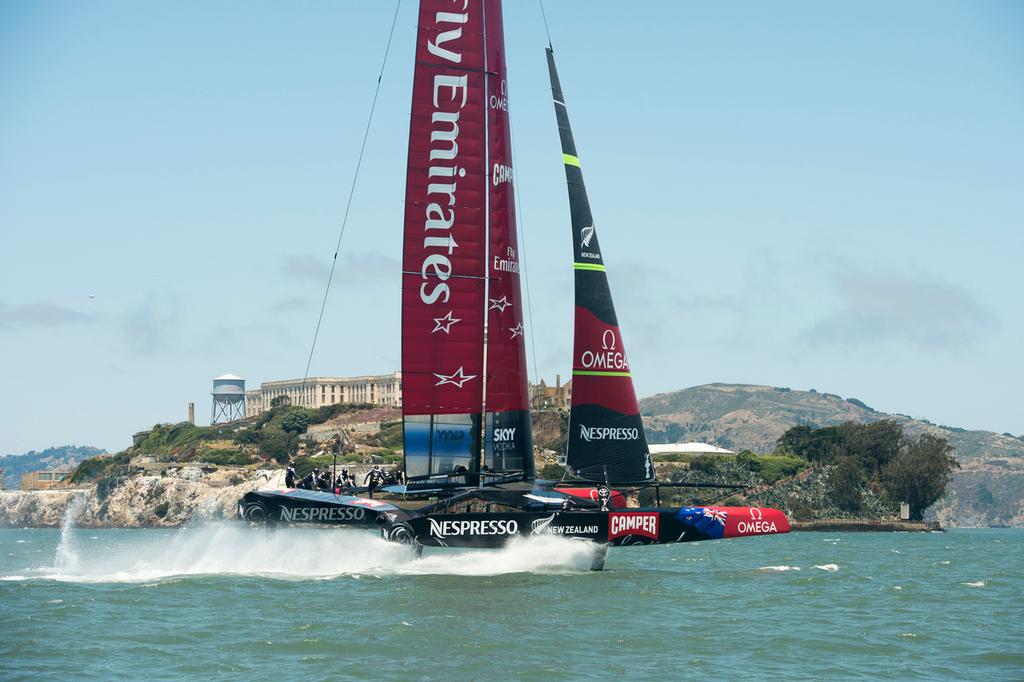
The new AC50 class and its one design wingsails and near one design jibs have greatly reduced the need for sail designers in the 35th America's Cup Chris Cameron/ETNZ
http://www.chriscameron.co.nz
New Zealander Burns Fallow has been at the cutting edge of sailmaking technology for more than 25 years, fundamentally changing the sport through engineering and working closely with customers at all levels.
Tim Kelly of North Sails chatted to him about his unparalleled experience in America’s Cup, Superyachts and beyond, and what he’s excited about for 2016…
'We had to learn a hell of lot very quickly in 2011. None of us had ever been involved in wing design before, not for boats.'
You’ve been with North Sails for more than 25 Years. What has kept you there for so long?
There’s never been a dull day at North Sails. If you’d been in the same job for 25 years and nothing had changed then that would be pretty hard for anyone to stomach. Every year or two there is something really significant which changes in the design world and the job grows. I was meant to be an engineer and qualified in college as such, but then couldn’t face the reality of doing a normal engineering job so I consider myself very lucky to have landed the job at North Sails. But as time has gone on it hasn’t just been about design, there’s been a lot of management, and the company can take you wherever you want to go.
Tell us about your experience with the America’s Cup?
I’ve done five campaigns with Team New Zealand going all the way back to 1995. It has changed a lot – the first four iterations were developments from where we were with the old IACC Class 80 foot monohulls. Each time you would learn a bit more and the rules would develop, but then of course in the last one it was a complete seismic shift when we went from 25 tonne monohulls with sails to 6 tonne machines with a fixed wing.
In the 2013 campaign, I was very much involved with the fixed wing. I was the aero-coordinator and there was a team of four of us who came up with aerodynamic design of the wing. Another team took care of the structural side led by Steve Wilson from Southern Spars. We had to learn a hell of lot very quickly in 2011. None of us had ever been involved in wing design before, not for boats at least. We had some pretty good tools at our disposal to combine the aerodynamics with the structural model which nobody else had at that time.
Do you ever see the fixed wing design breaking into the wider sport of sailing?
It’s got three problems. The first one is the cost, which is unbelievably high. Maybe if it became a mass market product it might come down a little bit but it’s still very high for entry level. Second problem is getting the wing in and out – what do you do with it at the end of the day? You can’t drop it! And finally, the third problem is it is not reef-able. If you came up with something reef-able you might also solve the second problem of dropping it. Those are the barriers and they’re not insurmountable, there’s lots of smart people in the world, but those are the barriers currently stopping wings dominating sailing.
How are North Sails involved in the ACWS this year and the America’s Cup 2017?
I can essentially say that I have retired from the America’s Cup as the whole environment has changed. The shape of the wings and the sails are all one design across the entire fleet. JB Braun from North Sails has worked with Oracle to come up with the designs which you buy off the shelf from North Sails.
How has the America’s Cup influenced sail technology across the sport?
If you take a really broad view, in 1995 it was the first time that 3DL really came through as a major breakthrough product and the next three campaigns were all about refining our understanding to make them work best. Then 3Di was born out of North Sails working with Alinghi in 2007, but we got hold of it and changed it a lot. 2009 to 2012 was a very active time for designers learning about 3Di. And compared to 3DL we had much better structural models trying to predict what was going on and we had a much more scientific approach. When 3Di was first conceived with Alinghi in 2007, the expected lifespan was literally hours. But by 2011 the product was on Volvo boats sailing around the world with them.
Do you see 3Di technology being adopted across the sport at all levels?
Well it’s happened with pretty much every other development coming out of the top end of the sport. If you go back to the early 1980s, Kevlar or even laminate Mylars were brand new then and only on America’s Cup yachts. But by the end of the 1980s club racers were getting panelled Kevlar sails. The same thing happened with 3DL. You will see it with 3Di for sure.
And look at foiling. Prior to 2012, very few boats foiled – the moths did and not much else. Now we see a lot of boats out there foiling. So that area has trickled down pretty well. Whether the fixed wings do, that depends on those barriers that I mentioned earlier. The biggest surprise with 3Di was its durability. The ultimate lifespan and how long it holds shape is incredible. But then 3Di Raw came out of the Artemis campaign in 2013 and took it to a new level. And now 3Di Endurance is coming out really soon and is proving hugely popular with Superyachts. We’ve had 3Di on Superyachts for 5 years or so now, but if you look at the volume of 3Di sails being ordered for Superyachts it’s quite staggering how quickly it’s being adopted by that fleet. And these sails last a long, long time.
Take the J Classes. North Sails have worked with quite a few J Class boats since 2006 and every two years we would replace the 3DL mainsail. They would race pretty hard and the sails would get beaten up pretty hard. So it required a pretty constant rate of change. But then in 2012 we put 3Di sails on those J Class boats, and those sails are still on those boats. They’ve raced four seasons with those same sails which is an incredible testament to the product.
You have a long connection to Superyachts and believe you helped develop the inboom furling systems?
The boom furling started in the early 1990s on small boats. Then it was a real leap of faith to then take it from 40-50 footers to start putting it on 110-120 footers. One of the nice things we’re doing with 3Di is that it is just so physically thin, because the composite is so integrated, that it furls very nicely inboom.
Now the concept of what a Superyacht sail can be is being stretched as people want more out of their Superyachts, so now we’re doing square-top mainsails which furl! So we need to come up with some quite tricky systems with the battens. We have to work really closely with the spar makers to find a solution.
What’s the next trend or technology that is going to be the next game-changer?
I’m too much of an engineer to be a visionary! But I think one thing North Sails does very well as a company is take ideas and develop them, an turn them into a really robust product.
For a recent yacht forum presentation I gave, I decided to explore some of the key performance parameters as a theme and see how they’ve changed over 30 or 40 years – records, top speeds, distances. And you find that they’ve all increased by a very similar amount, which is something like 60-70%. Which is just a staggering amount. If you look at any other sport or any other record, they change incrementally. I know that it’s an unfair example to compare humans to machines, but the 100m record has got better by 3%. Sailing is changing and it doesn’t look like flattening out.
Tell us about how North’s relationship with their customers drives technology and development?
To be honest, it’s another example of trickle-down from the America’s Cup because the integrated relationship between customer and designers was born out of team New Zealand when they won the Cup in 1995 in San Diego. That whole team was built on the philosophy of not just getting the sail designer involved early but treating the crew as the client. So the boat, mast and sail designers don’t just work in isolation – you all work at the same time on solving the problem and interact. And put the users in the mix as well. What we see now is that whether it’s a club racer, superyacht or grand prix racer, North Sails are now seen as an important part of the process from early on. In Superyachts we’re involved in design work before the owner has even given the go-ahead on the yacht, just part of the Research & Development to see if the project is viable.
In the past, you’d design a boat and build a boat. Halfway through the process they’d think “we’d better order a mast” and then at the end order the sails right at the end. That was very common. But we’ve realised boats are a system and need to tap into all the smart people across the industries. And this philosophy has been adopted by North Sails across the company and around the world, so every customer benefits from this approach at all levels.
What are you excited about for 2016?
For me personally, I’m excited about the Superyacht season. There’s so much going on there and how much things are developing, so there’s lots of interesting challenges. That’s what’s going to keep me busy.
And the Olympics will be interesting. Especially as a kiwi, we’re all excited about Pete Burling but he’s got a busy time on juggling America’s Cup and his 49er.
I hope he can carry on through and bring home the gold medal! And the Olympics is where the future of our sport lies.
If you want to link to this article then please use this URL: www.sail-world.com/143049