Valentin Mankin- 'I deal with sailing around the clock and I am happy'
by Eugenia Bakunova, www.mainsail.ru on 3 Jun 2014
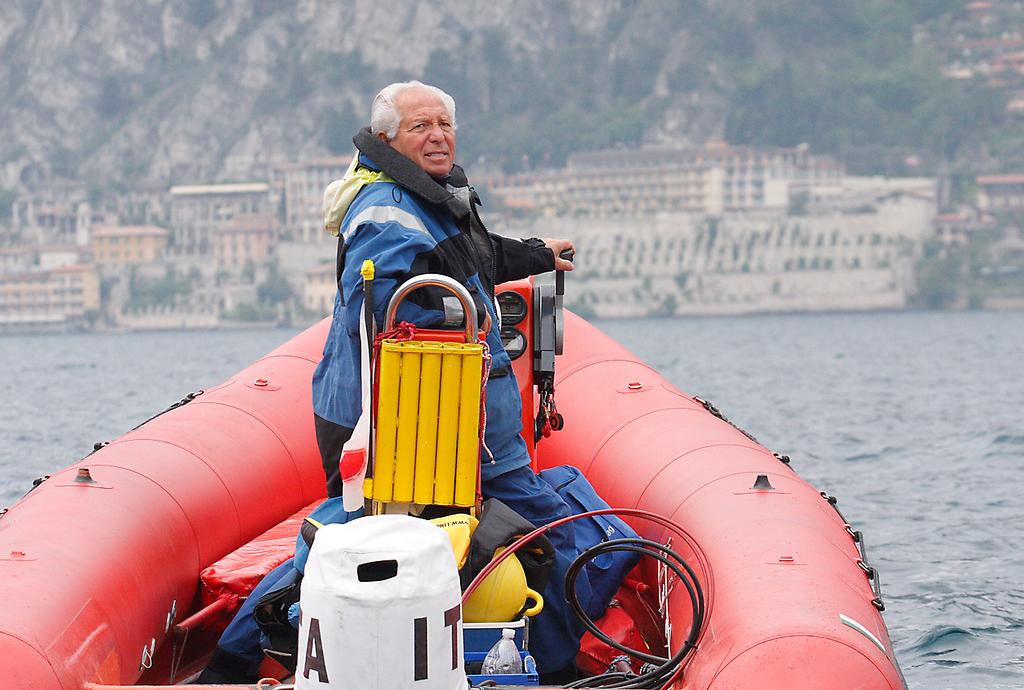
Valentin Mankin coaching at Lake Garda, Italy in 2010 Eugenia Bakunova
http://www.mainsail.ru
Valentin Mankin, the Soviet sailing legend, athlete, who won three Olympic Gold medals in three different classes, died on June 1, in Italy, losing a long battle against cancer.
After closing his brilliant competitive sailing career, Mankin became no less brilliant coach. For over 20 years he lived and worked in Italy, where he coached a big number of world-class sailors.
Leading Russian sailing journalist and photographer, Eugenia Bakunova of the website www.mainsail.ru travelled to Lake Garda, Italy in 2010 and interviewed the greatest Russian sailor, who won three Gold Medals and one Silver Medal in the Finn, Tempest, Star classes between 1968 and 1980. He would probably have had an even better Olympic record had he been selected on merit to sail for then USSR in 1960 and 1964 Olympics. But he was passed over for reasons of seniority in the Soviet program.
In this interview, conducted originally in Russian, he covers his sailing career, and gives an insight into a sailing life behind the then Iron Curtain, together with his reasons for moving to Italy and his thoughts on Western approaches to sailing.
To get Valentine Mankin as a coach was a huge success for the Italian Sailing Federation in 1988. Soon from that moment Italians sailors rapidly improved their results. He has trained almost all the stars of contemporary Italian sailing - Alessandra Sensini (Olympic champion and world champion), brothers Sibello (European Champion in class 49er), as well as young stars Julia Conti, Diego Negri, Andrea Trani, Gabrio Dzandona.
Valentin Mankin is over 70 years old now, but he is very active, he is all the time at work and makes it with passion and excitement.
Eugenia Bakunova: You started sailing rather late - at the age of 15 and you have achieved outstanding success. What do you consider is the main reason for your successful sports career?
Valentin Mankin: Now young sailors usually start at age 10-11 on Optimists . I started I was 15 years old, and I think if I had started earlier, it would only be worse. Why? Because if child starts with just one sport he will develop from one-side. I began with swimming. Then I had a year of acrobatics, two years of dancing, gymnastics, rowing ...
Swimming was the main sport for a long time for me - it's a good school for the coordination and physical strength.
Thanks to swimming I trained to manage my time, to set tasks and i've got used to living in the sport mode.
By my nature, I didn't have opportunities to be a champion in swimming. Physical sizes of my body were not so good in terms of swimming - for example the size of my foot is just 42-43, and I had to have 45 size to swim faster.
I also played water polo. But my physical details were not so good to play polo too - for example, if I had fingers 2 cm longer, I would have been more successful goalkeeper.
One day I walked by the riverside with a broken heart after the polo match we lost 1-15. The match took place on the Dnepr river, because the pool was closed. I walked and thought what to do. And then I saw the guys - they were repairing the boat. I thought they were the rowers, and asked if I could stay with them. They gave me blowtorch with which they filmed the old paint from the hull and said: 'We are sailors.' And I've stayed with them.
This section was sport club 'Medic.' I started on an M-class boat in Kiev. There were 50-60 of such boats that time there. We had a coach - Nicholay Doodnik, and he was a medical student and part-time sailing coach. In winter, we studied the theory. In the summer I was sailing, boat scrubbing, studying knots and thinking about DOSAAF club (big sport club in years of URSS).
DOSAAF had good yachts and very sporty atmosphere. Finally, I found a way to be there. The coach was Sergei Mashovets - a man never saw his life outside sailing, sailing history and traditions. He was able to talk nonstop about the sailing! We listened to him, forgetting about everything! Mashovets remained for me the only coach for the whole life. He gave me a ticket to a Big Sport.
But I want to return to our subject - at age of 15 I was in good shape physically. I knew how to swim well, and I had a wonderful coordination, I had a habit to make physical exercises daily. Those habits I've got from other sports. At age of 17, I won the first regatta in Kiev. And in 1958 I won the bronze medal of the USSR, and in 1959, I won in the selection process for the Olympic Games.
EB: That is, in just six years, you have done the way from the beginner to the highest level sportsman?
VM: Like that. By this moment, I was ready to win any regatta. I felt myself very strong and confident. But the Olympics in Rome were not for me - I was the spare crew in our team.
Meantime I graduated from the Kiev civil engineering university. I supposed that my success would come later.
If I got into sailing earlier, the result would be quite different. Here in Italy, for example, they begin to do sailing immediately not paying much attention to physical training. Young sportsmen are pressured for having results, but they are not prepared for fighting psychologically, and they are being burned off fast.
I am not against the early start, but better to begin with romancing the sailing, love for sailing but using other sports to develop physical abilities. It needs also to start sailing with professional coaches. There are many ways to go to the top level, but it is hard to be stable there. I was lucky - I had a real coach Sergei Mashovets, who opened my horizons. He is a high class professional and now I often call him. Together we analyze various situations. Thanks to him, sailing in Ukraine has grown significantly.
EB: Early sailing start isn't guarantee of success ?
VM: To start sailing on a yacht is OK at any age even for a one year old. But to my mind it is not necessary to start intensive training too early. In Italy, for example, almost everyone who comes to me to sail on optimists have almost zero of theory and zero of physical shape and training. And it is wrong. Many young athletes can not catch up on the horizontal bar. How do they will work in the sea under the strong wind, for example?
EB: How did you feel yourself more comfortable - as a solo sailor or as a part of a team ?
VM: As solo sailor. But this does not mean that I was bad as a crew.
My crew-partners were great people and great athletes. However, because I began as a solo sailor, I was able to prepare for high-level competitions.
I was studying in school, then in university then I began to work. All the time I needed to combine my study and my work with training and to elaborate optimal timetable. For a solo sailor, it was much more comfortable. To be a solo sailor gave me also an opportunity to easy move from class to class - because the helmsmen should always be the lead element in the team. Only when the helmsmen shows the maximum result, does he have the right to require a full commitment from a crew.
EB: Which of the Olympic medals was the most remarkable for you?
VM: Of course, that was the first 'Mexican' gold medal. Before that moment, I had eight years of waiting, training and doubts… During this time, I graduated from the University and began to work as an engineer. I did not have too much time to train. That was a difficult period. I was almost 30 years old. On the other side, I was ready for the competition physically and psychologically. And it helped me in those unusual conditions.
In Mexico, it was very hot weather, very warm water and very light winds. Heavy sailors didn't have a chance to succeed in those conditions. When I came there, I weighed 90 kg, but after two weeks of hard training on the spot I was able to lose weight. In the first race, I went out with a weight of 76 kg already. The first races were at an average wind, but later the winds died down and I could keep leading and to win. Those Olympics were special for me by the fact that it was the result of 15 years of hard training. I never announced the victory, but I tried to show maximum I could. It was a wonderful time; other Soviet sportsmen inspired me too - Latynina, Shakhlin, Brumel. Those people have overcome themselves and achieved high results.
EB: What do you remember from the 1980 Olympics?
VM: That were fourth Olympic Gold medal in my career, I made it in Star class with Alexander Musychenko. He is a Siberian guy with strong character. We understood each other without words. Tallinn was familiar for us - we sailed many Baltic regattas there before the Olympics. There was a lovely Olympic Center, wonderful ambiance, lots of friends wished success for us and hoped for our victory. For me, it was very comfortable to compete there. We did not think about the weight of the crew, we thought how to find the shortest way to finish line. When the Italian crew Giorgio Gorla, Alfio Peraboni said that we have a difference in weight of 20 kg, I replied that while they tack once, we would tack twice.
EB: How come you started coaching the Italian team ?
VM: It was in 1988, I came to the Olympics in Korea. I had an offer to be a principal coach for the USSR water sport selection team. I took that offer.
At this time, the hard times began for my family - after the Chernobyl accident, my daughter had health problems, she needed a treatment abroad.
All went well for me - after a successful performance team at the Goodwill Games in Seattle, 'Sovintersport' signed a contract with the Italians. Under this contract, I began to coach their athletes. And my daughter could have treatment in Italian hospital.
Later the USSR died, and I had no the place to return (different country, different problems, nowhere to work). I made a new contract with the Italians.
Sensini, Devoti and many others are from my first group. Then there were 20 people and all of them now are in a professional sport as tacticians, strategists and so on. And I'm still a coach - one trainee went out, and I take on the next one.
EB: When first victories came ?
VM: When I came to Italy there were no coaches there. I spent a lot of time analyzing the world of sailing and created my own training system. With those systems, we have succeeded in the world. I moved to Livorno where there was the Olympic Training Center. (Later this center was closed and a new one was never opened).
In 1994, Francesco Bruni became European champion, and World champion in Star class. In 2000 Devoti won silver at the Olympics. All sportsmen I worked with showed good results. And now some of my first students are coaches too, some of them surpassed me, and I'm very proud of it. I help them in some way and at the same time I learn from them.
EB: How do you feel yourself in Italy?
VM: I'm working and I am happy. I work with sails and sailing team 24 hours a day. I have everything to be happy - the sea, the boats, the wind.
EB: To work in Italy is easier ?
VM: Now easier. They are not starting from zero level; they continue what they were doing for many years.
In our country (former USSR), the old system has died. So they needed to start from the beginning in Ukraine and Russia. But I believe that Russia is full of energy and talents.
EB: Do you think that the popularity of sailing in the world is reducing lately?
VM: In my opinion yes. There is no motivation. Previously we did not think about money we fought for prestige of the country. Now life has become more complicated, and therefore it is necessary to create a special motivation for sportsmen. Moreover, sailing is not clear for spectators because of complicated rules, many classes, and many uncertainties.
EB: To your mind who is the all time Yachtsman of the World ?
VM: In 1953 I saw his portrait on the wall in yacht club 'Medic' in Kiev first time. That was Paul Elvstrom. For me, he is ideal in sailing.
EB: Who do you like now?
VM: I like Robert Scheidt and Ben Ainslie. I saw how they grew up, and I always watched them. This two stars who grew thanks to their painstaking work and his boundless love for sailing.
From www.mainsail.ru, interview conducted in Russian and translated into English by Eugenia Bakunova
For an earlier obituary on Valentin Mankin http://www.sail-world.com/index.cfm?nid=122813!click_here
Video shot by Valentin Mankin of the Italian Star crew he coached sailing in 40kts :
If you want to link to this article then please use this URL: www.sail-world.com/122853