
Hyde Sails and Bounty & Hope - From Design to the Open Ocean, an interview with Conrad Humphreys
by Hyde Sails 20 Oct 06:30 PDT
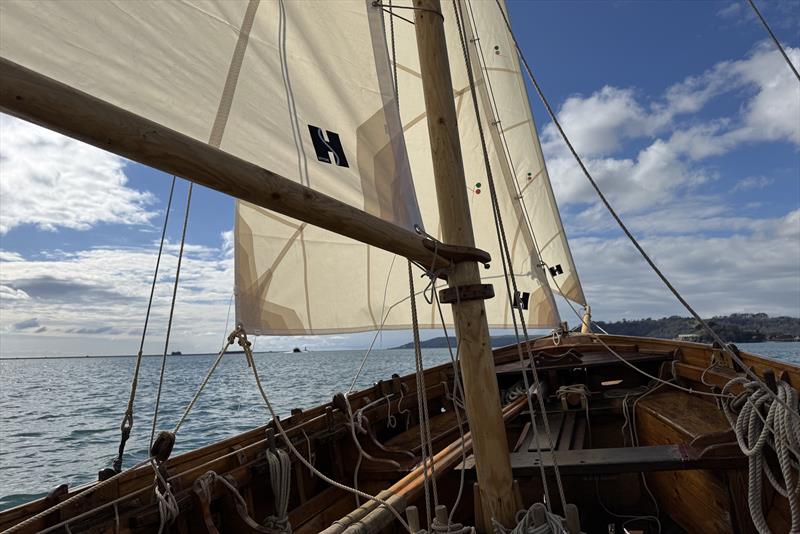
Hyde Sails aboard the Bounty © Hyde Sails
Bounty & Hope is a unique project, combining ambitious heritage design with serious offshore capability. We caught up with Conrad Humphreys to explore how the project came together, Hyde's role in developing the sail plan, and how Bounty has helped shape the next chapter; Hope.
Q: How did your relationship with Hyde Sails begin?
Conrad: Charlie and I knew each other from Musto days, but it was a meeting at METS in 2024 that started our relationship with Hyde Sails. What brought us together on Bounty was
timing and ambition. We'd finished the Mutiny voyage, and Bounty was ready for a second life, less as a TV prop and more as a working boat taking people out on Plymouth Sound. That meant rethinking her rig from scratch, and I wanted a sailmaker who'd take a 23-foot wooden open boat as seriously as a race yacht.
Q: What do you look for in a sailmaker?
Conrad: Bounty doesn't fit neatly into anyone's catalogue. She's a replica of Bligh's launch, so the look and feel has to be right, but she now carries paying guests every week, so the sails also have to be efficient, forgiving and durable. I wanted a sailmaker who could handle both. Hyde stood out because they listened first. They were as interested in the history as in the numbers, and they brought in bespoke Dimension-Polyant cloth to get the balance of performance and longevity we needed.
Q: Can you give us an insight into the initial conversations about the sail plan?
Conrad: The first conversations were about what Bounty needed to do, not what she needed to look like. She had to be simple enough for a small crew to handle with guests aboard, powerful enough to sail properly rather than motor-sail, and robust enough for day-in, day-out use in Plymouth Sound in whatever the weather gives us. The biggest decision was moving from the original lugger rig to a cutter rig. That gave us more flexibility, better upwind performance and a sail plan we could reduce easily when the breeze builds.
Q: How did the sail plan develop, and what challenges came up?
Conrad: Initially I developed a sail plan for a slightly larger 26ft version of Bounty that would have a Cutter-style rig and a long bowsprit. We went ahead and built the spars (cut down Douglas Fir from Dartmoor) and fitted them to Bounty with some makeshift sails to test her performance. From there we refined the design and shape to improve handling and performance. The challenge with a boat like Bounty is that you can't just scale down a modern yacht's rig. The hull shape, high freeboard and open layout all limit what's possible. Hyde was very willing to refine things after early trials rather than treat the first design as final.
Q: What did you notice when you first put Bounty under sail?
Conrad: We tested the sails on Plymouth Sound in a steady 10-12 knot southerly. The first thing I noticed was balance. She felt settled and sailed rather than being pushed along. The cutter rig let us trim for the conditions in a way the lugger never could, we tacked cleanly for the first time! and she was quicker than I expected. We've seen 7.4 knots out of her. Most of all, she was easy to handle, and that matters when your crew includes an eight-year-old on the Young Explorers programme.
Q: How important is the sailor-designer-sailmaker relationship?
Conrad: On a one-off boat, it's everything. There's no class rules or previous boat to copy, so you're relying on trust and honest feedback. My job was to be clear about how Bounty would really be used, not how I'd like to imagine her being used. Hyde's job was to turn that into cloth and shape, and then keep listening once she was on the water. The best results come when all three sit round the same table from day one.
Q: How has Bounty influenced Hope?
Conrad: Bounty taught me that heritage boats aren't museum pieces. They're a way of getting people to feel history, not just read about it. Mutiny showed what an open boat and a small crew can endure. Hope takes that idea to a different story: the survey cutter from HMS Beagle's first voyage (1826-1830), which charted some of the most remote coastline on earth and led, in the end, to Darwin joining the Beagle. Bounty gave us the confidence, the team and the partners, Hyde included, to take on that next chapter.
Q: What are you hoping to achieve with Hope?
Conrad: Our plan with Hope (Tradewind 26ft Atoll) is to voyage a little further afield. We will start off in 2027 exploring the West Country and then Scotland, Scandinavia and Norway. After that - well, I'd like to sail her south to Patagonia. With the Beagle bicentennial, Hope is about bringing FitzRoy's world of surveying, weather and seamanship to life, and connecting it to the ocean science that grew out of it. The sail plan is central to that. Hope was a working boat that went into uncharted waters under sail, and if we're going to tell that story honestly, we have to be able to sail her there too.
Q: What are some key considerations for serious offshore sails?
Conrad: Reliability over everything. Offshore, a sail that's 2% faster but fails at 2am is worthless. The priorities were durable cloth and construction, reinforcement at the high-load points, easy and fast reefing, and a sail wardrobe that covers the whole range from light airs to heavy weather without needing a big crew. I learned in the Vendée Globe that a boat is only as good as what you can repair and manage when you're tired. Hope will again be MCA coded for guest sailing and will need sails that are durable, easy to handle with the ability to cope with a variety of weather conditions including strong winds.
Q: Can you describe Hyde in three words?
Conrad: Craftsmanship, partnership, trust.
Find out more...