
The highs and lows of campaigning - Interview with Cameron Tweedle
by Mark Jardine 18 Dec 2025 23:00 AEDT
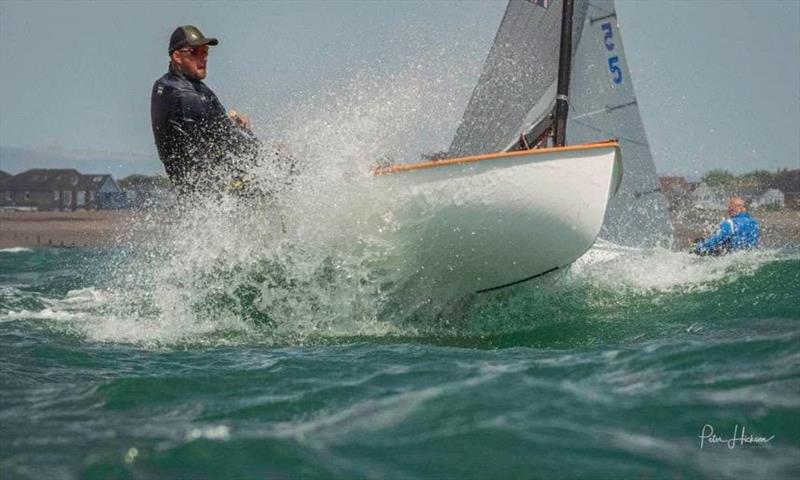
Cameron Tweedle in Hayling Bay during the 2023 UK Finn Nationals © Peter Hickson
Cameron Tweedle began sailing at age six and gradually transitioned to racing, from the Topper class initially, moving all the way up to an Olympic campaign in the Finn. Initially just enjoying the fun of time on the water, his competitive nature led him to more regattas, with the challenge of improving his performance being his driving force.
Sailing alongside Giles Scott in the Finn taught Cameron a vast amount, but when the Finn class was dropped from the Olympics it led him to question his sailing, and then reset what he was doing, diversifying into yachts, and now a member of the Hyde Sails team.
I had a fascinating chat with Cameron to hear his journey into sailing, his motivations, inspirations and strengths.
Mark: Cameron, first of all, when did you first start sailing?
Cameron: I started sailing around the age of six or seven with my family - I just loved being in and around the water. I didn't get into racing until I was quite a bit older. The main focus was always just enjoying being there with friends and family and just getting out as much as I could.
Mark: What kind of sailing was it?
Cameron: I was always big, so I got one foot in an Opi and the other one got out straight away. So I started off in Toppers, which then progressed into other junior and youth classes, but my emphasis was on trying to get sailing whenever I could. I sailed at Farmoor Reservoir in Oxford as I grew up there, and lived about half an hour away. Any excuse I could get, I asked my parents to take me to the sailing club and I'd get out in a Laser. It was brilliant and I spent a lot of time there over the years, before getting to the point where we were travelling around, visiting other clubs up and down the country.
Mark: What was it that first got you into the racing side of sailing?
Cameron: I think I've always had a competitive nature and was striving to better myself at the sport. Quite often in sailing, when you're racing against 50 plus boats, there's always someone who's a little bit better than you. Having that mountain to climb was quite inspiring for me.
Mark: Your racing progressed to become quite serious. What would you regard as your breakthrough regatta?
Cameron: I found it quite difficult as a young sailor, because I got too big before I could really progress in the classes. So by the age of 15 or 16, I was in the Finns. Probably one of the early regattas for me that I took huge pride in, after my Olympic campaign, was winning the Finn Nationals for the first time in 2022, and then stepping into keelboats, so probably one of my early Finn regattas.
Mark: In the Finns, you had some amazing mentors and people to sail against, which must have created such an accelerated learning curve.
Cameron: Yes, absolutely. I came in after Ben Ainslie had retired from the Games, but I was joining a team which was very much built around the model and all the information gained. When I was coming through, you had Ed Wright and Giles Scott, amongst many others.
You learn so much technical information from them, but I think the most prevalent thing for me as a young man coming through was learning a lot of life skills. Instead of going to university, I did my Olympic campaign; immersing yourself with these hyper-professional people who've been running Olympic campaigns for 15 years, you really get a great understanding of how you should be conducting yourself on and off the water.
Mark: When you're going for an Olympic campaign, and the person that you're battling against is Giles Scott for the place, it must feel like you're pushing yourself to the absolute limit against the best in the world.
Cameron: Yes, you are, and it's sometimes quite daunting to, and sometimes you question yourself asking, 'Can I get to that?'. Not many people can be as successful as Giles has been, so it acted as a great source of inspiration to be able to do tune-ups with him and train alongside him. The depth of that skill went through the fleet so much that even the youngsters coming through were at such a high level, and I think the best thing about it was that everyone helped each other. There weren't people stepping on each other's heads, which is ironic as there's one only one spot at the Olympics, but for that four year cycle everyone was trying to make everyone that little bit better.
Mark: When you've got the best of the best, training with the team must have been as good as any regatta you'll ever be at?
Cameron: Absolutely, and fundamentally what we're trying to do is replicate those situations and that standard. You had each other to uphold those standards and really make sure you were still operating at your maximum, and to pull you up if you need pulling up.
Mark: When the Olympic campaign finished and the Finn was removed from the sailing roster, how did your sailing progress?
Cameron: It was very difficult. Fundamentally, when you're doing an Olympic campaign, you know it's going to stop at some point. I think what a lot of us struggled with was that the decision was made for us, as opposed to us making that decision, so it was really quite gut-wrenching.
We were told to lose weight, keep sailing, get an ILCA. But that's not very easy for a six foot plus, 100 kilo plus sailor to do. I actually tried it and took a very extreme diet. I did a season racing in the ILCAs. I went from 108 to 78 kilos in a very short amount of time, and fundamentally I don't advise it as it wasn't healthy, but I wanted - in a way - to prove that it wasn't a sustainable practice for us to be able to race it that way.
After that, quite honestly, I fell out of love with the sport a bit. I felt quite disconnected from what I'd fallen in love with, and I did take a bit of a break before then coming back in, enjoying my sailing, and exploring a new side of sailing to me, going into the professional world of keelboat sailing.
Mark: Many sailors have taken a break from sailing when they've become disillusioned with things. Do you think it was your early grounding of just having fun sailing in the first place which brought you back?
Cameron: Yes, absolutely. Fundamentally I think if you look around the dinghy park, the fastest and the best are the people who enjoy it the most. It really gives you that drive to get out of bed, especially for the early morning sessions in Weymouth in the middle of winter; you've got to enjoy it to get out and do that.
It takes up so much time and a lot of money - it's a big investment of both those things. So you've got to be able to enjoy it when you're doing it and really make the most of it. I think it takes a mature decision to sometimes take a step away and then come back and perhaps identify what you weren't enjoying about it, and you can then open up and come back into the sport, perhaps somewhere where you get that thrill and excitement again.
Mark: How did you find the transition to the professional keelboat classes?
Cameron: In some ways it was very easy coming from a class like the Finn, as it was a huge step up as a youth, going from youth sailing to a professional, full time campaign in a Finn, being surrounded by people who have been there amongst it for such a long time; you pick up these skills and this knowledge.
Taking the step from that single-handed Olympic campaign into a multi-person professional team was big. That was a big change psychologically, to go from racing on my own to doing a job in a unit, and I would say that was the biggest challenge. The biggest skill development for me was, how do I take my knowledge and skills and elevate the people around me and let them elevate me, as opposed to bearing it all on your own.
Mark: The fact that you'd worked in a really tight-knit squad, even though you were in different boats, must have been of benefit to you.
Cameron: Yes, you get an understanding of how you can elevate one another at the same time. I think for a bunch of 18 year olds growing up, it's a very interesting circumstance, because, of course, there are times where that goes out the window, when you're at the World Championship and there's only one qualifying spot, so it's a testing circumstance. It definitely teaches you, and I think matures you, perhaps ahead of time.
Mark: With this mindset, and your natural build, you must now be in high demand in the keelboats. The combination of tactical and technical knowledge, your helming skills and strength must make you a useful and versatile keelboat sailor.
Cameron: Yes, it does. Obviously, some boats look for a small person and some boats need a big guy. A lot of my Finn colleagues have gone on and been quite successful and in demand within the sport, from professional yacht racing all the way through to the America's Cup; there is a demand for these big sailors, and it's a shame we haven't got that representation in the Olympics anymore, but brilliant that there's still a place in our sport which rewards big sailors.
I think it's very important to be able to choose what boats you're racing on, because even if you are pro sailing, or just sailing at a very high level, it comes back to that enjoyment. If you can be in a position to pick and choose who and what you're racing, that's a real luxury.
Mark: And now you've joined Hyde Sails. What was the attraction of the sailmaker?
Cameron: Obviously there are a lot of sailmakers, and I think what really attracted me to Hyde was their history - 60 years in this game and everyone knows Hyde. The older generation would remember that red boat on the tack of sails. For me, growing up, their sails were everywhere, and coming into the business, you kind of get blown away again, as you realise there's even more Hyde sails out there than you thought. That was a big pull which gets your foot in the door, and then when you speak to the team, and speak to their ideology, what they want to achieve moving forward and what they have already achieved, it's really appealing for an aspiring sailor.
Mark: So those ambitions, getting involved in more classes and aiming to achieve at the highest level, must really tie in with your own goals and the ethos you've gained through your Finn sailing?
Cameron: Absolutely. I think what I admire the most about Hyde Sails is they don't want to just be a high performance sailmaker. Performance comes in all aspects of the sport, be that cruising, racing dinghies or keelboats. I think it's brilliant to have this broad understanding of sailors' needs and the sport's needs, and to be able to achieve all of those goals, I think is vital.
Mark: What are your plans for 2026?
Cameron: We've got plenty of plans here at work, developing sails and keeping doing what we're good at. For me personally, I've got lots of racing coaching lined up, varying from dinghies to keelboats. I'm very excited to be back racing in the Finn again; seeing the class going from strength to strength outside of the Olympics is brilliant. Another focus for my year is racing within the Nordic Folkboat Class, which is very exciting for me personally, but also very exciting to see what we can develop as a company within those classes.
Mark: Are we going to see you and Ben McGrane sail on the same boat at any point?
Cameron: Maybe! I'd happily let him have the tiller as well. We'll see. It's a scheduling thing, making sure we can all have time to do it, but it'd be fantastic to sail with him. That again lends to Hyde's appeal, to be able to have such successful sailors like Ben here. He's so proven in so many different classes and it's fantastic to be able to sit in an office and bounce development ideas off each other.