
Final Final: Not just another fast 52-footer
by Richard Gladwell, Sail-World.com NZ 27 Sep 02:30 PDT
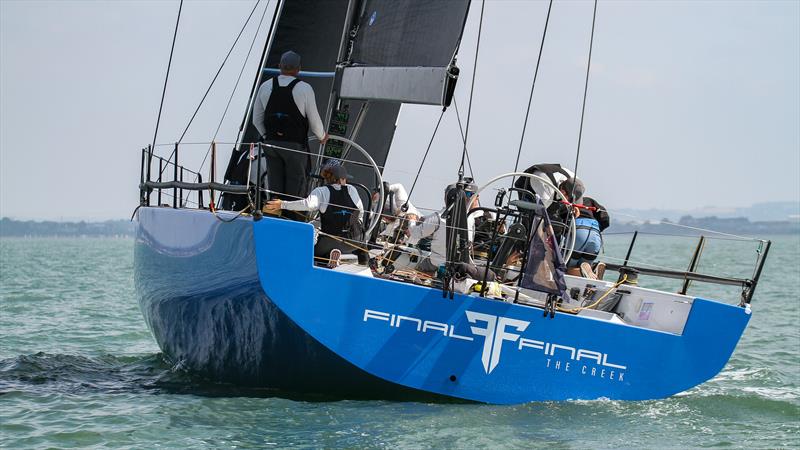
Final Final - TP52 - Admirals Cup - July 2025 © Richard Gladwell - Sail-World.com/nz
The TP52 may have evolved into one of the world's most sophisticated inshore racing machines, but Final Final represents a rather different branch of the family tree.
The Judel-Vrolijk 52-footer was one of the original group of Pac52s developed around West Coast USA offshore racing, while retaining the versatility to mix it with the specialist inshore boats.
That characteristic was amply demonstrated when the TP52, launched in 2017, sailed for the Royal Ocean Racing Club in the 2025 Admirals Cup series at Cowes, UK, performing credibly as one of the “Big Boats” in what proved to be a light airs regatta.
For Final Final's campaign manager Russell Whitworth, that versatility goes to the heart of why the yacht was acquired.
"The TP52 was a Transpac 52 when they were designed," he explains. “Over successive generations the concept changed, evolving through the Audi MedCup into what is now the 52 Super Series. The boats became increasingly specialised for inshore racing, increasingly sophisticated and, inevitably, increasingly expensive.
The Pac 52 concept attempted to turn that evolution back towards its origins, creating a lower-cost, more offshore-orientated Box-Rule 52-footer with a comparatively fixed configuration. Some components, such as steering compasses, galleys, toilets, and nav stations, are removable for inshore racing, keeping Final Final competitive in those events.
Renowned New Zealand-based builder Cookson Boats built two new boats based on a Judel/Vrolijk design in a joint project overseen by top America’s Cup program manager Bill Erkelens.
The Pac52 project began after professional skipper Gavin Brady spoke with a potential West Coast USA owner who was considering buying a second-hand SuperSeries 52 and converting it for IRC racing and some SuperSeries events, but not offshore racing.
The upshot was that it was probably easier to build a low-cost new boat with all the features required for the SuperSeries 52 conversion.
'The owner knew of three others in California that were looking to undertake similar conversions,' says Erkelens in the March 2017 Sail-World interview.
The two Cookson-built boats were essentially Judel/Vrolijk Super Series 52 hulls, with some modifications and a Cookson-designed deck, based on the yard's extensive experience with the type and the highly successful Cookson 50, which is still placing well in premier offshore races.
'We've increased the hull freeboard by 200mm - so the crew can actually get into the bunk, and there is also access to the area under the cockpit floor to a navigation station,' explains builder Mick Cookson.
'Most of the sail control systems are either on deck or sealed,' he adds in deference to producing a seaworthy offshore racer.
Launched as BadPak and later renamed Warrior Won, the yacht had already built a substantial offshore pedigree before the present programme acquired her in 2024 and renamed her Final Final.
The attraction was not simply that she was another fast 52-footer.
She was developed specifically for the racing her new owner wanted to do, in a five-year programme of offshore and inshore racing events.
An offshore programme
The team first inspected the boat in Antigua in early 2024, while campaigning the owner's 41-footer.
"We bought the boat after the 2024 January Transat," says Whitworth. The sale was subsequently completed after the boat reached Newport in May.
The team's existing programme meant there was no immediate pressure to launch into a major campaign. They contested the Bermuda Race with the 41-footer, while using a summer of racing from Newport to learn the new 52.
Importantly, they initially sailed with the yacht's existing sails rather than immediately launching a major optimisation programme.
From Newport, Final Final headed to the Caribbean and subsequently Britain, where she raced in the Admiral's Cup programme before moving to the Mediterranean.
The results have steadily improved.
A third in the Caribbean 600 was the first significant marker. After what Whitworth describes as a "fair to middling" Admiral's Cup, Final Final won the IRC Europeans in Bonifacio and finished fifth overall in the Middle Sea Race. They won the IRC-0 class at the 2025 IRC Europeans.
The following season brought fifth at the ORC Worlds, an overall victory on IRC in the Miglia 151 and an overall ORC win in the Aegean 600.
Asked whether Final Final has been optimised for IRC and Whitworth quickly points out that rating discussions are a double-edged sword.
"When this owner bought her, it was because our plan for however long it takes - three to six years - is to knock off all of the offshore races," he says.
"So we were very much buying an offshore-capable TP52."
On longer offshore legs, particularly downwind, the configuration works extremely well.
"She's quicker than IRC downwind," he says. "Upwind she sails to her rating and does very well."
Put Final Final alongside a highly developed Super Series 52 around an inshore course, however, and the differences become apparent.
She can sail to her rating, says Whitworth, but the crew has to work considerably harder to achieve it.
The specialist inshore boats have systems designed around extremely rapid manoeuvres. Final Final's control systems are above deck and consequently involve more friction. The boat doesn't have the reeling systems used to haul halyards aboard almost instantaneously during manoeuvres.
"Some mug here has to actually coil them," he jokes.
That distinction becomes increasingly significant when the racecourse requires repeated manoeuvres in quick succession.
Final Final simply wasn't configured to "turn six corners in 25 minutes".
But stretch the legs and send the fleet offshore, and the equation begins changing.
The offshore advantage
One of the most obvious differences is freeboard.
Final Final has approximately 200mm more freeboard than the equivalent Super Series 52 configuration. The underwater platform remains closely related to the 2017-era designs, but above the waterline the offshore philosophy becomes much more obvious.
While an inshore TP52 can be riddled with openings for control systems, jib tracks and reelers, Final Final's lines remain above deck.
That carries an aerodynamic and handling penalty around a short course but has an obvious offshore benefit: substantially fewer opportunities for water to come into the boat.
In heavier conditions, Whitworth believes that can begin cancelling out some of the handling advantages enjoyed by the more specialised machines.
Then there is the extra internal volume. The additional freeboard even allows another level of pipe berths below, as Mick Cookson noted.
Those sound like small distinctions until the boat is racing offshore for several days.
Final Final's present configuration goes further.
"She's very much optimised for offshore," says Whitworth. "She's got the water ballast. She's got a more downwind-orientated keel configuration because hopefully most of the offshore races we all do, we like to go downwind."
Yet the fundamental appeal remains the adaptability of the TP52 platform.
"You can throw whatever keel you want on it. You can do so many different things."
990 litres of movable righting moment
Perhaps the most interesting feature of Final Final's offshore specification is her water-ballast system.
Two 495-litre carbon tanks sit around the wheel-to-runner-winch area, one each side. They are properly formed structural tanks rather than flexible bladders, with twin inspection hatches and internal baffling. The tanks provide righting moment rather than fore-and-aft trim.
The important detail is how the system has been configured.
Final Final isn't designed to gulp ballast aboard and dump it repeatedly during an inshore race. Filling takes "a couple of three minutes", according to Whitworth.
Once aboard, however, the water can be transferred between sides in approximately 12 seconds during an offshore tack.
For offshore racing that's entirely acceptable.
"For trying to fill it up on a start line with 20 boats and get your way out, you're more likely to end up in trouble," Whitwoth explains.
The team considered installing a faster inshore system capable of filling roughly four times quicker and emptying five times quicker. For the 2025 Admiral's Cup, however, they took a pragmatic route and removed the pumps while leaving the tanks themselves aboard. Others in their class cut away the tanks completely.
Born from the Pac 52 idea
Final Final's origins go back to the American Pac 52 concept.
According to Whitworth, BadPak and Invisible Hand were very similar boats, derived from moulds of the 2015-era TP52 generation, with approximately 200mm added to the freeboard to create more internal volume and a drier offshore boat.
The deck arrangement remained substantially TP52 in concept, but with control systems moved above a very flat deck.
Cookson Boats then contributed refinements including aspects of the interior, navigation arrangement and pedestal drivetrain. The yacht has subsequently received a different rudder aimed at offshore power sailing.
Whitworth characterises the result as roughly "85% Euro TP52" with the remainder reflecting the Cookson/Pac 52 approach.
That combination produced a Grand Prix 52-footer capable of genuinely serious offshore racing without becoming a one-dimensional offshore specialist.
Immaculate condition
The biggest surprise came when the prospective buyers stepped aboard in Antigua.
By then the yacht had already been through all the world’s major offshore events: Transpacs, a Transatlantic, Fastnets and Sydney Hobarts.
Whitworth expected her to look like a boat that had lived a hard life.
Instead, he says, "I was astounded at how tidy, clean, and just how immaculate it had been kept."
That standard has continued under Final Final's ownership.
The yacht has undergone an upgrade period that included new deck finishes, non-skid, and painting. Multiple non-destructive testing programmes have also been undertaken.
At purchase, Whitworth says the hull survey returned zero anomalies, as did surveys of the mast and boom.
The lack of deterioration is, he believes, a testament to both the original Cookson construction and the yacht's previous owners and crew.
"You'd be hard pressed to look at it find something wrong," says Whitworth.
One platform, several possible futures
Perhaps that is the most interesting aspect of Final Final.
The modern TP52 has reached an extraordinary level of inshore refinement. But in pursuing that specialisation it has travelled some distance from the Transpac 52 concept which gave the class its name.
Final Final travelled the other way.
Her additional freeboard, above-deck systems, water ballast, offshore keel configuration, accommodation and relatively dry layout deliberately sacrifice some of the split-second efficiency demanded by the Super Series 52s.
Final Final’s happy place is when the race course puts the fleet out of sight of land.
Her results suggest that the trade-offs with inshore racing aren’t necessarily as great as might be imagined.
Final Final has won offshore under both IRC and ORC rating systems, while also finishing fifth at a recent inshore ORC World Championship.
For Whitworth, however, its strongest proposition remains the one around which it was originally developed.
"For this platform, for people who don't just want to do only inshore sailing, I'd say it's probably the best 52 on the market out there."
That might also be the Final Final’s catch-cry.
Like to know more? Contact McD Yachts or Juan Yacht Design
Contact: Paul MacDonald
Ph/WhatsApp: +64 27 5133 524
Email:
Web: www.mcdyachts.com/finalfinal
Or:
Philippe Oulhen
Ph/WhatsAPP: +34 668 119 999
Email: