
Debriefing the NYYC Women's International Championships with Cascadia Sailing's Jen Glass
by David Schmidt 24 Sep 08:00 PDT
September 23, 2026
2026 NYYC Women's International Championship Day 3 © Paul Todd /
www.outsideimages.com
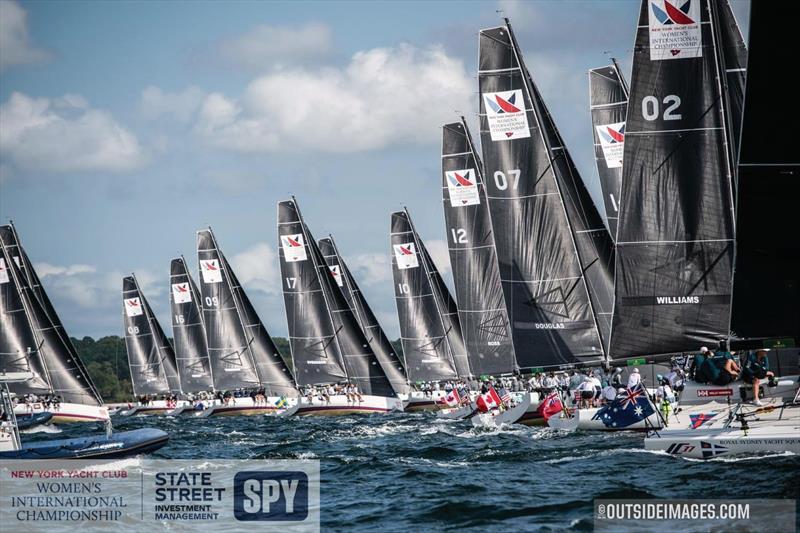
Without question, one of the coolest and hardest fought regattas of the year was the New York Yacht Club's inaugural Women's International Championships (WIC; September 12-19). The invitational event saw 20 star-studded, all-women's teams from 14 countries compete for top honors aboard the NYYC's fleet of identical IC37s over five end-of-summer racing days on Rhode Island's Narragansett Bay.
After a total of ten scored races, skipper Megan Grapengeter-Rudnick (USA) and her Team Vigilant, representing Sail Newport, took top honors. Team Vigilant was joined on the winner's podium by skipper Michelle Lahrkamp (USA) and her Fair American team, representing the American Yacht Club, and by skipper Hannah Swett (USA) and her Team MO-Amundsen, representing the Conanicut Island Sailing Foundation.
Sail-World is lucky to know many of the highly talented sailors who competed aboard Cascadia Sailing, a multinational Canadian/U.S. team that represented the Orcas Island Yacht Club, the Royal Victoria Yacht Club, the Seattle Yacht Club, the Corinthian Yacht Club of Seattle, and the Royal Vancouver Yacht Club.
The team, which finished the regatta in sixteenth place, was led by Joy Dahlgren (CAN; mainsail trimmer), Christina Wolfe (USA; skipper and US Sailing's 2023 Rolex Yachtswoman of the Year), and Jen Glass (USA; tactician), and their crew roster included national- and world-championship title winners.
Impressively, the team earned a proud bullet in Race 6, plus a pair of eight-place finishes (Race 3 and Race 10).
I checked in with Glass, via email, to debrief the team's experiences at the WIC, and to learn more about this exciting new championship-level event.
[Editor's Note: This is Sail-World's fourth interview in a mini-series with Cascadia Sailing on the WIC. The first three interviews can be found here:]
Can you please start us off by describing the level of competition that you and Cascadia Sailing encountered at the WIC? How much margin—if any—was there to recover from a mistake, a sticky maneuver, or even from a bad race?
The level of competition was one of the highest I have ever seen. Out of a field of 200 competitors, I counted roughly 30+ women who had been to the Olympics, 17 who have raced in the America's Cup, and 10 who have raced around the world.
No one was giving up an inch.
The fleet would get to the first weather mark, which was about 1.5 miles from the start line, within approximately 1 minute of each other, with most of the 20 boat fleet overlapped.
As you can imagine, this means there is no time for recovery.
The leaders are able to come off the line and go just a little faster than those around to be able to make the tack and cross. Everyone else is left searching for an elusive lane. This is what makes regattas like this so exciting!
You've sailed in a lot of high-level, mixed-sex events. Can you please describe the overall "feel" of the WIC compared to other championship-level events?
For the most part, I would say you couldn't tell it was a women's event. The competition as described above was fierce, and the skill level was very high.
However, there was a vibe of doing something for the first time: Assembling over 200 of the world's best female sailors in one place, racing in one fleet. This has never happened before.
There was an energy, a feeling of taking that huge step that was palpable. Looking around the room at the morning briefings or during evening socials gave you goosebumps as you recognize the caliber of the competitors all in one place.
The Mighty Mary movie launched in Newport just a few days before racing began, and we were lucky to have many members from that team racing, coaching, or cheering on the WIC. I kept thinking about the huge leap forward that team took, and that here we were standing on their shoulders. It felt like history in the making.
What proved to be the bigger divide (if any divide existed at all)—teams that had previously raced aboard IC37s, and/or teams that had local knowledge of Narragansett Bay? Also, were teams that hadn't sailed locally or aboard IC37s compete at the same level as teams with area- and vessel-specific experience?
The results speak for themselves here. Five of the top six teams included many sailors who have spent more than a season (some more than five seasons) racing in IC37s.
One of the most critical skills when racing in a one-design fleet is to be able to quickly settle into the right mode, both upwind and downwind. This gives you the little speed advantage you need to be able to make that tack and cross the fleet on the first beat, for example. The more familiarity you have with the boat, the easier it is to identify and achieve that target mode.
Racing in a competitive fleet of IC37s is the best experience you can have in order to do well at the WIC. The Race Committee did a good job of placing the racecourse in locations where local knowledge was minimized, so while local knowledge was beneficial, having fleet experience was the most impactful.
Let's talk about Cascadia Sailing's preparations for the WIC. What ended up paying dividends, and what—with the wisdom of hindsight—would you and the team maybe have done differently in the months leading up to the WIC?
Certainly, having access to an IC37 on the West Coast was a great asset for us. This gave us the opportunity to practice our boathandling, and it was clear during racing that that investment paid off.
For example, our sets were some of the best in the fleet, and we could gain distance out of the windward mark!
We also had a good knowledge of the boat and the general settings that made the boat go fast, as well as how to hold the boat in a high-slow mode during the pre-start to build a nice hole to leeward. Those were our superpowers.
If we had been able to travel to Newport and race more IC37 events earlier in 2026, and even some in 2025, that would have made a huge difference in our ability to get to top speed and to stay at top speed longer.
During our racing there was wind against current quite frequently, making the course bumpy and putting a focus on keeping speed up.
In the Pacific Northwest, we sail in a lot of flat water, so this condition is out of our comfort zone. Spending time in Newport racing IC37s would have given us the experience to get into our good modes faster off the start line, out of a tack, or after a set of waves, and would have given us that experience with bumpy and confused water.
This is something that we knew would be helpful ahead of time, but also something that requires quite a bit of funding to make possible. We're proud of the support we had in the Pacific Northwest both financially and in-kind donations that helped us get as far as we did.
Now that the finishing guns have been silent for a little while, how successful do you think the inaugural WIC was, both as an regatta and as a potential change maker for high-level women's sailing?
As a stand-alone event, the WIC was incredibly successful. Forty-eight teams applied for 20 spots, the competition was fierce, and the NYYC put on a first-class event. The race committee and umpires made good decisions, and everyone had a great time. What more could you ask for?
In terms of a change maker for women's sailing, I expect we will see that play out over time, but I have a similarly very positive opinion here. Providing women this type of opportunity where there isn't a chance of being replaced by a male is critical. We all know that opportunity and access are what most commonly hold minority populations back.
A great example right at the event was Mark Richards, owner of Palm Beach Motor Yachts, who sponsored four competitors from the WIC to travel to Australia this year and race with his team on their newly renovated supermaxi. This is the type of opportunity women need. How cool!
[Editor's note: Richards is also the skipper of Palm Beach XI, formerly known as Wild Oats XI]
Do you have any read on the kind of messaging that the creation of the WIC might be sending to junior sailors—male and female—all over the world? Also, do you think your trajectory as a sailor might have been different if the WIC had existed when you were first learning to roll tack your Optimist?
Events like the WIC normalize gender equality in competition, and in the household, lessening or erasing the hurdles that younger generations perceive. Seeing women on the boat, sailing as professional sailors rather than being at home taking care of domestic responsibilities, sends a really important message.
It is hard for me to know what opportunities I could have had if women were seen as equally capable when I was a younger sailor.
I dedicated years of my life in my 20s and 30s to equal medals for women in Olympic Sailing and the creation of the women's skiff. If I had been able to spend that time focused on campaigning instead of politicking, who knows what would have been different for me?!
Do you and Cascadia Sailing have any advice for other away teams that are interested in competing in future WICs?
Certainly, prioritize any time you can racing in the IC37 fleet in Newport, even if you are on other boats with other teams. I would say there is nothing more important. Get added to the IC37 WhatsApp group so you can see the fleet conversation, learn from the tips shared, and see if you can find an opportunity to sail.
On the boat, think about where you want to have muscle or how you will create a team at the right weight. There are many ways to work the boat with smaller people. For example, we sailed with 11 people (no one was very big) and often doubled up on the bigger muscle tasks like hoisting the spinnaker and managing the main sheet and traveler.
Is there anything else about the 2026 WIC, or about Cascadia's Sailing's preparations or racecourse efforts/experiences, that you'd like to add, for the record?
One of the most exciting parts of the event for us was our race win in Race 6. We had a good start, and the race was in some very Pacific Northwest-like conditions (8-10 knots and flat water). The team did a great job keeping our speed up off the start line, and we were able to get to the first windward mark in the Top 6.
We worked really well together to keep picking off boats from there, both with great speed and good tactical calls. We were sailing near Prudence Island with positive current (current running upwind), and Prudence provided a geographic right shift on the top right of the course. This combined with the positive current gave us an opportunity to tack well low of lay line and be lifted and pushed up to it, picking off two more boats.
We were in second at the second windward mark, with four boats really close behind us. We all sailed on starboard downwind and we knew it would be critical to pull off the jibe to the finish line without being jibed on.
The team executed a perfect "no look" jibe and we were able to sail to the finish line just rolling over the top of the first-place team.
It felt really good to work together as a team to pick our way through the fleet and get the race win. We reminded ourselves a number of times during the race to take a deep breath and just keep doing what we know how to do. Our skipper, Chris Wolfe, was so focused that she nearly jumped out of her skin when the gun went off right next to her as we finished at the committee boat. The best part was a huge cheering squad of supporters who were there with us on the water to celebrate with us.