
Return of the Doublehanders
by Mark Jardine 1 Sep 12:00 PDT
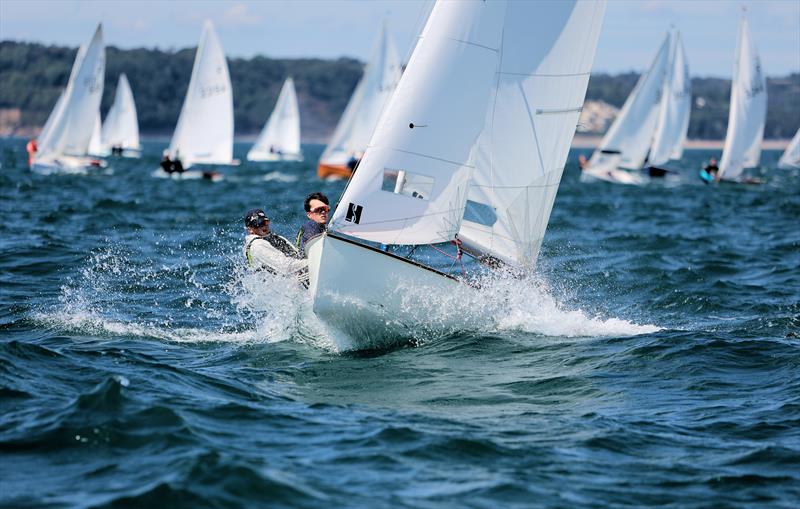
Launched on Day 1 of the 80th Anniversary Firefly Nationals at Tenby © Mark Jardine
It doesn't feel that long ago when doublehanders seemed to be going out of fashion. There was a new crop of singlehanded dinghies, led by the RS Aero, and it felt like everyone was sailing on their own.
For our worldwide readers, this will seem a bit UK-biased, but I know that many countries look on with envy, and quite a bit of bewilderment, when they cast their eye over the British dinghy scene and its plethora of classes.
There are already a few classes in the 50+ club for UK National Championship attendance, with the 80 years young Firefly leading the way after the epic event at Tenby in South West Wales attracted 116 boats. Then it was the RS Feva at 101, the RS200 having 71 boats for their Nationals (albeit down from its high of 182 in 2022), the Scorpion at 62, the Fireball at 52 and the RS2000 (formerly known as the 2000 or Laser 2000) at 50.
The Mirrors had 44 for their Nationals but a whopping 73 sailed at Abersoch Mirror Week, while the Merlin Rockets had 41 entries, while Salcombe Merlin Week had 103 boats, proving that many sailors are attracted by the location rather than the cut and thrust of a championship event.
Despite summer now being over and the weather finally turning in the UK, we still have a few doublehander championships to come, with the RS400 Nationals arguably being the pick of the bunch with an entry list stacked with champion sailors..
Among the big names entering, is Micky Beckett, fresh from his medal at the ILCA 7 Men's World Championship, crewed by none other than kitesurfing Olympic gold medallist Ellie Aldridge - this is a team who could give the established RS400 sailors a serious run for their money, despite their lack of time in the boat.
Tom Morris, widely known as 'Mozzy' of YouTube fame, is also sailing with crew Rob Ashman. Tom's a winner in many classes, and has won the Endeavour Trophy - the UK Champion of Champions event - in the past, so they'll be another team to watch, especially with the event being held in his home waters of Hayling Island.
Doublehanded sailing is back on a high in the UK, and sailing is benefitting from it.
This led me to the question of whether the doublehanders ever went away, or if it was just my perception? So I went to look at the numbers to find out. The graph of the top twenty classes from the year 2000 onwards is a mess, but there was a marked dip from 2008 onwards until the pandemic resulted in a gap in the figures and things have gradually been on the rise since.
So why is this important? If people wanted to sail singlehanders more for a while, what was the problem? What has happened lately is a bit more nuanced than just raw statistics - we've seen the return of parent and child sailing, which is possibly one of the best routes to encourage sailors for life.
The Mirrors are the headline act here, with the likes of Ben McGrane, Ian Dobson, Matt and Jonny McGovern, all sailing with their kids, some helming and some crewing. Instead of shouting at them with a loud hailer, they're alongside them, guiding them through the processes and passing on their knowledge. It's worked in the past and it's working again right now.
In an era where we look at ageing fleets (and I'm talking about the sailors here rather than the boats) the Firefly class is completely bucking the trend. At the Tenby Nationals an incredible 61% of the fleet's helms were under 30, and 47% of the fleet was female. This really is a young, diverse, and welcoming fleet, and wow was it fun to be around them all. To attract 116 boats was incredible, and it was the highest turnout in the class since 1974, but I wouldn't be at all surprised to see the fleet size go higher still in the next few years.
Team racing has been a key to the Firefly's success, with it widely used by universities, but this class has mastered generational sailing. Entire families take part, and if you look down the results you'll see the Tylecote, Pank and Morris surnames in abundance. They're far from the only ones, which explains why the championship is regarded like a holiday as well as an event.
What of singlehanders? Has their attendance gone down? There has been a marked decline in numbers in the Optimist and Topper class Nationals, which is a worry for the future. My personal thought is this has much to do with over-coaching at the top of the fleets, which has turned off many sailors (and their parents) from wanting to attend.
There are sailors who are burning out at 14 or 16, which is a crying shame for the sport. One of the greatest strengths sailing has in this crazy world is that you can carry on doing it into old age, so seeing teens give up this early is desperately sad.
On the other hand the ILCA fleets are going from strength to strength, with 111 at the ILCA 6 Nationals and 92 at the ILCA 4 Nationals, and the Masters scene is incredible, with some events, especially internationally, attracting extraordinary numbers.
Elsewhere the Solos had 74 for their Nationals, the Supernova had 52, the Blaze 50 and even the Comet had 50 entries, but two didn't sail.
In the world of yachting, doublehanders have been on the rise for a number of years, with JOG and RORC racing being especially popular in the UK, and the Rolex Sydney Hobart Tattersall Cup winner in 2025 was.a doublehander, with an incredible seven double-handed teams in the top ten overall.
I realise National Championships aren't the only measure of a class's health, but they can be a bellwether and are generally the only annual occasion when many of those active in a fleet congregate in one place. There are a lot of sailors, myself included, who are choosing to club race instead of travelling - due to time pressures, costs of living and logistics - and that's understandable, but it is superb to see the return of the doublehanders. In my opinion it's really good for the long-term health of the sport.
Mark Jardine
Sail-World.com and YachtsandYachting.com Managing Editor