
Fly Higher. Travel Faster. Last Longer. - Part One
by John Curnow, Sail-World.com AUS Editor 15 Aug 00:00 PDT
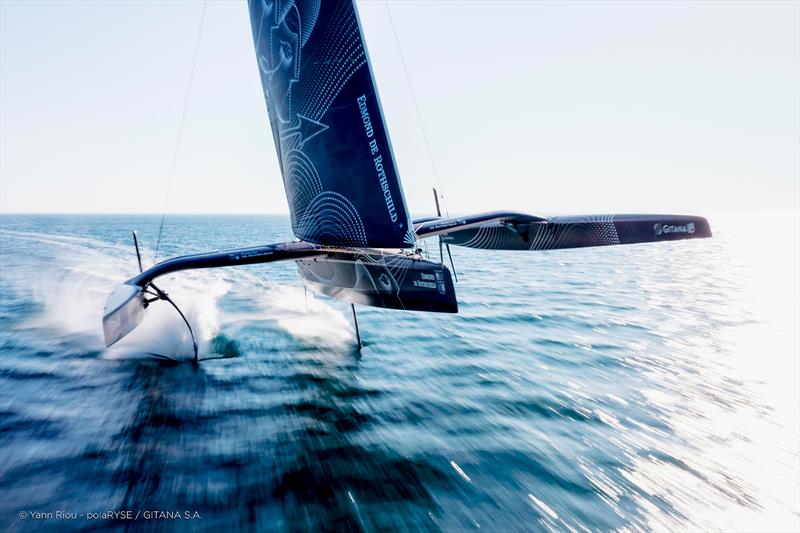
Nothing looks like the new Maxi Edmond de Rothschild - Gitana 18. Nothing! © Yann Riou / polaRYSE / GITANA SA
And yes, as the pictures show, this is all about Gitana 18, the maxi Edmond de Rothschild. Not some new wonder pill. No matter how many ways you distill it, those three propositions about performance are entirely what the new Ultim is all about. We are way past cool. This is not epic, extraordinary, or immense. I reckon we can go with, quite literally, another dimension.
So the offer came along as, 'Would you like time with Charles Caudrelier, and Sébastien Sainson from Gitana Team?' Like, hell yeah!
Now ever since the doors were rolled back of the ginormous shed, to reveal a pterodactyl with a wingspan that nobody had ever seen before, I had been pondering not just the seismic level engineering feat, but operation secrecy that had flown it under the radar so well, for so long.
Baroness Ariane de Rothschild was clear. "I want something new, something different, and to break the code. So, if you want to do just an upgrade of Gitana 17, I'm not interested. So propose me something new, something which has a lot of innovation, and maybe we'll go," is how the inimitable Charles Caudrelier put it.
"She likes to make this kind of decision. She likes to take the risk. It's part of the idea of the family, and when we showed her the first idea, she was enthusiastic, and she said, 'Let's go! Let's take the risk.' We know it can take a long time to perform with this boat, but that was the deal when we proposed the new concept to the Baroness."
Of course, as well as being the Skipper of Team Gitana, Caudrelier is quite 'bankable' (intended) as a former Solitaire du Figaro winner, then a first place in the Transat Jacques Vabre, and also two wins in the Volvo, along with the Fastnet, Route du Rhum, and also the inaugural Arkea Ultim Challenge - Brest.
Head of the Gitana Design Team, as well as qualified Naval Architect from the prestigious Southampton School, Sébastien Sainson, added, "We're really fortunate; innovating and being the first people to do new things, but it is not just in sailing. It's within their DNA, and so Ariane and the bank, they really follow us to do just that. Obviously we have pressure, we have stress, but I think we give more to ourselves most of the time because we want to do the most perfect boat we can, and we want to do that in the smallest amount of time."
You might say that Gitana Team is part of the family, to which Caudrelier adds, "I think we have a long history. It started before I was here, and I think she trusts us. We have shown with Gitana 17 that we were doing things well, but it did take some time to have Gitana 17 performing as expected. Ariane makes things simple for us. What could be better?"
History builds real legacy
Of course, offshore multis would be nothing without the French, and in the last 15 years their global exposure has climbed in direct correlation with their average speeds, and record-breaking achievements. Is it all about design developments that have led to the kinds of average speeds for such long distances, such as RTW, that's led to the rest of the world taking real notice of what's going on in the offshore multi-hull area?
On this matter, a very proud Sainson said, "I think it's a multiplication of things. Yes, the days of ORMA 60s, and MOD70s, then the Ultims, but I think it's more than a few historic teams that have been able to show over the years that we were able to do big boats that were reliable. Obviously in the beginning, some other teams had problems with those big boats. Gitana Team has shown that you can do it with a flying boat in Gitana 17. We showed the direction. We've proven that we could go around the world, crewed, single-handed, and do multiple races with those boats, and so I think they're kind of attractive today."
Nope there is a level of secrecy, and certainly the 11 secret herbs and spices to it all, but the industry is small, so you open your trap today, and you're shot tomorrow, never to work again in the field. So inducement comes in the form of future focus. Equally, success builds success. An. Integrated and internal team, as much as you can, certainly helps.
Look at the relationship between Gitana Team and Guillaume Verdier's office. CFD and Engineering all handled between them. No other external contractors. All the info is locked up between the two. All in all it is quite the achievement, "...because there was more than 200 people involved in the building of this boat. You try and keep it in between three, four, five companies, and stress that when they start the project, it has to stay inside the team or inside the shed. Also around Lorient like a lot of other hubs, it is small industry, so everyone finishes by knowing everything. Yet it is also true for the people who break the secrets, I'd say, as we've always finished by knowing who said what and how it came about. So, I think people know that and people try to keep the secrets as much as possible."
Spelling it out even further, Sainson added, "We try to keep everything internally and to work as much as possible with all the data we have from the previous boats. In the design office today, we're able to design appendages on our own. We also have a structural engineer, so we're able to do design the complex parts from the beginning to the end, and also undertake the production."
"So that helps us a lot to keep our little secrets, and it also speeds up the process. There is an F1 aspect to it all. If you do everything on your own, well you keep your knowledge and your secrets, but you're also much more reactive, which is something really important in our kind of industry and boats."
"Imagine you have a problem on the boat. If you have to wait for a contractor to do a structural calculation, and then wait for someone to do your drawing to fix the boat, and then go ahead fix the boat, it takes ages. If you're able to do all of that on your own, you're able to react super quickly to problems, and to solve them swiftly."
"I think that's a key part of the performance in our teams, to be able to react super quickly during a race, but also during the year, because with our boats, we don't have much time to sail, as much as we would like, so every time you have a problem, the quicker you fix it, the more you have sailing time for Charles."
Taking the pram round the park for the first time
The Route du Rhum looms. November 1, 2026. Gitana 18, looking like a blend of say Edward Scissorhands, and something from The Incredibles, will be there. Make no mistake either, it is the focus, but the notion of the 35 days for the round the world is there.
How do you keep the focus on the one race that's going to provide you with an enormous amount of data, realising that also part of what you're trying to do is set up for a Jules Verne attempt when when time, production, engineering and weather allow for it? How do you quell long term desire at the same time going out to race for the first time?
Caudrelier says, "We'll go step by step. Before we go to the Jules Verne Trophy, maybe we'll spend two or three years to develop the boat, and make it reliable. Next year we will do the Arkéa Ultim Challenge, which is coming back for its second edition, so this is the first big goal."
"Of course we would like to win the Route du Rhum, and we do everything, every day, to be ready, but it's very soon for this boat. We are always discovering things with this boat. Every single day we are sailing, we increase the performance, but we've also met some problems we have to fix, and some problems take a long time to rectify. We know that some of them we'll only solve next winter when we will have time."
"It is a double focus. We want to make the boat perform, but we also have to make it reliable, which is the most complicated part of this kind of boat because the loads are huge. All the systems are new for Gitana 18, and they are all working now, but we are not sure how reliable they are. Probably in 2028 we will go for the first Jules Verne Trophy with Gitana 18, and of course we want to go under 40 days; this is the goal; the boat can do it."
So, what are we talking?
Note here that Gitana 17 does 35 knots uphill, so the goal with Gitana 18 is 40, when conditions prevail, but the parameters are designed to have more prevail and far less yield or succumb. We'll talk more about angles in the section on North Sails later, but for now Caudrelier says, "We won't go at the AWA of an AC75. Too many variables compared to the conditions they sail in. Our goal is to have a steadier AWA in more seas states, which then translates to more consistent speed. That's why we want to fly higher.
"We work a lot on stability, but when you go for that, you lose your maximum performance. We also do not have the human power on board to tackle the constant adjustments. AC boats are not stable. You have six sailors who give power to change the appendage angle. We cannot achieve that, so we have to do something more stable by itself, which is against performance. So, I think we are going to win a little bit sometimes upwind, but in the flat and steady wind, I don't think the performance of the boat will increase."
"Where we want to win is when we are offshore, which means steadier speed, and steadier AWA. We can go to 15-16 AWA on the computer, and we can do it on very flat water today, but as soon as you have a sea state, it's impossible. We are we are trying to reach this number, but yes we have an AWA of 15-20 when we are on flat sea, and we go to 80 sometimes in big sea states. 80-90 even is huge, so this makes the game much more complicated," added Caudrelier.
Just now, think about the complexities of a boat that has so many appendages, so many parts that move in both the hydro and aero packages, then consider the playbook that has to work with all of those, along with sea state, wind direction and volume, along with it's density (eg. Southern Ocean). Accordingly, where does one begin to write a playbook on how to drive such a magnificent thoroughbred with so many nuances?
"The simulator has changed the game for us, because beforehand we were just waiting the boat to float to start to write the playbook. Now we have a little idea with the VPP, (BTW the VPP are always still wrong), but they have improved a lot. Not perfect, but it has given us hours and hours of sailing, and we understand what is the ideal yield, what is the ideal trim, what change between upwind, downwind, how to play with all the foils, all the appendages, where to be if you want to put more load on the daggerboard, or more load on the foils or the rudder. So, it gives us a really a good idea what we have to achieve in terms of trim and yield, which are basically the two most important factors, and also how high we want to sail," stated Caudrelier.
In short, the computer delivered a post code, and then at sea they turn that into a street name and number.
Remember too, that this is not touchscreen. It is analogue: Levers, knobs, slide controls, buttons, clutches, jammers, and grinders.
Sainson added, "You can have presets, but it's still the sailor(s) that has to press the button, make the required setting, pump and then the setting goes, so it makes the multiplicity of the settings longer to do. Charles was speaking about stability earlier on, and it's a big thing of these boats is that sometimes you lose a bit of pure performance, because you have to have a stable boat, but that also means a stable configuration in between all of the appendages because we can't move all of them at the same time. When you move a bit of flap on the foil, it has an effect, and then you'll move on the rudder, and then on the centreboard. You can't do that every second.
"It kind of sets your limits into the design, and in the use of the boat. At some point the boat has to be able to fly 40 knots when Charles is sleeping, so we can't spend our time setting the appendages. That said, you're allowed to have a flight controller during the Jules Verne Trophy, so obviously it's something that it's more like an extension of the autopilot. So yes, it's something that we will use, and it will help to stabilise the boat, or to have a bit more aggressive settings and gain that little bit more performance."
Just to be clear, and take canting for instance, there are presets that can be arranged via pre-determined pressures and control mechanisms, but also note that we are not talking five degrees out the like here. As Caudrelier says, "We speak about 0.1, 0.2, and 0.5 degree changes, which have significant behavioural outcomes, so finesse is key. You have to be very accurate."
"Given the offshore nature, the systems that are super fine tuning, super complex with hydraulic cylinders everywhere, and today the complexity of the hydraulics versus an AC75 is multiplied by the number of cylinders because we maybe have three times more cylinders and control systems than them," added Sainson.
Note also that said elements all have to be 100% reliable as they get constantly pounded during a race around the globe! The balance between robustness and fine tuning is one challenge the team is acutely aware of.
Part One is now complete. Never fear, there is more to come. Loads more as it turns out... Stay tuned!
Want more in the meantime, well here is the link to the Gitana Team channel, and below is a list of the great content you can find there -
Flying Offshore Web Series
This series captures the high-stakes journey of the Maxi Edmond de Rothschild as the team prepares to defend their Route du Rhum title.
Episode 1: In the Beginning - The transition from carbon reality to the liquid element as the boat hits the water.
Episode 2: Step by Step - The technical "first steps" involving rigorous stress-testing of the latest foils and rig.
Episode 3: Ehe Sailor and the Machine - A deep dive into the physical and mental preparation required for Charles Caudrelier to master the high-tech 32-meter giant
Episode 4: First foil, first flights | Flying Offshore - A behind the scenes look as the team head out offshore to try foiling for the first time on the first foil
DNA Web Series
This series delves into the entire creation process of the Gitana 18, from the initial concept and design to the final manufacturing.
Episode 1: Conception - Focuses on the initial design and the hydro/aerodynamic risks taken during the project.
Episode 2: Construction - Details the physical building phase of the vessel.
Episode 3: Artistic Identity - Explores the visual and aesthetic design and the "kinetic" livery.
Episode 4: Du Virtuel au Réel - Features the transition from digital models to the physical boat.
Episode 5: Expertise Internationale - Highlights the innovation hub in Lorient and specialized testing tools.
Episode 6: Teamwork - Showcases collaboration between the hydraulics, electronics, and design departments.
Episode 7: Reveal - The official unveiling of the finished Maxi Edmond de Rothschild.
John Curnow
Sail-World.com AUS Editor