
An interview with Schelleen Rathkopf about the 2026 edition of Race Week Bellingham
by David Schmidt 14 Jul 08:00 PDT
July 14, 2026
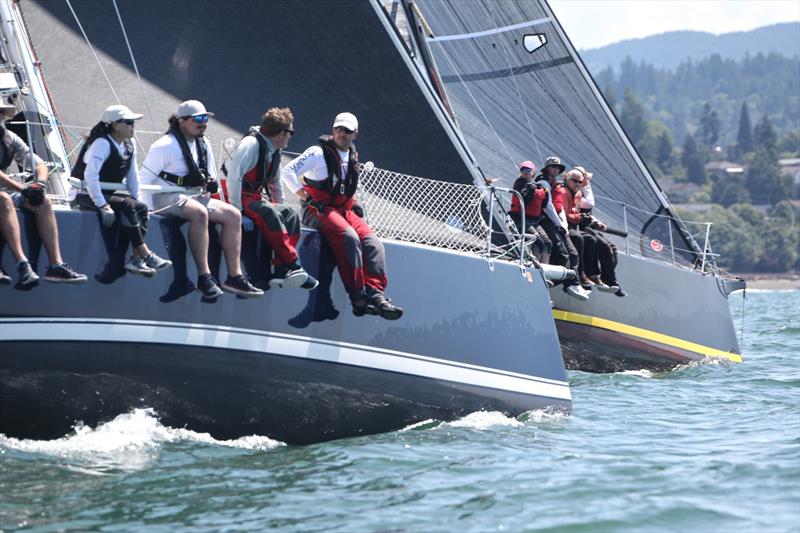
Racecourse action at the 2025 edition of Race Week Bellingham © Jan Anderson, Jan's Marine Photography
In 1983, Yachting magazine created Whidbey Island Race Week, and a Pacific Northwest legend was born. The Washington State regatta, which unfurled off of Whidbey Island, which is located north of Seattle on Puget Sound, attracted local boats, as well as teams from states to the south, and from Canada. It didn't take too long before someone coined the phrase, "adult summer camp" to describe the scene, which, I'm told, involved great racing and great parties ashore.
Yachting magazine exited the scene in 1994, but Whidbey Island Race Week continued offering its adult summer-camp services on the waters of Whidbey Island's Penn Cove thanks to support from local sponsors.
Then, following the 2019 edition, word hit the docks that the event would move to Point Roberts, Washington, which straddles the American and Canadian border, starting in 2020.
The Covid pandemic put paid to this idea, however, and Point Roberts Race Week never happened. Instead, the first edition of Race Week Anacortes took place in 2021, and the event stayed at this locale, which is on the doorstep of the majestic San Juan Islands, through the final finishing guns of the 2024 edition.
That's when news broke that the 2025 event—now rebranded as Race Week Bellingham—would be moving north up the coast to Bellingham Bay.
By all accounts, the 2025 event offered great racing (not to mention the Race Week Kids Camp program, for the junior set), however change hangs in the air for the Pacific Northwest's favorite adult sailing camp
I checked in with Schelleen Rathkopf, Race Week Bellingham's longtime race producer, via email, to learn more about this classic PNW regatta.
Can you please tell us a bit about Race Week Bellingham's culture, and its competition levels?
For decades, Race Week has attracted the Pacific Northwest region's most active sailboat racers for a solid week of racing. Racers know that the RC at Race Week represents some of the best US Sailing-certified race officers and judges in the region. They also appreciate the notoriously fun post-race party experience, which includes really great live music, an open bar, and fun party themes.
For many, Race Week is by far the best week of summer and has earned the reputation of being Adult Summer Camp.
What have entry numbers been like over the past few years?
Like many racing events and yacht clubs, we have definitely seen a steady decline in participation over the past five years. The trajectory doesn't look pretty! I've been working the problem since I took over producing the event in 2014. We shifted venues, and even shortened the event by a day one year. People complained that it was shortened because they liked the Monday to Friday race format, with weekend bookends for deliveries. So, we went back to a five-day race program.
In 2025, I moved the event to Bellingham, hoping to draw more fleets from Vancouver and Victoria, British Columbia. However, this was when Trump started referring to Canada as the 51st state, and the racers in BC disliked that, so they didn't cross the border for Race Week...at all.
We are seeing the same thing in 2026 despite [enjoying] a stellar first year in Bellingham. In addition to Canadians boycotting travel to the U.S., we're also seeing longtime competitors aging out of the sport altogether, and there just hasn't been an influx of young competitors that can afford the big boat and all that it takes to maintain this. We also hear that skippers are having trouble finding crew [willing] to commit to a full week off in the summer when vacation and PTO is limited and they have families who are not racers.
Are you seeing any significant concentrations of one design classes entered? What about interesting custom builds or international entries?
Definitely. Back in 2000 (my first year at Race Week), it was primarily PHRF classes. As the years have gone on, we have seen a drop in PHRF, and big-boat racers [are instead] leaning in on ORC because they feel it is a more complete, accurate and fair handicap system. I've also seen a rise in the smaller one-design fleets. For a while it was the J/80s and the Melges 24s. This has shifted to J/105s and now the J/70s.
Puget Sound has a huge J/24 fleet, but they've never participated in Race Week. Word on the street is that they prefer to play on the lake and stay clear of the salt water!
Generally speaking, what kind of weather conditions can sailors expect to encounter on the Bellingham Bay in late July? What are the best case/worst case scenarios? Also, how do tides, currents, and local knowledge fit into (or complicate) the picture?
We saw steady southwesterlies last year, which provided ideal racing conditions. We raced five solid days with a 10-20 knot breeze, and it was awesome.
Salish Sea tides create some interesting challenges, but the big-boat racers in this region are really used to it. There is a bit of a toilet-bowl affect (similar to the effect of racing in Penn Cove when Race Week was on Whidbey Island), which proved to be much less complicated than when we were in Anacortes. There, we raced off the northeastern shores of Guemes Island, and the tides were wicked and really fast.
The NOR states that "if weather permits, there may be a Pursuit Race or Distance Race planned to a destination beyond Bellingham Bay." What kinds of conditions would be needed to send the fleet on a longer race? And would you and the other organizers likely use movable buoys or nearby islands to create this course?
The Pursuit Race is definitely a crowd favorite at Race Week. Conditions must show a steady 10-12 knot breeze, and we use fixed marks for this such as circumnavigating Vendovi Island. Racers choose which direction they want to go, which is another fun aspect requiring some knowledge and timing of the tides and currents.
Does Race Week Bellingham plan to use any modern racecourse management tools such as MarkSetBots or GPS-based automated starting-line technology (e.g. Velocitek RTK Puck or the Vakaros Racesense), or will the RC handle this all old-school style?
We have always preferred to handle it old school. Conceptually, these seem really slick and cool. But Seattle was a beta tester for the bots, and I guess I saw way too many instances when they didn't work properly, or couldn't stay in position because of the strong currents.
I also saw data malfunctions that affected the overall competitor experience if the Vakaros devices weren't properly attached to the boat, or stopped working altogether. And with the strong currents and tides, the MarkSetBots weren't always up to the task or easily controlled.
Using this stuff requires that RC include a bot/tech expert on board at all times to troubleshoot issues. We always secure an experienced RC team (including mark setting), so I never wanted to take all those added complications on.
I read a lot of NORs, but I don't see too many that make specific mention of orca whales. Have orca whales made their presence known at Race Week Bellingham before?
The Puget Sound area is very protective of its resident and non-resident whale populations! It's definitely a thing but because Bellingham Bay is so shallow, it is definitely not a feeding area for the whales.
What's the onshore scene like at Race Week Bellingham? Can you please give us some local color, based on your experience at previous editions of this event?
Bellingham seemed like the perfect venue as moorage opens up in Squalicum Harbor as the fishing boats head to Alaska, and there is a great 9,000 square foot event space right on the bay in Fisherman's Pavilion [at Zuanich Point Park]. This gave us a great venue for staging and live music, [and for] our big Goslings Rum bar, food trucks, cornhole, dancing, and daily awards. [We] love this venue so much.
Is there anything else about Race Week Bellingham that you'd like to add or tell us about, for the record?
2026 will be my last dance at Race Week, and my hope is that someone steps up and wants to take the torch from here. I've been involved for 25 years, and the time is right to pass the torch to someone who may have new ideas to build participation.
This effort to keep the event going is exhausting! I've been trying new stuff for years—and nothing has worked so far. The participation trajectory just continues to be a challenge. I'm afraid [that] for it to survive, it will require shortening and shifting: shorten it to a three-day weekend and shift it into the weekend.
After all the work to get it set up in Bellingham, I'm afraid I'm not the person to do all this cutting and pasting! This conclusion required a lot of thought, as Race Week has been a part of my family for 25 years. My kids grew up with it. I am very proud of the development of the Kids Camp program at Race Week, which serves families who want to race but need a fun camp for their children so they can attend Race Week. It's been an all-consuming joy to be a part of something so special that people in the past built their summer vacations around.
But times have changed and change sometimes requires new leadership. (Maybe my problem was that I never brought the fancy bots into the mix and this has been the secret sauce that has been missing all along!)