
The IMOCA Class is back with The Ocean Race Atlantic
by Ed Gorman / IMOCA Globe Series 28 Aug 02:39 PDT
1 September 2026
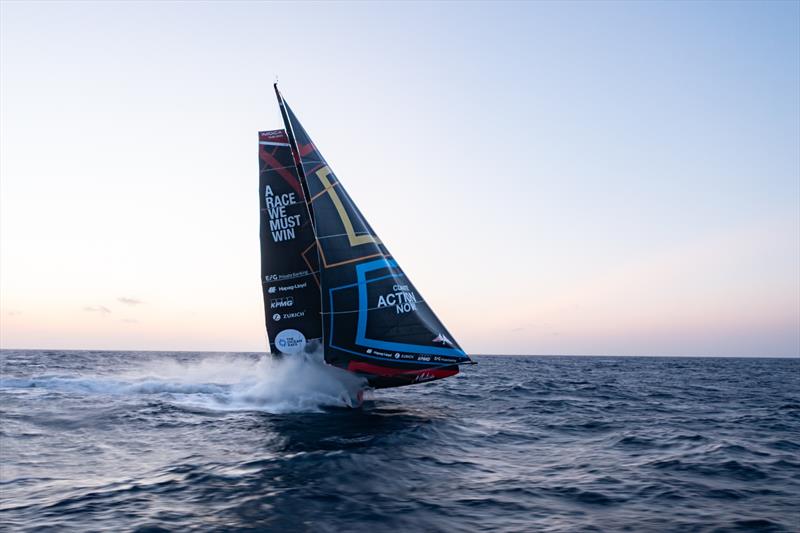
Team Malizia © Gauthier Lebec / Malizia
After a long hot summer, the IMOCA Class is back next week with The Ocean Race Atlantic, a trans-continental sprint featuring six mixed gender crews and an eagerly-awaited clash between two of the newest boats in the fleet.
The 3,300-nautical mile transatlantic starts from New York on Tuesday and finishes at Lorient, the home of much of the IMOCA fleet. It is expected to take as little as eight days in classic north Atlantic conditions with the Gulf Stream and plenty of wind to provide the power.
Among the boats on the startline is DMG Mori Global One, the new foiler from the board of French superstar designer Guillaume Verdier, and Team Malizia, also fresh out of the box and designed by Verdier's main rival in IMOCA - Antoine Koch, also of France.
Their respective crews are relishing the chance to test their boats against each other in the white heat of competition for the first time."We can't wait," was how the British veteran DMG MORI Global One crew member Sam Davies summed it up from New York. "Not just to line up against Team Malizia, but with the rest of the fleet too. This transat will give us the chance to compare the two boats and also compare our performance against boats we already know," she added.
The two hull treatments represent very different approaches to the never-ending quest for speed in the world's pre-eminent offshore foiling Class and both boats have barely been on the water for more than a few weeks. Whereas Team Malizia, skippered by Boris Herrmann, is regarded as an evolution of Koch's previous highly successful designs, DMG MORI features a conceptual leap with a bustle that runs the length of the hull, a design option tested in the America's Cup but not before in IMOCA. Davies says the early signs are that it plays a critical role in producing a fast and smooth ride, even at high speeds, in helping early take-off in transitional winds and then achieving high average speeds.
The 52-year-old former skipper of Initiatives-Coeur has been impressed with what she has seen of the new DMG MORI on the delivery trip to the US. "The boat is like a rocketship. Once it starts going you are like: 'Whoa! Are we really going that quick and we haven't even trimmed the sails yet,'" she said.
The positive vibes in the DMG Mori camp are matched by those in Team Malizia where Herrmann has been massively impressed with his new boat, a design featuring distinctive twin chines in the bow area. "We knew after five minutes of flight that this is something spectacular," said the German skipper. "The boat is amazing."
DMG Mori and Team Malizia apart, the Ocean Race Atlantic fleet includes three earlier generation boats - 11th Hour Racing from 2022, (formerly Malizia-Sea Explorer) skippered by Francesca Clapcich; United by the Ocean, also from 2022, (formerly Biotherm) skippered by Paul Meilhat; and Embrace the Challenge from 2018, (formerly Teamwork-Team SNEF) skippered by Ollie Heer. There is also one non-foiler in the form of Conrad Colman's MSIG Europe, a well-travelled IMOCA that dates back to 2007.
Heer is looking forward to a competitive race, especially against 11th Hour Racing and United by the Ocean. "It will be exciting to see how we line up and how we compete against these boats," said the Swiss skipper whose crew includes Frenchwoman Marie Riou and the young Australian navigator Lincoln Dews. "11th Hour Racing are very fortunate to have Will Harris on board, who knows that boat very, very well, and Paul Meilhat knows his boat very, very well. So we have definitely got our competition cut out for us," he added.
Heer only took ownership of his new foiler in May and although the transition has gone well he says there are still conditions where he and his team are struggling to match the performance numbers passed on by its former skipper Justine Mettraux, who is sailing this race aboard Team Malizia. "Sailing these days is brutally honest and we know exactly where we stand," said Heer, who completed the last Vendée Globe in 29th place. "In certain modes and certain conditions we are sailing the boat at the pace that Justine used to sail it, and then there are conditions where we realise we still have to improve our performance slightly. But we are getting there. Considering we have been sailing the boat for three months, we are where we are supposed to be."
Heer says this transat will be a learning experience for a team heading for January's Ocean Race around the world, but he is determined to try and prevent mistakes that could lead to a slowdown on a course that should be flat out from start to finish. "The moment you slow down to five knots while the others are doing 20-25 knots, you lose a lot of distance and that's the key - sail a clean race and not ever have to stop the boat," he explained.
Davies knows a thing or two about this course. The Ocean Race Atlantic will be her 37th transatlantic passage going back to 1997. The four-time Vendée Globe entrant says this race requires an open mind and total commitment from start to finish from the four-strong crews.
"One of the keys to doing well on this course is not to expect anything classic, to expect the unexpected, and to have no ideas of what it's going to be like before you leave because, at any time of year, the north Atlantic is pretty crazy," said Davies. "This is going to be a quick race, so it's going to be a no-regrets-race where every second counts and you can sleep when you get to the finish," she added.