
Embrace The Challenge ready to race in The Ocean Race Atlantic
by Oliver Heer Ocean Racing 26 Aug 05:27 PDT
1 September 2026
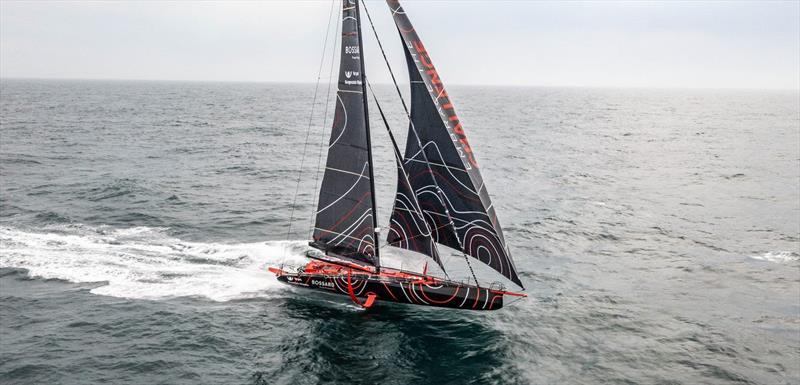
Embrace The Challenge ready to race in The Ocean Race Atlantic © Oliver Heer Ocean Racing
Embrace The Challenge will get its first opportunity to measure performance against the IMOCA fleet when Oliver Heer Ocean Racing lines up for The Ocean Race Atlantic from New York on 1 September.
Just a few months after taking ownership of the foiling IMOCA, the team has been on a steep learning curve. The focus has been on understanding the boat, calibrating systems, building reliable performance data and learning how to get the best from it with four sailors onboard.
The 3,200 nautical mile race from New York to Lorient will be the first time the new team puts all of that work under genuine race pressure.
It is also a significant event in its own right. The Ocean Race Atlantic is a new point-to-point race and the first IMOCA event to require gender-balanced crews, with two male and two female sailors onboard each boat.
For skipper Oliver Heer, the race also marks a major shift from the solo sailing that has shaped much of his IMOCA experience to date.
After becoming the first Swiss-German skipper to complete the Vendée Globe in February 2025, Heer is now focused on understanding how much more performance can be unlocked when the boat is raced fully crewed.
With four sailors onboard, everything changes. Manoeuvres can be executed faster, sail changes can be managed differently and the boat can spend more time being driven at its target numbers. It also allows specialist knowledge in navigation, weather and performance to play a much bigger role in decision-making.
Heer will race alongside Lincoln Dews of Australia, Liz Wardley of Australia and Marie Riou of France, bringing together an international crew with experience spanning The Ocean Race, the Vendée Globe, SailGP, Olympic classes and elite offshore racing.
Lincoln Dews will race as co-skipper, navigator and tactician. Alongside his offshore racing experience, he brings a strong background in meteorology and data, and has played a central role throughout the team's training programme in performance analysis and translating onboard data into practical decisions on the water.
Liz Wardley brings extensive IMOCA and fully crewed offshore experience. A veteran of four editions of The Ocean Race, she adds deep knowledge of offshore systems, boat handling and the challenge of maintaining performance over long distances.
Marie Riou brings a similarly broad high-performance background, with experience across Olympic classes, SailGP and offshore racing, including IMOCA competition. Her versatility adds another dimension to the team's focus on speed, execution and performance.
Heer said:
"I've deliberately surrounded myself with people who bring experience at the highest level of the sport. Everyone brings a different strength, and that is exactly what we wanted. For me personally, this is also a very different way of racing an IMOCA. Solo sailing teaches you to protect yourself and the boat, and every decision sits with you. With four people onboard, we can push much harder, execute manoeuvres differently and look much more deeply at areas like navigation, weather and performance. My job is to bring those strengths together and get the best possible performance from the team and the boat."
Since acquiring the IMOCA in May, Embrace The Challenge has completed an intensive training programme from the team's UK base in Gosport.
A major focus has been establishing reliable performance data and understanding the boat's optimum modes across different conditions. That has included calibrating instruments, validating target numbers, refining sail selection and analysing where actual performance differs from predicted performance.
The team has also welcomed experienced sailors including Dee Caffari, Brian Thompson, Tom Dolan and the boat's previous skipper Justine Mettraux onboard during the summer, adding further perspectives and helping accelerate the learning process.
"Performance starts with preparation," Heer continued.
"Every sail we've completed this season has had a purpose. We've taken a structured approach to understanding how to get the best from the boat across different conditions and wind angles, while also improving the way we work as a crew through manoeuvres, sail changes and decision-making. The Ocean Race Atlantic is where we find out what that work means in race conditions. Training tells you a lot, but racing tells you even more. Of course we want to perform, but this is also our first real benchmark. We want to understand where we're strong, where we're leaving performance on the table and what we need to improve next. Every mile gives us more information."
For Embrace The Challenge, the race marks the start of the competitive phase of a campaign that will continue through The Ocean Race 2027 and towards the Vendée Globe 2028.
After months of testing and preparation, New York will provide the first real measure of how far the team has come.
And where the next gains need to be found.