
Jen Glass on Cascadia Sailing's experiences at the Safe Harbor Race Weekend ahead of the NYYC's WIC
by David Schmidt 11 Aug 23:00 HKT
August 11, 2026
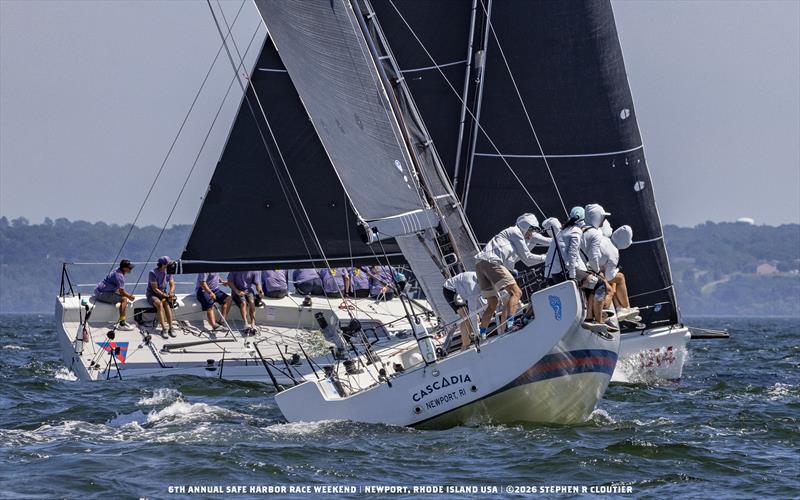
Cascadia Sailing competes at the 2026 Safe Harbor Race Weekend © Stephen Cloutier
Memories of the FIFA World Cup 2026 may already be fading, but there's another international competition on the horizon that also promises to deliver impressive levels of team chorography, high-end strategy and tactics, and world-class competition. The inaugural edition of the New York Yacht Club's Women's International Championships (WIC) will take place on the waters of Rhode Island's Narragansett Bay from September 12-19 and will see 20 all-women's teams, hailing from 13 countries (and five continents) racing aboard the NYYC's fleet of identical IC37s.
The WIC is an invitational-only event, and when one looks at the names on the entry list, there's little doubt that the regatta will offer some of the year's best keelboat racing.
Cascadia Sailing will be on the WIC's starting line, representing the Orcas Island Yacht Club, the Royal Victoria Yacht Club, the Seattle Yacht Club, the Corinthian Yacht Club of Seattle, and the Royal Vancouver Yacht Club. The multinational team is being led by Joy Dahlgren (CAN; mainsail trimmer), Christina Wolfe (USA; skipper and US Sailing's 2023 Rolex Yachtswoman of the Year), and Jen Glass (USA; tactician), and they enjoy the talents of many of the region's best sailors.
In addition to a great crew, Cascadia Sailing also has an IC37, which is owned by Dahlgren and her husband, and which is likely the only IC37 on the Left Coast. While this has given the team a fantastic training platform in the lead up to the WIC, racing the boat in handicap fleets on Puget Sound and the greater the Salish Sea doesn't provide the same level of battle hardening as racing IC37s in a one-design fleet.
So, Cascadia Sailing recently traveled to Newport, Rhode Island for the 2026 Safe Harbor Race Weekend (August 7-9), where they faced off against 17 other IC37 teams, some of which were all-women's teams that were also preparing for the WIC, while others were raced by crews of various compositions. After seven hard-fought races, including a proud third-place finish, the team finished the regatta in 14th place.
I checked in with Glass, via email, to learn more about the team's experiences at the Safe Harbor Race Weekend, and about their ongoing preparations ahead of next month's WIC.
[Editor's Note: This is Sail-World's third interview in a mini-series with Cascadia Sailing as they build-up to September's racing. The first two interviews can be found here: Part 1, Part 2]
Can you please bring us up to speed on the sailing that Cascadia Sailing has been doing since we last spoke back in May?
Since we last spoke I've been lucky enough to join the Qubit IC37 Team as tactician at two of the [IC37] class regattas in Newport. Seeing the fleet in action was a huge benefit, and I took many boat tricks back to the team for our practices locally.
As a team, we continued to benefit from some excellent coaching during our practices locally. Sailing by ourselves, we primarily focus on specific maneuvers each practice, including mark roundings, start-line boathandling, time and distance. We also practice straight-line boat speed, although without a good second boat the lessons are more about the speed teams communication and racing our polars.
You and Cascadia Sailing just competed in the Safe Harbor Race Weekend. What was it like to be on a racecourse with 11 other IC37s? Also, how did this experience stack up to the handicap fleet racing that you and the team have been doing in the Pacific Northwest aboard your team's West Coast-based IC37?
It was an incredible experience to finally sail against other IC37s. The fleet is very competitive, and the racing was as tight as we expected. It feels like entire fleet arrives at the first windward mark overlapped.
The handicap fleet racing we did locally [in the Pacific Northwest] allowed us to practice our maneuvers and build confidence that we could get around the racecourse under pressure. The Safe Harbor regatta allowed us to hone-in our speed, lane holding, and practice crowded starts that you just can't replicate outside of a one-design experience.
What are the biggest lessons and impressions that you and the team gained at the Safe Harbor Race Weekend? Also, how do you and the team plan to incorporate this into your racing ahead of next month's WIC?
The racing is really tight such that if you're not in the top couple of boats, you are quickly fighting for lanes, and likely making a choice between bad air or overstanding. A less-than-perfect start can really put you in the back immediately. Lane holding is critical.
One big difference between competitive one design sailing and handicap sailing is the urgency by which you need to make small changes to keep speed and height in the critical few minutes off the start line. This skill has been a focus of ours but is very difficult to practice on your own. Racing in tight one design fleets like Seattle's Wednesday night CYC J/70 fleet is a great way to practice these skills and is a part of our team's practice plan.
What do you think was more important to the team's development—racing against some of the other teams that will be competing at the WIC, or racing on the waters where the next month's championship race will take place?
One thing we learned at the Safe Harbor regatta racing against a handful of the other WIC teams was the personality of those particular teams. We'll come into the WIC with some awareness of which teams are more likely to be aggressive, and which ones tend to sail high versus low upwind.
That said, going back to the above answer, the most important thing is sailing against a competitive IC37 fleet and practicing starts, speed, and mode choices around the racecourse. If you can succeed at those skills, you will be able to adapt to different conditions and [the] personality of a fleet.
There's roughly one month left before the start of the WIC. How do you and the team plan to use this time to address any lingering weak spots and/or reinforce valuable strengths ahead of next month's event?
We took a lot of video using a 360-camera mounted on the back of our boat during the racing. We're focused on reviewing that video to analyze decision making, boathandling, and sail setup to continue learning over the next month. I'm confident there are some hidden gems in those videos, it is a great tool.
We are also focused on doing as much local racing that is similar to the IC37, like I mentioned where we can focus on starts, lanes, speeds, and tight-fleet decision making. Finally, we'll keep honing our boathandling together in the IC37 as a team.
Generally speaking, how are you and Cascadia Sailing feeling about the WIC after having just competed at the Safe Harbor Race Weekend? Also, did this recent experience change your feelings about the levels of competition that you and Cascadia Sailing will be up against next month?
We knew when we started this campaign that the level of competition at the WIC would be very high. Many of the world's best sailors, who also happen to be female, will be there. It is going to be one of the most competitive events of the year.
Sailing at Safe Harbor confirmed this belief. No one is slow or going easy in this fleet.
We had some great races in the top 5 and [top] 10 at Safe Harbor that show us we have the skills to finish well against those who race these boats frequently. But we also had both some starting and speed challenges that held us back in other races.
We're so glad we had the opportunity to check in with the fleet, and also learn from the experience. Every day on the racecourse makes you a better sailor.
Recent years have seen many regattas move from week-long affairs to shorter-format schedules. In light of this, how important do you think energy and concentration management will be at a regatta that includes two days of mandatory practice starts and racing, five days of racing, plus shoreside activities?
Great question. Certainly, energy management is an important element of the WIC. It is important to fuel well, get adequate sleep, and manage personal energy levels. Even beyond sleep, traveling and sailing with 11 people can be exhausting. Sometimes we each need a little alone time. Commuting, cooking, and handling normal life tasks with a team this size takes extra energy. We also used Safe Harbor to practice our meal planning for both on and off the water.
Newport can still be quite hot and humid, even in September, which puts an extra drain on sailors physically. Teams that can manage energy and continue to improve over the course of the WIC will move up in the results. The fleet usually improves every day as teams settle into the boats and venue. If you're not able to keep up or stay ahead of the fleet's learning curve, you'll see your standings move down.
Is there anything else about Team Cascadia's experiences at the Safe Harbor Race Weekend, or about the team's preparations for the NYYC Women's International Championships, that you'd like to add for the record?
For those who haven't raced the Safe Harbor regatta, I highly recommend it! For us it was a great mix of competition, and fun socials in the evening. Friday night's clam bake at New England Boatworks was delicious. And walking the docks to see all of the super yachts at the Shipyard on Saturday was a cool experience. Definitely a great regatta to add to your calendar.
Sail-World thanks Stephen Cloutier for the great images of Cascadia Sailing.