
America's Cup Recon: Luna Rossa catching up to the Kiwis
by Richard Gladwell, Sail-World NZ 2 Aug 01:36 PDT
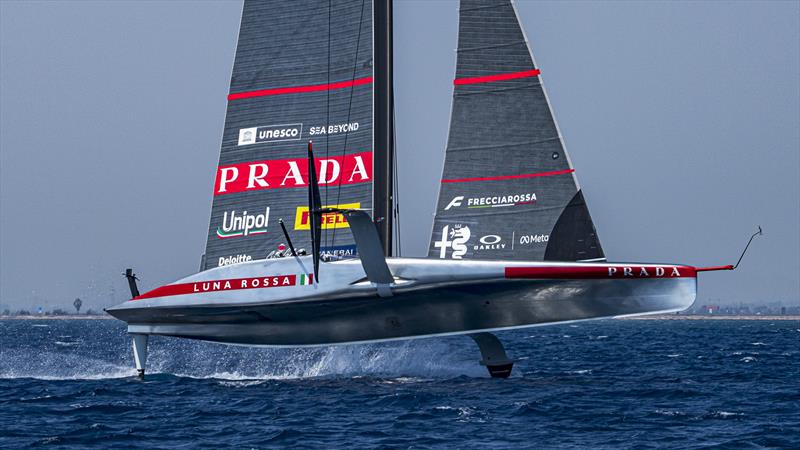
Luna Rossa (ITA) - Day 13 - July 31, 2026 - Cagliari, Sardinia © Ivo Rovira
Italian Challenger, Luna Rossa, is fast catching Emirates Team New Zealand in terms of their sailing day quota.
On Saturday, the Silver Bullet left the team base in Cagliari for their 13th sailing day - only three short of the Kiwis, who are on 16 sailing days.
The difference between the two is that the Italians have done the bulk of their sailing in glorious sailing conditions in the Mediterranean, while the Kiwis will have one eye on the windchill factor in the Hauraki Gulf.
As the third-ranked competitor in the 2024 America's Cup, the Italians have an extra four days above the top-ranked Kiwis on the base quota of 45 days, and on their current schedule, should get ahead of the America's Cup champions.
The Italians claim they are still in a commissioning phase - getting their crew and sailing routines sorted - which also accommodates the change from manually pressured hydraulic systems to electrically powered systems used to pump hydraulic oil around the AC75.
Looking at the gear recorded by the Recon team spying on the Italians, their AC75 remains in the same configuration in which it was relaunched after the 2027 Rule upgrades. The only changes that appear to be made are in different rudders, which are all presumed to be legacy models from the 2024 America's Cup cycle. Not that we would actually know, as it can take 48hours from the time the change is notified to the Measurement registrar to it hitting the Recon team reports.
One of the strengths of the Italian team is the strength and experience within its coaching group - which has a nice blend of experienced Italian team members who are now on the chase boat, but who are well aware of the mistakes/learning experiences made by the previous six Italian Challenges since the heady days of the Louis Vuitton Cup win ahead of the 2000 America's Cup in Auckland.
That group has been augmented with a top non-Italian resident coaching team, bringing an external perspective to the team.
One of those is former Emirates Team New Zealand team member and coach, Josh Junior, who signed up with the Italians soon after the 2024 Cup.
When interviewed by the Recon unit after Saturday's session, giving a lovely dissertation on the weather in response to a question: "Can you give us a recap for this month?"
He was a little more forthcoming on the learning curve ahead of the team.
"I think it's like any America's Cup. The learning curve is huge. There's always a lot to work on and a lot to improve. There's a lot of people in the team with a lot of amazing ideas. So it's just about bringing them all together and developing in a really good way, which I think we're doing nicely."
One of the points of difference between the Italian team and the others that competed in the 2024 cycle, is that Luna Rossa ran their Youth and Womens teams as a pack with their America's Cup team. It yielded the immediate reward with wins in both the Youth and Womens America's Cups.
In the current Cup cycle the squad seems to working well together. The usual routine seems to be that the starboard side crew remain constant, with three-time America's Cup-winning skipper Peter Burling on the helm, with the highly talented Vittorio Bissaro as starboard trimmer. The Italians rotate crew through the port-side positions, giving a degree of consistency for crew and sailing performance evaluation.
Today's session rounded out with some pre-start training. "We're just practising different things, trying new things, and it's pretty early days for us on the big boat," Junior explains. "So practising doing a few circles or double tacks is exciting for us. We're just stepping it up day by day, and working towards the end goal."
The New Zealanders are expected to resume AC75 sailing in Auckland, later this week.
Luna Rossa - Sailing Day 13, July 31, 2026 - Cagliari, Sardinia
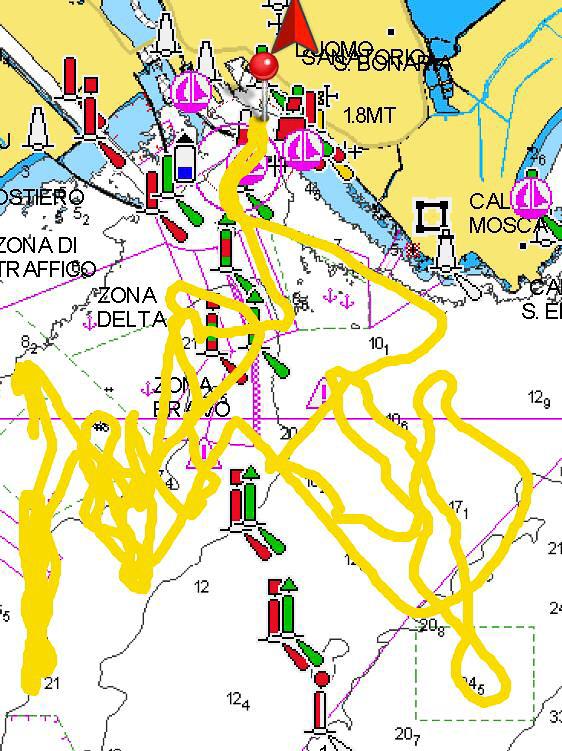
Recon Unit track - Luna Rossa - Sailing Day 13 - July 31 2026 - Cagliari, Sardinia - photo © Luna Rossa Recon Unit
- Port Helm: Marco Gradoni/Ruggero Tita
- Starboard Helm: Peter Burling (NZL)
- Port Trimmer: Umberto Molineri(ITA)
- Starboard Trimmer: Vittorio Bissaro (ITA)
- Pos: 5: Maria Giubilei (Port)
- Pos 6 Andrea Vergombello (VPP Engineer)
Wind & Sea Conditions
- @12:05 6-8kts 170°,
- @12:25 7-9kts 190°,
- @13:10 11-13kts 210°,
- @14:45 15-17kts 210°
- Quite flat seas
Key times & Stats
- Dock Out: 1210hrs
- Dock In: 1640hrs
- Time sailed; 270mins
- Foiling time: 146mins
- Tacks: 48; Gybes 46
Crew List:
- Port Helm: Marco Gradoni
- Starboard Helm: Peter Burling (NZL)
- Port Trimmer: Gigi Ugolini (ITA)
- Starboard Trimmer: Vittorio Bissaro (ITA)
- Pos: 5: Maria Giubilei (Port)
- Pos 6: William Brooks (Structural Engineer)
Wind & Sea Conditions:
- 1140hrs 4-6kts 140°
- 1305hrs; 6-8kts 150°
- 1355hrs: 7-9kts 145°
- Flat seas
Key times:
- Dock Out: 1130hrs
- Dock In: 1430hrs
- Time sailed: 2hrs 50 mins
- Foiling time: 33mins
- Tacks: 15; Gybes 12
Recon Unit Report: Luna Rossa - Sailing Day 13, July 31, 2026 - Cagliari, Sardinia
The Italian boat rolled out shortly after 1000, the mast was stepped by 10:28, and the boat was quickly launched. A total of 4 cameras were now mounted on the starboard wing: the usual two slim cameras on the midsection suction and pressure sides, with two additional GoPros pointing towards the foil boot. Dock-out was scheduled for 11:15 to take advantage of the light filling seabreeze.
The starting crew consisted of Marco Gradoni (helm), Umberto Molineris (trim), and Maria Giubilei (5th) on port, and Peter Burling (helm), Umberto Molineris[ S-W NZ we we think this should be Bessario (trim), and Andrea Vergombello (VPP Engineer) (6th) on starboard. Later in the day, Ruggero Tita swapped with Marco Gradoni, Luigi (Models Engineer) swapped with Andrea Vergombello, and Guido Gallinaro swapped with Maria Giubilei. By 11:35, mainsail M2-1 was hoisted. As J1-1 was just being locked into the halyard, the whole onboard personnel gathered at the transom to obstruct the view of the uncovered main track, where fairings had been removed to solve a speculative issue. Once cleared, J2-9 was hoisted instead, considering the breeze had increased to 7–8 kts from 170°.
The very first session began with only a few minutes foilborne after a long starboard board, as the boat fell hullborne exiting the first tack. Foilborne again by 12:18 with a self take-off, the team started sailing upwind quite high in right ride height and bow-down trim. Overall, dry manoeuvring in the light air, with J2-9 delivering the required amount of power when manoeuvring. Very few mistakes, mostly losing the rudder exiting gybes. On the last upwind on port tack, the team switched from VMG to high-and-slow mode several times, slowing the boat down to just above minimum foiling speed, with larger spray coming out from the starboard wing.
Before the second session began, J2-9 was lowered, and J3-1 was hoisted as the breeze ramped up to 11–13 kts from 210°. The GoPro cameras were removed from the starboard wing. Foilborne by 13:35, the team practised some tacks in the increased seabreeze, and tack-bear-aways were executed. After a couple of gybes, JKs took the team upwind again, and this routine was executed a couple of times. When upwind, the boat looked end-plated on the water, with good consistency in the majority of manoeuvres. Before stopping on the last upwind, several board drops were executed. Once hullborne, both sails were quickly lowered. Batteries were swapped, and the sailmakers worked on the upper batten mast track hardware with tools.
By 14:45, the mainsail M2-1 was rehoisted while, considering the increased breeze of 14–16 kts, J3-1 was swapped with the legacy J4-5. At 14:55, the boat was foilborne with a self-take-off for the third session. The boat sailed towards Sarroch, where it found consistent pressure, with gusts definitely up to 17 kts. After a couple of sharp tacks, the boat bore away and practised some gybes. An interesting note, observed several times in the heavier air and documented in videos: when initiating the round-up manoeuvre, the windward cant was lowered by about 10 degrees without immersing the wing, then canted back up at mid-turn, resulting in a balanced trim on exit.
When exiting one of the last gybes of this session, the leeward board did not seem to be raised properly, forcing the boat onto two boards for longer before re-locking in and gybing. After sailing several legs, the chase boat stopped, and the boat practised four pre-starts: two entries on each tack and, depending on the entry, manoeuvring in a confined space in the top right when entering on port and in the top left box area when entering on starboard. After an impressive manoeuvring session, including full circles, double tacks, two legs were sailed before decelerating and stopping.
The mainsail was lowered slightly to work on the hardware of the second bottom batten and then quickly rehoisted for the fourth session of the day. Foilborne by 16:15, the boat executed several aggressive bear-aways and round-ups in between some freestyle sailing towards Cagliari. Here the pressure seemed a bit lighter than before, though never below 15 kts. Three additional pre-start routines were then practised before heading to the harbour and calling it a day with approximately 146 minutes of foiling time, completing 48 tacks and 46 gybes.